'Visionary' US astrophysicist Eugene Parker dead at 94: NASA

 American Nobel laureate in medicine hopes to illuminate the brain

 Trump approves firing squad for convicted US military base shooter

 Grappling with 'homework scams,' US universities shun AI detectors

 Separatists win Quebec election in test for Canada PM

 Leaders visit Pacific atoll at frontline of climate change

 Yemen's Houthis claim striking Riyadh airport, other Saudi sites

 Best-selling British author Jeffrey Archer dies aged 86

 Military plane crash kills 32 in Nigeria

 Olise powers France to win over Belgium in Nations League

 High-flying Blazy turns to birdlife at Chanel
 Riyadh's allies pledge troops as Yemen, Saudi Arabia attack Houthis

 Clashes erupt outside Kosovo parliament over war crimes court
 Milan's Saelemaekers suffers ankle setback, faces lengthy spell out

 Rubio arrives in Iceland to push for greater US presence in Arctic

 Putin allows Italy's UniCredit to sell part of Russian business

 Djokovic into China Open final as Medvedev out for hitting fan with ball

 ICC unseals arrest warrants for Taliban education ministers

 Modric hopes fans back Croatia against Spain after England shame

 Bolsonaro rides right-wing surge into Brazil's election runoff

 Turkey blocks X account of British reporter

 Ukraine says using AI robot guns to shoot down new Russian drones

 At Oct 7 memorial, Netanyahu says will be no Hamas rule in Gaza

 Ukraine blames Russia for deadly sinking of Turkish ship in Black Sea
 UN rights council slams Taliban's 'oppression' of women

 Norway eyes partial ban of smart glasses
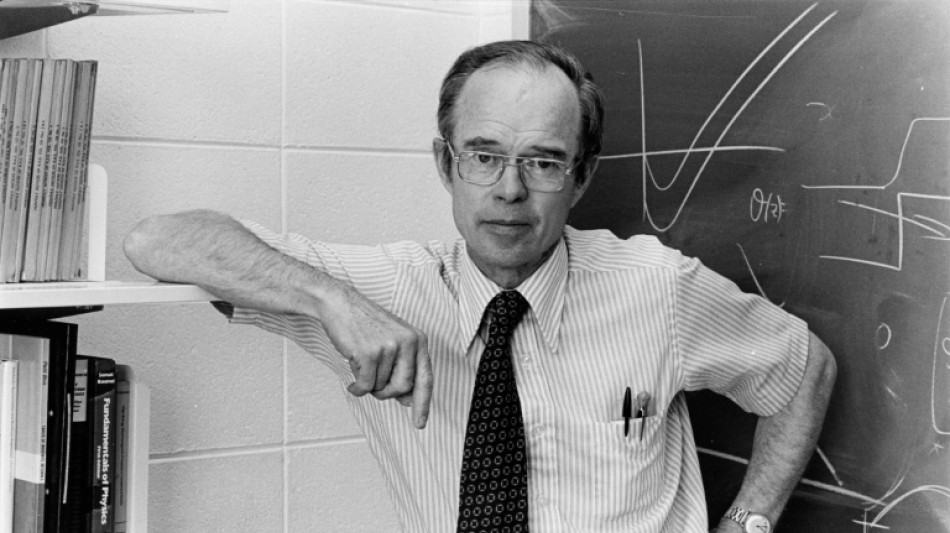
Eugene Parker, a pioneering American astrophysicist who developed a mathematical model predicting the stream of charged particles from the Sun known as solar wind, has died aged 94, NASA said on Wednesday.
Parker, who in 2018 became the first person to witness the launch of a spacecraft bearing his name, was hailed as a visionary who laid the groundwork for the field of heliophysics, the science of understanding the Sun and its interactions with Earth and the solar system, including space weather.
"We were saddened to learn the news that one of the great scientific minds and leaders of our time has passed," said NASA Administrator Bill Nelson in a statement. Parker died Tuesday, according to the University of Chicago.
Born on June 10, 1927 in Michigan, Parker earned a bachelors degree in physics from Michigan State University and a PhD from Caltech, then taught at the University of Utah before settling at the University of Chicago, his longtime home, in 1955.
He began studying the temperature of the Sun's corona, and his calculations showed the conditions should produce a supersonic flow of particles off the surface.
The idea was initially met with skepticism -- even ridicule.
It only saw publication in the Astrophysical Journal when then editor and future Nobel prize winner Subrahmanyan Chandrasekhar realized he could not find a flaw in Parker's math, and overrode the objections of two reviewers.
The theory was proved correct in 1962 when NASA's Mariner II spacecraft encountered the stream of particles, called the solar wind.
Scientists now know that solar wind blankets all the planets, protecting them from harmful radiation, but also at times disrupting communications here on Earth when solar flares occur.
He also proposed the idea of "nanoflares" -- small solar explosions that occur all over the Sun -- which are responsible for the superheated corona, which was hotter than the surface, and couldn't be explained by known physics at the time.
Parker went on to study cosmic rays, the magnetic fields of galaxies and myriad other topics, and won numerous accolades including the US National Medal of Science, the Kyoto Prize, the Crafoord Prize and the American Physical Society Medal for Exceptional Achievement in Research.
"Anyone who knew Dr. Parker, knew that he was a visionary," said Nicola Fox, director of NASA's heliophysics division.
NASA's Parker Solar Probe, named after Parker, was launched in 2018, circling the Sun closer than any spacecraft had previously ventured.
It has already sent back troves of valuable data leading to new discoveries about space weather and the detection of a long theorized zone where the Sun's radiation vaporizes all cosmic dust.
G.P.Martin--AT