US to invest $1.2 bn on facilities to pull carbon from air / Photo: Patrick T. Fallon - AFP/File

 Allen rushes Bills to thrilling 37-34 win over Rams

 India youth shift tactics as police clamp down on election protest

 Malaysia's Firefly extends flight cancellations due to haze

 IMF upgrades 2026 growth forecast but warns of 'split' outlook

 Infantino could pull off 'Houdini' act as critics struggle for candidate

 France braces for fresh nationwide student demonstrations

 Ahead of Israel vote, desert town becomes frontline against ultra-Orthodox expansion

 El Nino Watch: the impacts around the world this week

 Man City, PSG clash at contrasting time for state-backed projects

 Akkodis Brings Multilingual Intelligence to Mercedes-AMG PETRONAS Formula One Team races

 'Breaking Bad' actor RJ Mitte dead: representatives

 Former DR Congo president Kabila forms new force with M23 armed group
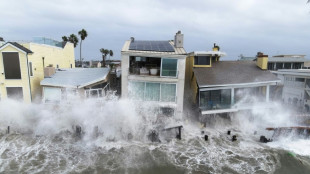
 Tom Cruise's 'Digger' tanks, leaving studio with $250 mn hole
 US actress Selma Blair arrested after flight altercation

 One dead as Hurricane Simon creeps along Mexico's Pacific coast

 Carrick's Man United 'hungry and eager' to fix worst start in decades

 Fury as US federal agents search anti-Trump lawmaker's home

 One goal enough for Flick as Barca enter Galatasaray cauldron

 A7 to unveil a service that will re-invent the international payments market

 'Status quo' with EU 'not good enough', UK PM says as summit date set

 Stolen Renoir paintings found behind wall in France

 French supermarkets suffer refrigerator shutdown after 'unprecedented' cyberattack

 Arsenal lose Hincapie and Zubimendi in freak double blow

 Saudi says resilience tested, vows response after deadly airport attacks
 Alcaraz exits Shanghai Masters in straight-sets loss
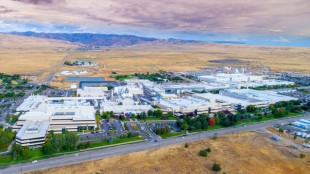
The US government said Friday it will spend up to $1.2 billion for two pioneering facilities to vacuum carbon out of the air, a historic gamble on a still developing technology to combat global warming that is criticized by some experts.
The two projects -- in Texas and Louisiana -- each aim to eliminate one million tons of carbon dioxide per year, equivalent in total to the annual emissions of 445,000 gas-powered cars.
It is "the world's largest investment in engineered carbon removal in history," the Energy Department said in a statement.
"Cutting back on our carbon emissions alone won't reverse the growing impacts of climate change," Energy Secretary Jennifer Granholm said in the statement. "We also need to remove the CO2 that we've already put in the atmosphere."
Direct Air Capture (DAC) techniques -- also known as Carbon Dioxide Removal (CDR) -- focus on that CO2 emitted into the air, which is helping to fuel climate change and extreme weather.
Each of the projects will remove 250 times more CO2 from the air than the largest carbon capture site currently in operation, the Energy Department said.
The UN's International Panel on Climate Change (IPCC) considers capturing carbon dioxide directly from the atmosphere one of the methods necessary to combat global warming.
But the sector is still marginal -- there are just 27 existing carbon capture sites commissioned worldwide, according to the International Energy Agency, though at least 130 projects are under development.
And some experts worry that use of the technology will be a pretext for continuing to emit greenhouse gases, rather than switching more quickly to clean energies.
Direct capture "requires a lot of electricity for extracting CO2 from the air and compressing it for pipes," Stanford University professor Mark Jacobson told AFP.
"Even in the best case, where the electricity is renewable, that renewable electricity is then prevented from replacing a fossil electricity source on the grid, such as coal or gas."
That means such technology is nothing more than a "gimmick," he said, adding: "It will only delay our solution to the climate problem."
- Storing CO2 underground -
US non-profit Battelle is the prime contractor on the Louisiana project, which will inject captured CO2 for storage deep underground.
It will partner with another American company, Heirloom, and the Swiss firm Climeworks, already a sector leader that operates a plant in Iceland with an annual capacity to capture 4,000 tons of CO2 from the air.
The Texas project will be led by the American company Occidental and other partners, including Carbon Engineering. It could be developed to eliminate up to 30 million tons of CO2 per year, according to a statement from Occidental.
"The rocks in the subsoil of Louisiana and Texas are sedimentary rocks, very different from Icelandic basalts, but they are perfectly viable for storing CO2," Helene Pilorge, an associate researcher at the University of Pennsylvania studying carbon capture, told AFP.
The two projects should create 4,800 jobs, according to the energy department. No start date is yet confirmed for either.
They will be funded by President Joe Biden's major infrastructure bill passed in 2021.
The Energy Department previously announced plans to invest in four projects to the tune of $3.5 billion.
Direct capture differs from carbon capture and storage (CCS) systems at source, such as factory chimneys, which prevent additional emissions from reaching the atmosphere.
In May, the Biden administration announced a plan to reduce CO2 emissions from gas-fired and coal-fired power plants, focusing in particular on this second technique.
S.Jackson--AT