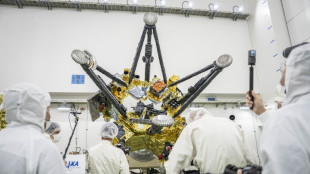
NASA picks Lockheed Martin to develop nuclear rocket / Photo: MANDEL NGAN - AFP/File

 Mbappe hits two as Real Madrid rout Sevilla

 Browns edge Ravens for division lead, Texans beat Jags

 Lyon go top of Ligue 1 as Monaco fall to first defeat of the season

 Venezuela opposition alliance reaffirms Nobel laureate Machado as leader

 'Street Fighter' wins N. America box office, buzzy doc stuns in 2nd

 NFL: Paris game to go ahead despite protests in France

 Arteta hails Arsenal 'finishers' after Madueke fells Forest

 Trump backs ally Netanyahu ahead of Israel's tight election

 Madueke strikes late as below-par Arsenal sink Forest

 Second day of street clashes in Milan

 Dupont's Toulouse hold off Exeter as English Champions Cup woes continue

 Zelensky speaks to US envoys amid Trump spat

 Paris police in new battles with protesters and looters

 Multiple deaths, injuries at western Canada military base: minister

 Boland strikes twice for Australia in rain-hit South Africa Test

 Marseille put Angers to the sword in Ligue 1

 Albanian PM refuses to quit as violent protests enter sixth day

 Chwalinska fights back to win Wuhan Open in title breakthrough

 Kulusevski on brink of return for Spurs after 17-month absence

 Ukraine sets Saint Petersburg refinery ablaze in large-scale drone attack

 Spain's in-form Chacarra wins DP World India Championship

 Kuwait announces maintenance closures in Nuzha, Surra and Rai

 Moody’s lifts OYO parent Prism outlook to positive before planned IPO

 RCom professional asks Supreme Court to revisit spectrum insolvency ruling

 Premium products and financing drive Navratri appliance demand

NASA and the US military said Wednesday they had selected defense contractor Lockheed Martin to develop a nuclear powered rocket, with a view to using the technology for missions to Mars.
The Demonstration Rocket for Agile Cislunar Operations (DRACO) program may launch as soon as 2027, officials said on a call.
Nuclear thermal propulsion (NTP) systems could cut journey times, increase fuel efficiency, and require less propellant, meaning future spacecraft could carry larger payloads than today's best chemical rockets.
NTP works by pumping a liquid propellant, in DRACO's case cryogenic hydrogen, through a reactor core, where uranium atoms split apart through fission.
The process super heats the propellant, converting it into a gas and funneling it through a nozzle to produce thrust.
"These more powerful and efficient nuclear thermal propulsion systems can provide faster transit times between destinations," said Kirk Shireman, vice president of Lunar Exploration Campaigns at Lockheed Martin Space.
"Reducing transit time is vital for human missions to Mars to limit a crew's exposure to radiation," he added.
BWX Technologies will be responsible for developing the nuclear reactor and propellant.
For safety purposes, DRACO's reactor will not be turned on until the spacecraft has reached a high orbit.
Shireman added that the technology could also "revolutionize" future missions to the Moon, where NASA plans to build long term habitats as part of the Artemis program.
NASA conducted its last nuclear thermal rocket engine tests more than 50 years ago but the program was abandoned due to budget cuts and Cold War tensions.
M.King--AT