-
 Kings' Ben Simmons tears Achilles in training
-
Zelensky speaks to US envoys as Trump lashes out

-
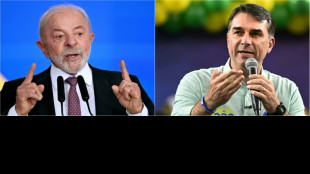 Lula, Bolsonaro set for first debate showdown in bitter election race
-
'Surprise package' Lazio crush Juve to keep pace with Serie A leaders Inter

-
 Mbappe hits two as Real Madrid rout Sevilla
-
China growth expected to miss official target in third quarter

-
 Browns edge Ravens for division lead, Texans beat Jags
-
Lazio crush Juventus to move level with Serie A leaders Inter

-
 Lyon go top of Ligue 1 as Monaco fall to first defeat of the season
-
Leeds draw feels like 'fresh start' for Man Utd's Carrick
-
 Venezuela opposition alliance reaffirms Nobel laureate Machado as leader
-
Macron denounces 'unbridled' violence as France hit by new clashes
-
 'Street Fighter' wins N. America box office, buzzy doc stuns in 2nd
-
Hurzeler lauds 'hard worker' Gomez after Brighton goal from halfway line

-
 NFL: Paris game to go ahead despite protests in France
-
Toulouse hold off Exeter, Northampton save English Champions Cup blushes
-
 Arteta hails Arsenal 'finishers' after Madueke fells Forest
-
Arsenal snatch late win to keep pressure on Man City as Man Utd held
-
 Trump backs ally Netanyahu ahead of Israel's tight election
-
Arsenal strike late to keep pressure on Man City as Man Utd held
-
 Madueke strikes late as below-par Arsenal sink Forest
-
Four soldiers dead, dozens injured in fire at Canada military base
-
 Second day of street clashes in Milan
-
Ton-up Agha helps Pakistan down Sri Lanka in tri-series opener

-
 Dupont's Toulouse hold off Exeter as English Champions Cup woes continue
-
Man Utd draw at Leeds keeps pressure on Carrick

-
 Zelensky speaks to US envoys amid Trump spat
-
Barca defenders Garcia, Kounde injured before key games
-
 Paris police in new battles with protesters and looters
-
Lula, Bolsonaro to face off in first debate of bruising election
-
 Multiple deaths, injuries at western Canada military base: minister
-
Maza and Schick help Leverkusen clip Freiburg's wings

-
 Boland strikes twice for Australia in rain-hit South Africa Test
-
Leeds hit back to deny Man Utd morale-boosting win

-
 Marseille put Angers to the sword in Ligue 1
-
Zelensky tells NBC 'thankful' US has unblocked intelligence sharing
-
 Albanian PM refuses to quit as violent protests enter sixth day
-
Pau see off Leicester in Champions Cup
-
 Chwalinska fights back to win Wuhan Open in title breakthrough
-
Kremlin says Ukrainian attacks won't change war aims as Kyiv hits Saint Petersburg
-
 Kulusevski on brink of return for Spurs after 17-month absence
-
Martinez starts for Man Utd after outburst

-
 Ukraine sets Saint Petersburg refinery ablaze in large-scale drone attack
-
Alberta separatists rally ahead of independence vote
-
 Spain's in-form Chacarra wins DP World India Championship
-
Gold closes week near $4,165 as US inflation outlook pressures market

-
 PSG rally past Strasbourg to take Ligue 1 lead
-
Kuwait announces maintenance closures in Nuzha, Surra and Rai

-
 Moody’s lifts OYO parent Prism outlook to positive before planned IPO
-
AP review finds racist and antisemitic posts in forum tied to Nevada candidate

Europe's space telescope launches to target universe's dark mysteries
Europe's Euclid space telescope blasted off Saturday on the first-ever mission aiming to shed light on two of the universe's greatest mysteries: dark energy and dark matter.
The telescope successfully took off from Cape Canaveral, Florida, at 11:12 am local time (1512 GMT) on a Falcon 9 rocket from the US company SpaceX.
The European Space Agency was forced to turn to billionaire Elon Musk's firm to launch the mission after Russia pulled its Soyuz rockets in response to sanctions over the war in Ukraine.
After a month-long journey through space, Euclid will join its fellow space telescope James Webb at a stable hovering spot around 1.5 million kilometers (more than 930,000 miles) from Earth called the second Lagrange Point.
From there, Euclid will chart the largest-ever map of the universe, encompassing up to two billion galaxies across more than a third of the sky.
By capturing light that has taken 10 billion years to reach Earth's vicinity, the map will also offer a new view of the 13.8-billion-year-old universe's history.
Scientists hope to use this information to address what the Euclid project manager Giuseppe Racca calls a "cosmic embarrassment": that 95 percent of the universe remains unknown to humanity.
Around 70 percent is thought to be dark energy, the name given to the unknown force that is causing the universe to expand at an accelerated rate.
And 25 percent is dark matter, thought to bind the universe together and make up around 80 percent of its mass.
"Ever since we could see stars we've wondered, is the universe infinite? What is it made out of? How does it work?" NASA Euclid project scientist Michael Seiffert told AFP.
"It's just absolutely amazing that we can take data and actually start to make even a little bit of progress on some of these questions."
- 'Dark detective' -
Euclid consortium member Guadalupe Canas told a press conference ahead of the launch that the space telescope was a "dark detective" which can reveal more about both elements.
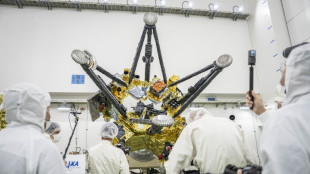
Euclid, which is 4.7 meters (15 feet) tall and 3.5 meters wide, will use two scientific instruments to map the sky.
Its visible light camera will let it measure the shape of galaxies, while its near-infrared spectrometer and photometer will allow it to measure how far away they are.
So how will Euclid try to spot things that cannot be seen? By searching for their absence.
The light coming from billions of light years away is slightly distorted by the mass of visible and dark matter along the way, a phenomenon known as weak gravitational lensing.
"By subtracting the visible matter, we can calculate the presence of the dark matter which is in between," Racca told AFP.
While this may not reveal the true nature of dark matter, scientists hope it will throw up new clues that will help track it down in the future.
For dark energy, French astrophysicist David Elbaz compared the expansion of the universe to blowing up a balloon with lines drawn on it.
By "seeing how fast it inflates," scientists hope to measure the breath -- or dark energy -- making it expand.
- 'Goldmine' -
A major difference between Euclid and other space telescopes is its wide field of view, which takes in an area equivalent to two full moons.
Project scientist Rene Laureijs said that this wider view means Euclid will be able to "surf the sky and find exotic objects" like black holes that the Webb telescope can then investigate in greater detail.
Beyond dark energy and matter, Euclid's map of the universe is expected to be a "goldmine for the whole field of astronomy," said Yannick Mellier, head of the Euclid consortium.
Scientists hope Euclid's data will help them learn more about the evolution of galaxies, black holes and more.
The first images are expected once scientific operations start in October, with major data releases planned for 2025, 2027 and 2030.
The 1.4 billion euro ($1.5 billion) mission is intended to run until 2029, but could last a little longer if all goes well.
burs-la/ia/bfm/leg/la/nro/md
Y.Baker--AT