NASA finds key building block for life in a moon of Saturn / Photo: HANDOUT - NASA/AFP

 Rubio seeks to strengthen US foothold in Central Asia

 LeBron joins 76ers to chase one more NBA title at age 41

 Rays one win from World Series return after downing Guardians

 Kings' Ben Simmons tears Achilles in training

 Lula, Bolsonaro set for first debate showdown in bitter election race

 Mbappe hits two as Real Madrid rout Sevilla

 Browns edge Ravens for division lead, Texans beat Jags

 Lyon go top of Ligue 1 as Monaco fall to first defeat of the season

 Venezuela opposition alliance reaffirms Nobel laureate Machado as leader

 'Street Fighter' wins N. America box office, buzzy doc stuns in 2nd

 NFL: Paris game to go ahead despite protests in France

 Arteta hails Arsenal 'finishers' after Madueke fells Forest

 Trump backs ally Netanyahu ahead of Israel's tight election

 Madueke strikes late as below-par Arsenal sink Forest

 Second day of street clashes in Milan

 Dupont's Toulouse hold off Exeter as English Champions Cup woes continue

 Zelensky speaks to US envoys amid Trump spat

 Paris police in new battles with protesters and looters

 Multiple deaths, injuries at western Canada military base: minister

 Boland strikes twice for Australia in rain-hit South Africa Test

 Marseille put Angers to the sword in Ligue 1

 Albanian PM refuses to quit as violent protests enter sixth day

 Chwalinska fights back to win Wuhan Open in title breakthrough

 Kulusevski on brink of return for Spurs after 17-month absence

 Ukraine sets Saint Petersburg refinery ablaze in large-scale drone attack

The long hunt for extraterrestrials just got a big boost.
Scientists have discovered that phosphorus, a key building block of life, lies in the ocean beneath the icy surface of Saturn's moon Enceladus.
The finding was based on a review of data collected by NASA's Cassini probe, and was published Wednesday in the prestigious journal Nature.
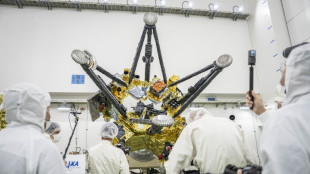
Cassini started exploring Saturn and its rings and moons in 2004, before burning up in the gas giant's atmosphere when its mission ended in 2017.
"This is a stunning discovery for astrobiology," said Christopher Glein of the Southwest Research Institute, one of the paper's co-authors, adding: "We have found abundant phosphorus in plume ice samples spraying out of the subsurface ocean."
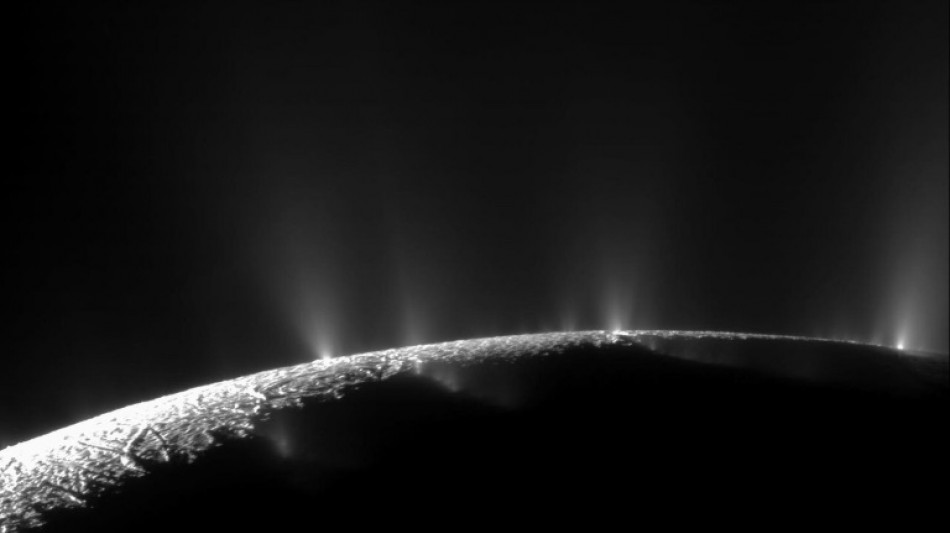
Geysers on Enceladus' south pole spew icy particles through cracks on the surface out into space, feeding Saturn's E ring -- the faint ring outside the brighter main rings.
Scientists previously found other minerals and organic compounds in the ejected ice grains, but not phosphorus, which is an essential building block for DNA and RNA, and is also found in the bones and teeth of people, animals, and even ocean plankton.
Simply put, life as we know it would not be possible without phosphorus.
While geochemical modeling had previously found it was likely phosphorus would also be present, and this prediction was published in an earlier paper, it is one thing to forecast something and another to confirm, said Glein.
"It's the first time this essential element has been discovered in an ocean beyond Earth," added first author Frank Postberg, a planetary scientist at Freie Universitat Berlin, in a NASA statement.
To make the new discovery, authors combed through data collected by Cassini's Cosmic Dust Analyzer instrument, and confirmed the findings by carrying out laboratory experiments to show that Enceladus' ocean has phosphorus bound inside different water-soluble forms.
Over the past 25 years, planetary scientists have discovered that worlds with oceans beneath a surface layer of ice are common in our solar system.
These include Jupiter's moon Europa, Saturn's largest moon Titan, but even the more distant body, Pluto.
While planets like Earth that have surface oceans need to reside within a narrow window of distance from their host star to maintain the right temperatures for life, the discovery of worlds with subsurface oceans expands the number of habitable bodies that might exist.
"With this finding, the ocean of Enceladus is now known to satisfy what is generally considered to be the strictest requirement for life," said Glein.
"The next step is clear –- we need to go back to Enceladus to see if the habitable ocean is actually inhabited."
Y.Baker--AT