Musk's Neuralink says cleared for human test of brain implants / Photo: Michel Euler - POOL/AFP

 Rubio seeks to strengthen US foothold in Central Asia

 LeBron joins 76ers to chase one more NBA title at age 41

 Rays one win from World Series return after downing Guardians

 Kings' Ben Simmons tears Achilles in training

 Lula, Bolsonaro set for first debate showdown in bitter election race

 Mbappe hits two as Real Madrid rout Sevilla

 Browns edge Ravens for division lead, Texans beat Jags

 Lyon go top of Ligue 1 as Monaco fall to first defeat of the season

 Venezuela opposition alliance reaffirms Nobel laureate Machado as leader

 'Street Fighter' wins N. America box office, buzzy doc stuns in 2nd

 NFL: Paris game to go ahead despite protests in France

 Arteta hails Arsenal 'finishers' after Madueke fells Forest

 Trump backs ally Netanyahu ahead of Israel's tight election

 Madueke strikes late as below-par Arsenal sink Forest
 Second day of street clashes in Milan

 Dupont's Toulouse hold off Exeter as English Champions Cup woes continue

 Zelensky speaks to US envoys amid Trump spat

 Paris police in new battles with protesters and looters

 Multiple deaths, injuries at western Canada military base: minister

 Boland strikes twice for Australia in rain-hit South Africa Test

 Marseille put Angers to the sword in Ligue 1

 Albanian PM refuses to quit as violent protests enter sixth day

 Chwalinska fights back to win Wuhan Open in title breakthrough

 Kulusevski on brink of return for Spurs after 17-month absence

 Ukraine sets Saint Petersburg refinery ablaze in large-scale drone attack

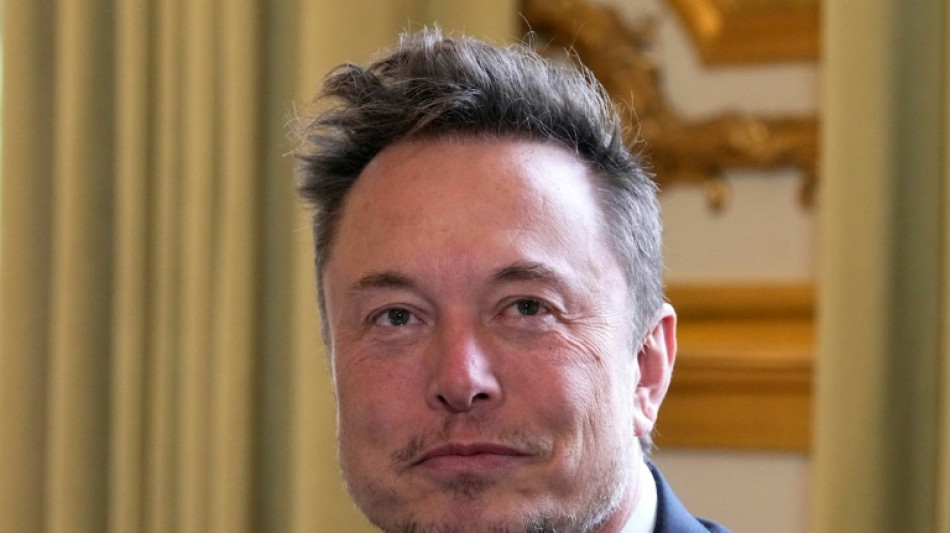
Elon Musk's start-up Neuralink on Thursday said it has gotten approval from US regulators to test its brain implants in people.
Neuralink said clearance from the US Food and Drug Administration (FDA) for its first in-human clinical study is "an important first step" for its technology, which is intended to let brains interface directly with computers.
"We are excited to share that we have received the FDA's approval to launch our first-in-human clinical study," Neuralink said in a post on Musk-run Twitter.
"This is the result of incredible work by the Neuralink team in close collaboration with the FDA."
Recruitment for a clinical trial is not yet open, according to Neuralink.
The aim of Neuralink implants is to enable human brains to communicate directly with computers, Musk said during a presentation by the start-up in December.
"We've been working hard to be ready for our first human (implant), and obviously we want to be extremely careful and certain that it will work well before putting a device in a human," he said at the time.
Musk -- who bought Twitter late last year and also owns SpaceX, Tesla and several other companies -- has been known to make ambitious predictions about his companies, with several such forecasts ultimately failing to pan out.
In July 2019, he vowed that Neuralink would be able to perform its first tests on humans in 2020.
Product prototypes, which are the size of a coin, have been implanted in the skulls of monkeys, demonstrations by the startup showed.
At the Neuralink presentation, the company showed several monkeys "playing" basic video games or moving a cursor on a screen through their Neuralink implant.
Musk said the company would try to use the implants to restore vision and mobility in humans who had lost such abilities.
"We would initially enable someone who has almost no ability to operate their muscles... and enable them to operate their phone faster than someone who has working hands," he said.
"As miraculous as it may sound, we are confident that it is possible to restore full body functionality to someone who has a severed spinal cord," he said.
Beyond the potential to treat neurological diseases, Musk's ultimate goal is to ensure that humans are not intellectually overwhelmed by artificial intelligence, he said.
Other companies working on similar systems include Synchron, which announced in July that it had implanted the first brain-machine interface in the United States.
D.Johnson--AT