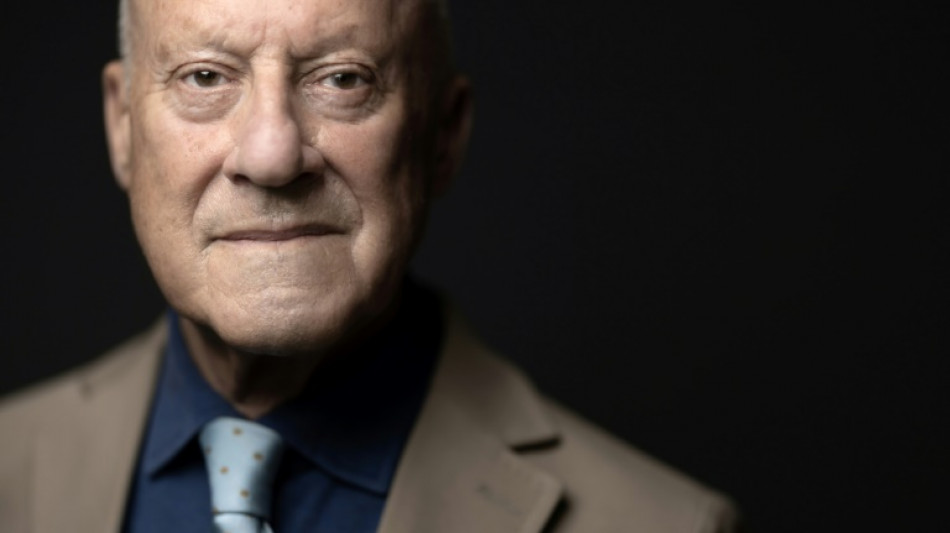
Architects don't need AI, says high-tech pioneer Norman Foster / Photo: JOEL SAGET - AFP

 Rubio seeks to strengthen US foothold in Central Asia
 LeBron joins 76ers to chase one more NBA title at age 41

 Rays one win from World Series return after downing Guardians

 Kings' Ben Simmons tears Achilles in training

 Lula, Bolsonaro set for first debate showdown in bitter election race

 Mbappe hits two as Real Madrid rout Sevilla

 Browns edge Ravens for division lead, Texans beat Jags

 Lyon go top of Ligue 1 as Monaco fall to first defeat of the season
 Venezuela opposition alliance reaffirms Nobel laureate Machado as leader
 'Street Fighter' wins N. America box office, buzzy doc stuns in 2nd

 NFL: Paris game to go ahead despite protests in France

 Arteta hails Arsenal 'finishers' after Madueke fells Forest

 Trump backs ally Netanyahu ahead of Israel's tight election

 Madueke strikes late as below-par Arsenal sink Forest
 Second day of street clashes in Milan

 Dupont's Toulouse hold off Exeter as English Champions Cup woes continue

 Zelensky speaks to US envoys amid Trump spat

 Paris police in new battles with protesters and looters
 Multiple deaths, injuries at western Canada military base: minister

 Boland strikes twice for Australia in rain-hit South Africa Test

 Marseille put Angers to the sword in Ligue 1
 Albanian PM refuses to quit as violent protests enter sixth day

 Chwalinska fights back to win Wuhan Open in title breakthrough
 Kulusevski on brink of return for Spurs after 17-month absence

 Ukraine sets Saint Petersburg refinery ablaze in large-scale drone attack

British architect Norman Foster has spent six decades pushing the boundaries of technology with awe-inspiring modernist structures from California to Hong Kong, but he is yet to be convinced by the craze for artificial intelligence.
"Artificial intelligence at the moment has the ability to cheat, to invent," he told AFP in a recent interview in Paris, which is hosting a retrospective of his work.
"We live in a world which is physical, we inhabit buildings, streets, squares. That physicality, you can't replicate by artificial intelligence."
Foster has been shaping urban landscapes since the 1960s and won the Pritzker Prize, the equivalent of the Nobel Prize in architecture, in 1999.
His statement projects include Apple's giant ring-shaped headquarters in California, London's Wembley Stadium and Millennium Bridge, and Berlin's Reichstag.
Experts describe his practice, Foster and Partners, as possibly the most prolific in history, and the most adept at navigating changing trends and technologies.
"He conceives architecture almost as an organism balancing itself with the air, the sun, life," said Frederic Migayrou, curator of the Norman Foster exhibition at the Pompidou Centre in the French capital.
Yet he has not swerved controversy, irking climate campaigners with his keenness to build airports and his views on the environment.
- 'Hard facts' -
He is a champion of urban living -- "people live longer in cities" -- but his vision for sustaining urban lifestyles has courted some criticism.
He supports nuclear power, saying it had not caused a single death and the world would only be able to tackle climate change "with hard facts, not emotion".
He sees it as a vital part of the solution to the deprivation and poverty seen in megacities and overpopulated slums across the world.
"Many people gravitated to those cities because there are more opportunities," he said.
"The answer has to be an abundance of clean energy, and the cleanest, safest form of energy is nuclear."
Hong Kong's Chek Lap Kok airport, opened in 1998, made a huge splash for his firm, and he has worked on several airports since -- much to the annoyance of climate activists, who see air travel as part of the problem.
Yet when he talks of his broader philosophy, the 87-year-old could easily make common cause with climate activists.
- End of the sprawl -
Surrounded by models of his greatest creations, he talked breezily about the development of cleaner, greener cities.
The pandemic accelerated a growing need for people to have access to outdoor spaces for eating and strolling, and for services within walking distance of their homes, he argued.
"The cities which are most popular... they fit that model, essentially it's a European model born before the ascendency of the automobile," he said.
And the transformation of our relationship with cars is central to the reshaping of modern cities, he said.
"You have younger generations who are less interested in ownership, who will move towards ride-sharing and mobility more as a service," he said.
This was pushing us away from sprawling car-centric cities with rigid work-home zones to ones where buildings were multipurpose, reducing the need for commuting.
Despite his storied history, Foster, still a central figure in all these threads of modern design, is not keen to dwell on his achievements.
The Pompidou exhibition, which displays models of his buildings alongside exhibits that inspired their design, has allowed him to see hidden connections.
But understandably for someone who forged the "high-tech" architectural movement in the 1960s with fellow Briton Richard Rogers, what comes next is always more important than what has already gone.
"Overall, I'm more excited by the future than I am by the past."
M.White--AT