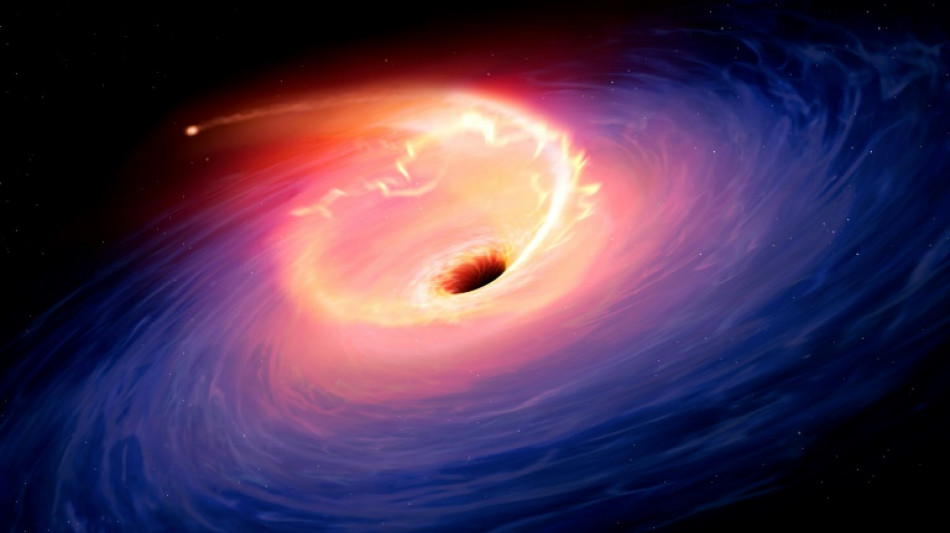
Astronomers puzzled by 'largest' ever cosmic explosion / Photo: MARK A. GARLICK - SHEFFIELD UNIVERSITY/AFP/File

 Rubio seeks to strengthen US foothold in Central Asia

 LeBron joins 76ers to chase one more NBA title at age 41

 Rays one win from World Series return after downing Guardians

 Kings' Ben Simmons tears Achilles in training

 Lula, Bolsonaro set for first debate showdown in bitter election race

 Mbappe hits two as Real Madrid rout Sevilla

 Browns edge Ravens for division lead, Texans beat Jags

 Lyon go top of Ligue 1 as Monaco fall to first defeat of the season

 Venezuela opposition alliance reaffirms Nobel laureate Machado as leader

 'Street Fighter' wins N. America box office, buzzy doc stuns in 2nd

 NFL: Paris game to go ahead despite protests in France

 Arteta hails Arsenal 'finishers' after Madueke fells Forest

 Trump backs ally Netanyahu ahead of Israel's tight election

 Madueke strikes late as below-par Arsenal sink Forest

 Second day of street clashes in Milan

 Dupont's Toulouse hold off Exeter as English Champions Cup woes continue

 Zelensky speaks to US envoys amid Trump spat

 Paris police in new battles with protesters and looters

 Multiple deaths, injuries at western Canada military base: minister

 Boland strikes twice for Australia in rain-hit South Africa Test

 Marseille put Angers to the sword in Ligue 1

 Albanian PM refuses to quit as violent protests enter sixth day

 Chwalinska fights back to win Wuhan Open in title breakthrough
 Kulusevski on brink of return for Spurs after 17-month absence

 Ukraine sets Saint Petersburg refinery ablaze in large-scale drone attack

Astronomers said on Friday they have identified the "largest" cosmic explosion ever observed, a fireball 100 times the size of our Solar System that suddenly began blazing in the distant universe more than three years ago.
While the astronomers offered what they think is the most likely explanation for the explosion, they emphasised that more research was needed to understand the puzzling phenomenon.
The explosion, called AT2021lwx, is not the brightest flash ever observed in the universe. That record is still held by a gamma-ray burst in October that was nicknamed BOAT -- for Brightest Of All Time.
Philip Wiseman, an astrophysicist at Britain's University of Southampton and the lead author of a new study, said that AT2021lwx was considered the "largest" explosion because it had released far more energy over the last three years than was produced by BOAT's brief flash.
Wiseman told AFP it was an "accidental discovery".
The Zwicky Transient Facility in California first spotted AT2021lwx during an automated sweep of the sky in 2020.
But "it basically sat in a database" until being noticed by humans the following year, Wiseman said.
It was only when astronomers, including Wiseman, looked at it through more powerful telescopes that they realised what they had on their hands.
By analysing different wavelengths of light, they worked out that the explosion was roughly eight billion light years away.
That is much farther away than most other new flashes of light in the sky -- which means the explosion behind it must be far greater.
It is estimated to be around two trillion times brighter than the Sun, Wiseman said.
Astronomers have looked into several possible explanations.
One is that AT2021lwx is an exploding star -- but the flash is 10 times brighter than any previously seen "supernova".
Another possibility is what is called a tidal disruption event, when a star is torn apart as it is sucked into a supermassive black hole. But AT2021lwx is still three times brighter than those events, and Wiseman said their research did not point in this direction.
The only somewhat comparable bright cosmic event is a quasar, when supermassive black holes swallow huge amounts of gas in the centre of galaxies.
But they tend to flicker in brightness, Wiseman said, whereas AT2021lwx suddenly started flaring up from nothing three years ago, and it is still blazing away.
"This thing we have never, ever seen before -- it just came out of nowhere," Wiseman said.
- 'Absolute puzzle' -
In the new study, published in the Monthly Notices of the Royal Astronomical Society, the international team of researchers laid out what they believe is the most likely scenario.
Their theory is that a massive, single cloud of gas -- around 5,000 times larger than the Sun -- is slowly being consumed by a supermassive black hole.
But Wiseman said that "in science, there's never certainty". The team are working on new simulations to see if their theory is "fully plausible," he added.
One problem could be that supermassive black holes sit in the centre of galaxies -- for an explosion this size, the galaxy would be expected to be as vast as the Milky Way, Wiseman said.
But no one has been able to spot a galaxy in the vicinity of AT2021lwx.
"That's an absolute puzzle," Wiseman admitted.
Now that astronomers know what to look for, they are searching the skies to see if other similar explosions have been missed.
R.Chavez--AT