Europe's JUICE mission to launch for Jupiter's icy moons / Photo: Charly TRIBALLEAU - AFP/File

 'I call it a bribe': Pennsylvania residents spurn $10,000 data center checks

 In a former US steel city, ordinary people struggle to get by

 'Liar,' 'clown': Lula and Bolsonaro spar in Brazil poll debate

 Record El Nino? Depends who's counting

 On the front line of ocean conservation off Portugal's Madeira

 Wembanyama targets title breakthrough as NBA season tips off

 With LeBron on board it's title or bust for Philly fans

 One year after Louvre heist, where are the missing jewels?

 Knicks face tall task in NBA championship repeat bid

 Warriors' Curry 'fine' after limping out of practice - Kerr

 Zelensky speaks to US envoys as Trump lashes out

 'Surprise package' Lazio crush Juve to keep pace with Serie A leaders Inter

 China growth expected to miss official target in third quarter

 Lazio crush Juventus to move level with Serie A leaders Inter

 Leeds draw feels like 'fresh start' for Man Utd's Carrick

 Macron denounces 'unbridled' violence as France hit by new clashes

 Hurzeler lauds 'hard worker' Gomez after Brighton goal from halfway line

 Toulouse hold off Exeter, Northampton save English Champions Cup blushes

 Arsenal snatch late win to keep pressure on Man City as Man Utd held

 Arsenal strike late to keep pressure on Man City as Man Utd held

 Four soldiers dead, dozens injured in fire at Canada military base

 Ton-up Agha helps Pakistan down Sri Lanka in tri-series opener

 Man Utd draw at Leeds keeps pressure on Carrick

 Barca defenders Garcia, Kounde injured before key games

 Lula, Bolsonaro to face off in first debate of bruising election

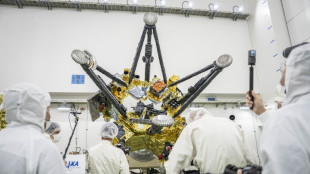
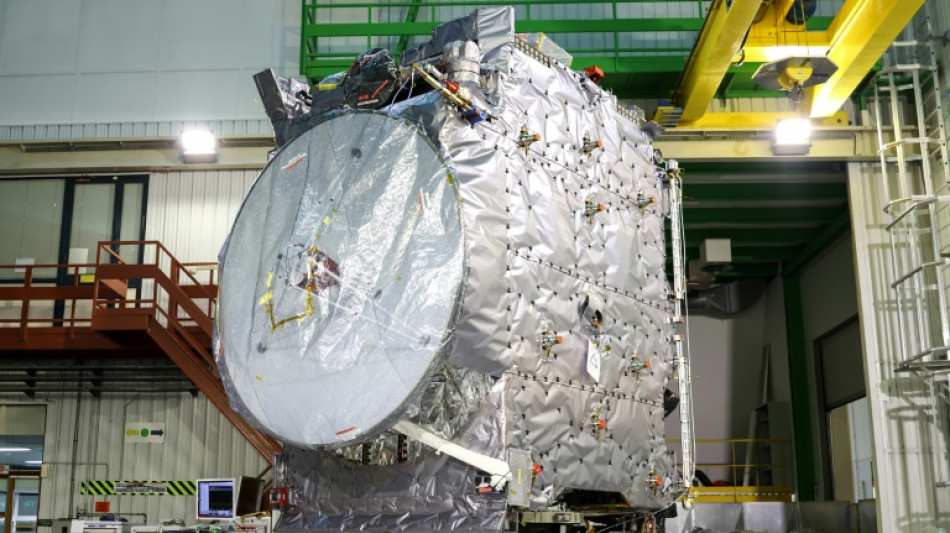
The European Space Agency's JUICE spacecraft is to blast off Thursday on an eight-year journey through the Solar System to discover whether Jupiter's icy moons are capable of hosting extraterrestrial life in their vast, hidden oceans.
The JUpiter ICy Moons Explorer (JUICE) has received the green light for its scheduled launch on an Ariane 5 rocket from Europe's spaceport in Kourou, French Guiana at 1215 GMT.
"The weather conditions are good," Guiana Space Centre director Marie-Anne Clair said on Wednesday in the control room, where Belgium's King Philippe was among those in attendance.
The six-tonne spacecraft, which is roughly four square metres, will separate from the rocket at an altitude of 1,500 kilometres (930 miles) a little under half an hour after blast-off.
Then begins JUICE's long and winding path towards Jupiter, which is 628 million kilometres from Earth.
Because the spacecraft lacks the power to fly straight towards Jupiter, it will have to slingshot around other planets to get a gravitational boost.
First, it will do a fly-by of Earth and the Moon, then slingshot around Venus in 2025 before swinging past Earth again in 2029.
Then it will finally take off on its challenging journey towards the Solar System's largest planet.
- 'Are we alone in the universe?' -
The spacecraft is wrapped in 500 layered thermal insulation blankets to protect itself against temperatures expected to soar above 250 degrees Celsius (480 degrees Fahrenheit) as it flies past Venus, then plummet below minus 230C near Jupiter.
It has a record 85 square metres of solar panels, which stretch out to the size of a basketball court, to collect as much energy as possible near Jupiter, where sunlight is 25 times weaker than on Earth.
Once the probe arrives at Jupiter in 2031 -- now with two billion kilometres on the odometer -- it will need to very carefully hit the brakes to enter the orbit of the gas giant.
From there, JUICE will focus on Jupiter's system, including the gas giant and its three icy moons Europa, Ganymede and Callisto.
Its 10 scientific instruments -- including an optical camera, ice-penetrating radar, spectrometer and magnetometer -- will inspect and analyse the moons' weather, magnetic field, gravitational pull and other elements.
Carole Mundell, the ESA's science director, said the Jovian system had all the ingredients of a mini-solar system.
Studying the system will allow scientists to investigate how our Solar System formed -- and ultimately attempt to answer the age-old question "are we alone in the universe?" she said.
The mission will not be able to directly detect the existence of alien life, but instead aims to establish whether the moons have the right conditions to harbour life.
- Liquid water -
First discovered by astronomer Galileo Galilei more than 400 years ago, Jupiter's icy moons were long ignored as potential candidates for hosting life.
But previous space probes have suggested that deep below their icy shells, there are huge oceans of liquid water -- the main ingredient for life as we know it.
That has made Ganymede and Europa prime candidates in the search for life in our celestial backyard.
Europa will be investigated by NASA's Europa Clipper mission, which is scheduled to launch in October 2024.
JUICE, meanwhile, has set its sights on Ganymede, the Solar System's largest moon and the only one that has its own magnetic field, which protects it from radiation.
In 2034, JUICE will slide into Ganymede's orbit, the first time a spacecraft has done so around a moon other than our own.
ESA director-general Josef Aschbacher said the 1.6 billion-euro ($1.7 billion) JUICE is one of the "most complex" spacecraft ever sent into the outer Solar System beyond Mars.
The launch comes as Europe is struggling to find ways to blast its missions into space following Russia's withdrawal of its Soyuz rockets in response to sanctions over the war in Ukraine -- as well as repeated delays to the Ariane 6 launcher and the failure of Vega-C's first commercial flight.
Thursday will mark the penultimate launch for Ariane 5 before it is replaced by the next-generation Ariane 6.
L.Adams--AT