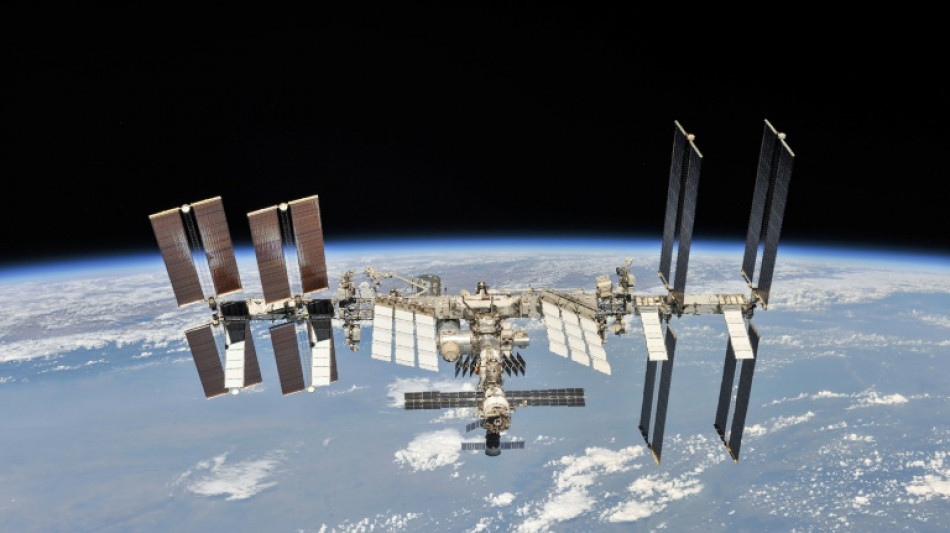
US-Russia tensions spill into space, but ISS safe -- for now

 American Nobel laureate in medicine hopes to illuminate the brain

 Trump approves firing squad for convicted US military base shooter

 Grappling with 'homework scams,' US universities shun AI detectors
 Separatists win Quebec election in test for Canada PM

 Leaders visit Pacific atoll at frontline of climate change

 Yemen's Houthis claim striking Riyadh airport, other Saudi sites

 Best-selling British author Jeffrey Archer dies aged 86

 Military plane crash kills 32 in Nigeria

 Olise powers France to win over Belgium in Nations League
 High-flying Blazy turns to birdlife at Chanel
 Riyadh's allies pledge troops as Yemen, Saudi Arabia attack Houthis

 Clashes erupt outside Kosovo parliament over war crimes court
 Milan's Saelemaekers suffers ankle setback, faces lengthy spell out

 Rubio arrives in Iceland to push for greater US presence in Arctic
 Putin allows Italy's UniCredit to sell part of Russian business
 Djokovic into China Open final as Medvedev out for hitting fan with ball

 ICC unseals arrest warrants for Taliban education ministers

 Modric hopes fans back Croatia against Spain after England shame

 Bolsonaro rides right-wing surge into Brazil's election runoff

 Turkey blocks X account of British reporter

 Ukraine says using AI robot guns to shoot down new Russian drones
 At Oct 7 memorial, Netanyahu says will be no Hamas rule in Gaza
 Ukraine blames Russia for deadly sinking of Turkish ship in Black Sea
 UN rights council slams Taliban's 'oppression' of women

 Norway eyes partial ban of smart glasses

Russia's invasion of Ukraine has placed a question mark over the future of the International Space Station, long a symbol of post Cold War cooperation, where astronauts and cosmonauts proudly live and work side-by-side.
The outpost was the subject of a menacing Twitter thread by Russian space agency head Dmitry Rogozin, who warned Thursday that US sanctions could "destroy our cooperation" and said the research platform would plummet to the Earth without his nation's help.
Experts view such threats as inflated political rhetoric, given the two sides' reliance on one another for the safety of their personnel. But it could hasten a long expected divorce in their fragile marriage.
"Nobody wants to put the lives of astronauts and cosmonauts in danger by political maneuvering," John Logsdon, a professor and space analyst at George Washington University, told AFP.
"It was a very conscious decision when Russia was brought into the station partnership in 1994 to make the station interdependent," he added -- a decision taken at the time with cost and speed concerns in mind.
- Hostile tweets -
The ISS, a collaboration among the US, Canada, Japan, the European Space Agency and Russia, is split into two sections: the US Orbital Segment, and the Russian Orbital Segment.
At present, the ISS depends on a Russian propulsion system to maintain its orbit, some 250 miles (400 kilometers) above sea level, with the US segment responsible for electricity and life support systems.
Rogozin referenced this co-dependence in a series of hostile tweets posted shortly after US President Joe Biden announced sanctions aimed at Russia's aerospace industry.
"If you block cooperation with us, who will save the ISS from uncontrolled deorbiting and falling on US or European territory?" said Rogozin -- noting that the station doesn't fly over much of Russia.
NASA, for its part, responded with a bland statement emphasizing it "continues working with all our international partners, including the State Space Corporation Roscosmos, for the ongoing safe operations of the International Space Station."
Julie Patarin-Jossec, a French academic and author of a book on the ISS, said Rogozin "is a political figure, who is known to be very loyal to power" and has a history of making fiery statements.
Those aboard the station -- Russia's Anton Shkaplerov and Pyotr Dubrov, the United States' Raja Chari, Thomas Marshburn and Kayla Barron, and Germany's Matthias Maurer -- are highly trained professionals, and unlikely to be affected, she told AFP.
"Most astronauts of the last decades, or who have had experience of the ISS, are very attached to international cooperation," Patarin-Jossec said.
What's more, she added, withdrawing from the ISS program would leave Russia without a crewed space program -- unless it quickly pivots to working with China aboard the Tiangong space station, which is still under construction and currently hosts three crew members.
- Long history -
US-Russian cooperation has a long history that stretches back to the height of the Cold War, but it hasn't been without it ebbs and flows.
After America placed the first men on the Moon in 1969, then president Richard Nixon looked for opportunities to make the space program more cooperative, inviting allies to join the Space Shuttle program.
"In parallel he and Henry Kissinger decided to use a possible joint US-Soviet mission as a symbol of detente," explained Logsdon.
That led to the landmark Apollo-Soyuz mission of 1975, when US and Russian spacecraft docked for the first time in a globally televised event.
The partnership was supposed to expand even further, with possible Space Shuttle missions to an early Russian space station, but president Jimmy Carter nixed such plans after the Soviet invasion of Afghanistan.
It wasn't until the collapse of the Soviet Union that Russian officials reached out to the administration of Bill Clinton about the idea of a merger, which paved the way for the launch of the first module of the ISS in 1998.
The ISS has weathered geopolitical storms in the past -- most notably the Russian invasion of Crimea in 2014 -- but current tensions, which Logsdon said were the most serious since the Cuban missile crisis, could mark the beginning of the end.
Space watcher Jonathan McDowell, of the Harvard-Smithsonian Center for Astrophysics, noted that the US is already developing propulsion capacity using Northrop Grumman's Cygnus cargo ships.
NASA currently wants the station to orbit until 2030, while Russia hasn't committed itself to beyond 2024.
"I would think that unless the current situation gets resolved quickly, that could affect the Russian desire to stay involved, or the US desire to keep them involved," said Logsdon.
P.A.Mendoza--AT