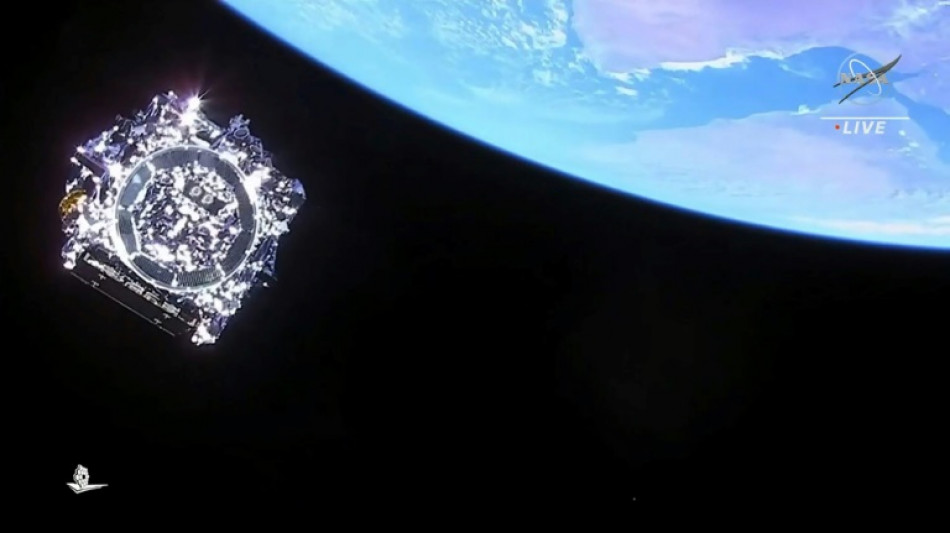
Small asteroid 'serendipitously' detected using James Webb telescope / Photo: - - NASA TV/AFP/File

 Australia's new Ghost Shark submarines grow some 'teeth'

 'I call it a bribe': Pennsylvania residents spurn $10,000 data center checks

 In a former US steel city, ordinary people struggle to get by

 'Liar,' 'clown': Lula and Bolsonaro spar in Brazil poll debate

 Record El Nino? Depends who's counting

 On the front line of ocean conservation off Portugal's Madeira
 Wembanyama targets title breakthrough as NBA season tips off
 With LeBron on board it's title or bust for Philly fans

 One year after Louvre heist, where are the missing jewels?

 Knicks face tall task in NBA championship repeat bid

 Warriors' Curry 'fine' after limping out of practice - Kerr
 InterContinental Hotels Group PLC Announces Transaction in Own Shares - October 19

 Hemogenyx Pharmaceuticals PLC Announces Feasibility Study Agreement

 Zelensky speaks to US envoys as Trump lashes out

 'Surprise package' Lazio crush Juve to keep pace with Serie A leaders Inter

 China growth expected to miss official target in third quarter

 Lazio crush Juventus to move level with Serie A leaders Inter

 Leeds draw feels like 'fresh start' for Man Utd's Carrick

 Macron denounces 'unbridled' violence as France hit by new clashes

 Hurzeler lauds 'hard worker' Gomez after Brighton goal from halfway line

 Toulouse hold off Exeter, Northampton save English Champions Cup blushes

 Arsenal snatch late win to keep pressure on Man City as Man Utd held

 Arsenal strike late to keep pressure on Man City as Man Utd held

 Four soldiers dead, dozens injured in fire at Canada military base

 Ton-up Agha helps Pakistan down Sri Lanka in tri-series opener

European astronomers using the James Webb Space Telescope have detected a previously unknown asteroid about the size of Rome's Colosseum in the main asteroid belt between Mars and Jupiter.
The asteroid measuring between 300 and 650 feet (100 to 200 meters) in length is the smallest object observed to date using the telescope, the US space agency NASA said Monday.
The European astronomers "serendipitously detected" the asteroid, NASA said in a statement, adding that more observations would be needed to better characterize its nature and properties.
"We -– completely unexpectedly -– detected a small asteroid," said Thomas Muller, an astronomer at the Max Planck Institute for Extraterrestrial Physics in Germany.
It was detected during calibration of the telescope's Mid-InfraRed Instrument (MIRI), which operates in mid-infrared wavelengths.
"Webb's incredible sensitivity made it possible to see this roughly 100-meter object at a distance of more than 100 million kilometers," Muller said.
Webb, which has been operational since July, is the most powerful space telescope ever built and has unleashed a raft of unprecedented data as well as stunning images.
One of the main goals for the $10 billion telescope is to study the life cycle of stars. Another main research focus is on exoplanets, planets outside Earth's solar system.
Webb was not designed to look for small objects such as the newly-discovered asteroid, but Muller said its discovery "suggests that many new objects will be detected with this instrument."
A.Moore--AT