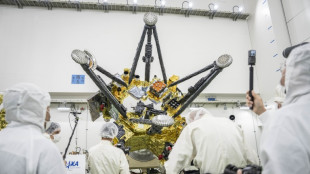
Earth's inner core rotating slower than surface, study suggests / Photo: HANDOUT - NASA/AFP/File

 Australia's new Ghost Shark submarines grow some 'teeth'

 'I call it a bribe': Pennsylvania residents spurn $10,000 data center checks
 In a former US steel city, ordinary people struggle to get by

 'Liar,' 'clown': Lula and Bolsonaro spar in Brazil poll debate

 Record El Nino? Depends who's counting

 On the front line of ocean conservation off Portugal's Madeira

 Wembanyama targets title breakthrough as NBA season tips off
 With LeBron on board it's title or bust for Philly fans

 One year after Louvre heist, where are the missing jewels?

 Knicks face tall task in NBA championship repeat bid

 Warriors' Curry 'fine' after limping out of practice - Kerr

 InterContinental Hotels Group PLC Announces Transaction in Own Shares - October 19

 Hemogenyx Pharmaceuticals PLC Announces Feasibility Study Agreement

 Zelensky speaks to US envoys as Trump lashes out

 'Surprise package' Lazio crush Juve to keep pace with Serie A leaders Inter

 China growth expected to miss official target in third quarter

 Lazio crush Juventus to move level with Serie A leaders Inter

 Leeds draw feels like 'fresh start' for Man Utd's Carrick

 Macron denounces 'unbridled' violence as France hit by new clashes

 Hurzeler lauds 'hard worker' Gomez after Brighton goal from halfway line

 Toulouse hold off Exeter, Northampton save English Champions Cup blushes

 Arsenal snatch late win to keep pressure on Man City as Man Utd held

 Arsenal strike late to keep pressure on Man City as Man Utd held

 Four soldiers dead, dozens injured in fire at Canada military base

 Ton-up Agha helps Pakistan down Sri Lanka in tri-series opener
Earth's inner core, a hot iron ball the size of Pluto, has stopped spinning faster than the planet's surface and might now be rotating slower than it, research suggested on Monday.
Roughly 5,000 kilometres (3,100 miles) below the surface we live on, this "planet within the planet" can spin independently because it floats in the liquid metal outer core.
Exactly how the inner core rotates has been a matter of debate between scientists -- and the latest research is expected to prove controversial.
What little is known about the inner core comes from measuring the tiny differences in seismic waves -- created by earthquakes or sometimes nuclear explosions -- as they pass through the middle of the Earth.
Seeking to track the inner core's movements, new research published in the journal Nature Geoscience analysed seismic waves from repeating earthquakes over the last six decades.
"We believe the inner core rotates, relative to the Earth's surface, back and forth, like a swing," the study's authors, Xiaodong Song and Yi Yang of China's Peking University, told AFP.
"One cycle of the swing is about seven decades," the authors said.
The inner core started rotating slightly faster than the rest of the planet in the early 1970s, the study said.
But it had been slowing down before coming in sync with Earth's rotation around 2009, it added.
There has been a "negative trend" since, the study said, meaning the inner core is now rotating slower than the surface.
The researchers predicted the next change would occur in the mid-2040s.
They said this rotation timeline roughly lines up with changes in what is called the "length of day" -- small variations in the exact time it takes Earth to rotate on its axis.
- Stuck in the middle -
So far there is little to indicate that what the inner core does has much effect on surface dwellers.
But the researchers said they believed there were physical links between all Earth's layers, from the inner core to the surface.
"We hope our study can motivate some researchers to build and test models which treat the whole Earth as an integrated dynamic system," they said.
Experts not involved in the study expressed caution about its findings, pointing to several other theories and warning that many mysteries remain about the centre of the Earth.
"This is a very careful study by excellent scientists putting in a lot of data," said John Vidale, a seismologist at the University of Southern California.
"(But) none of the models explain all the data very well in my opinion," he added.
Vidale published research last year suggesting that the inner core oscillates far more quickly, swinging around every six years or so.
His work was based on seismic waves from two nuclear explosions in the late 1960s and early 1970s.
That timeframe is around the point when Monday's research says the inner core was last in sync with Earth's rotation -- which Vidale called "kind of a coincidence".
- Geophysicists 'divided' -
Another theory -- which Vidale said has some good evidence supporting it -- is that the inner core only moved significantly between 2001 to 2013 and has stayed put since.
Hrvoje Tkalcic, a geophysicist at the Australian National University, has published research suggesting that the inner core's cycle is every 20 to 30 years, rather than the 70 proposed in the latest study.
"These mathematical models are most likely all incorrect because they explain the observed data but are not required by the data," Tkalcic said.
"Therefore, the geophysical community will be divided about this finding and the topic will remain controversial."
He compared seismologists to doctors "who study the internal organs of patients' bodies using imperfect or limited equipment".
Lacking something like a CT scan, "our image of the inner Earth is still blurry", he said, predicting more surprises ahead.
That could include more about a theory that the inner core might have yet another iron ball inside it -- like a Russian doll.
"Something's happening and I think we're gonna figure it out," Vidale said. "But it may take a decade."
Y.Baker--AT