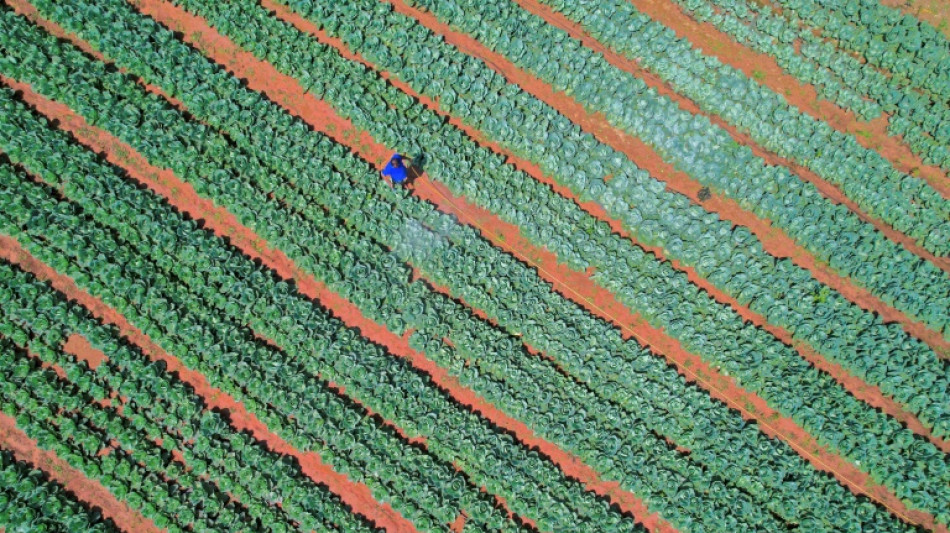
Reducing nitrogen use key to human and planetary health: study / Photo: Manjunath KIRAN - AFP

 Australian lawmaker 'critically' hurt in attack, officials say

 Indonesia fires burned over 1.9 mn hectares through September: monitor

 Asian tech stocks mixed after Wall St losses, eyes on earnings

 China's third-quarter growth narrowly beats forecasts

 Asian stocks start week on back foot, tracking tech-led Wall St losses

 China growth narrowly beats forecasts

 Faith and fury: Texas Senate rivals offer contrasting visions

 Women await justice for police killings in Brazil

 The painstaking task of cataloguing the world's species

 Nations seek reset at UN talks as nature goals off track

 Rubio seeks to strengthen US foothold in Central Asia

 LeBron joins 76ers to chase one more NBA title at age 41

 Rays one win from World Series return after downing Guardians

 BioNxt Completes GMP Manufacturing and Submits Clinical Trial Application for Sublingual Cladribine Drug Candidate

 Caledonia Mining Corporation Plc: Notification of Relevant Change To Significant Shareholder

 Kings' Ben Simmons tears Achilles in training

 Lula, Bolsonaro set for first debate showdown in bitter election race

 Mbappe hits two as Real Madrid rout Sevilla

 Browns edge Ravens for division lead, Texans beat Jags

 Lyon go top of Ligue 1 as Monaco fall to first defeat of the season

 Venezuela opposition alliance reaffirms Nobel laureate Machado as leader

 'Street Fighter' wins N. America box office, buzzy doc stuns in 2nd

 NFL: Paris game to go ahead despite protests in France

 Arteta hails Arsenal 'finishers' after Madueke fells Forest

 Trump backs ally Netanyahu ahead of Israel's tight election

Better management of nitrogen-rich fertilisers through alternating crops, optimising use and other measures can yield huge environmental and health benefits, but must boost food production at the same time, researchers warned Wednesday.
Reducing nitrogen pollution from global croplands is a "grand challenge," the group of international researchers said in a study in Nature outlining a dozen urgently-needed reforms.
The intensive use of chemical fertilisers helped fuel the four-fold expansion of the human population over the last century, and will be crucial for feeding 10 billion people by 2050.
But the bumper crops of what was once called the Green Revolution have come at a terrible cost.
Today, more than half the nitrogen in fertilisers seeps into the air and water, leading to deadly pollution, soil acidification, climate change, ozone depletion and biodiversity loss.
"Given the multiple health, climate and environmental impacts of reactive nitrogen, it has to be reduced in all the mediums such as air and water," lead author Baojing Gu, a professor at Zhejiang University, told AFP.
The benefits of doing so far outstrip the costs, he added.
- Nitrogen cycle -
The world is naturally awash in nitrogen, which is critical for the survival of all life on Earth, especially plants.
Nearly 80 percent of Earth's atmosphere is nitrogen, albeit in a gaseous form (N2) of little direct use to most organisms.
It is made available to plants when microbes that live within plants or soils turn it into ammonia through biological nitrogen fixation.
This process funnels some 200 million tonnes of nitrogen into the soil and oceans every year.
Various forms of the element are eventually transformed and find their way back into the atmosphere with the help of bacteria, especially in wetlands, and after leaching into the oceans or being burned.
But this natural "nitrogen cycle" has been massively imbalanced by the use of some 120 million tonnes of chemical fertiliser each year, according to the study.
Less than half of that input is actually absorbed by plants, with the rest seeping into the environment and causing a constellation of problems.
Researchers led by Gu analysed over 1,500 field observations from croplands around the world and identified 11 key measures to decrease nitrogen losses while still enhancing crop yields.
One such method is crop rotation where a variety of crops are planted on the same plot of land, optimising the flow of nutrients in the soil.
- Benefits outweigh costs -
The benefits of slashing agricultural nitrogen pollution are some 25 times higher than the implementation costs of about $34 billion, they found.
For China and India -– whose extensive and intensive use of fertiliser make them the world's top nitrogen polluters –- that cost would be about $5 and $3 billion, respectively.
Nearly half-a-trillion dollars in avoided costs are spread across reduced premature deaths from air pollution, less damage to ecosystem services and increased crop yields.
But the proposed measure could have a negative impact on the fight against climate change.
"Basically, the impact of nitrogen management on climate change is neutral, or slightly damages the climate due to the reduction of carbon sequestration in ecosystems," Gu told AFP.
Even with outsized benefits, advanced nitrogen management has up-front costs that would be beyond the reach of many smallholder farmers without the backing of strong government policies.
A nitrogen-credit-system, for example, could subsidise farmers who adopt advanced nitrogen management techniques, drawing from the economic benefits of reduced nitrogen pollution and increased food supply.
To initiate this virtuous circle, a financial budget could be secured by taxing food consumers or enterprises that use farming for commercial food production, or by taxing polluting activities and products.
M.O.Allen--AT