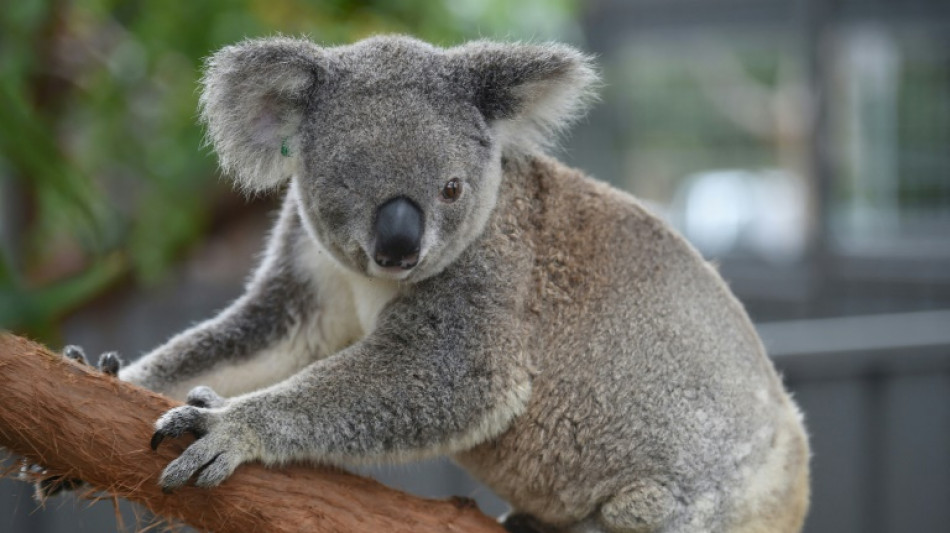
Nature at risk of 'cascading' species extinction: study / Photo: Peter PARKS - AFP/File

 Australian lawmaker 'critically' hurt in attack, officials say

 Indonesia fires burned over 1.9 mn hectares through September: monitor

 Asian tech stocks mixed after Wall St losses, eyes on earnings

 China's third-quarter growth narrowly beats forecasts
 Asian stocks start week on back foot, tracking tech-led Wall St losses
 China growth narrowly beats forecasts

 Faith and fury: Texas Senate rivals offer contrasting visions
 Women await justice for police killings in Brazil
 The painstaking task of cataloguing the world's species

 Nations seek reset at UN talks as nature goals off track

 Rubio seeks to strengthen US foothold in Central Asia

 LeBron joins 76ers to chase one more NBA title at age 41

 Rays one win from World Series return after downing Guardians

 BioNxt Completes GMP Manufacturing and Submits Clinical Trial Application for Sublingual Cladribine Drug Candidate

 Caledonia Mining Corporation Plc: Notification of Relevant Change To Significant Shareholder
 Kings' Ben Simmons tears Achilles in training

 Lula, Bolsonaro set for first debate showdown in bitter election race

 Mbappe hits two as Real Madrid rout Sevilla
 Browns edge Ravens for division lead, Texans beat Jags

 Lyon go top of Ligue 1 as Monaco fall to first defeat of the season

 Venezuela opposition alliance reaffirms Nobel laureate Machado as leader

 'Street Fighter' wins N. America box office, buzzy doc stuns in 2nd

 NFL: Paris game to go ahead despite protests in France

 Arteta hails Arsenal 'finishers' after Madueke fells Forest

 Trump backs ally Netanyahu ahead of Israel's tight election

Climate change and habitat degradation will cause extinctions that cascade through communities of animals and plants and drive dramatic biodiversity loss, according to new research published on Friday.
The study, in the journal Science Advances, found that chain-reaction extinctions are unavoidable and predicted Earth's ecosystems will see average biodiversity loss of between six and 10 percent by 2050, depending on different carbon emissions scenarios.
By 2100, losses of animals and plants could rise to as much as 27 percent, they found in their research that used virtual Earths to map out thousands of food webs.
The authors said their modelling suggested that the biggest changes will come before mid-century, predicting "the bleakest time for natural communities might be imminent and that the next few decades will be decisive for the future of global biodiversity".
With life on Earth under threat from human destruction, overexploitation and pollution, scientists have warned that a million species are facing extinction in what many fear heralds the planet's sixth mass extinction event.
Climate change is expected to dramatically accelerate the losses, with impacts of warming ranging from the effects of extreme weather, to changes in behaviour and habitat.
But authors of the new study said previous modelling has not included estimates for co-extinctions, based on the "cascading effect" of losses on interdependent species.
The researchers in Australia and Europe built hundreds of virtual Earths each populated with more than 33,000 vertebrate species in thousands of food webs across the planet –- "massive computer latticeworks of 'who eats whom'," said co-author Corey Bradshaw, a professor at Flinders University.
They then simulated different climate change scenarios and projections of habitat degradation -- like deforestation -- to predict local biodiversity loss, the proportion of animalslost in a given area.
- 'Life support' -
The virtual worlds allowed researchers to watch as species moved around and adapted to new environmental conditions and the implications of individual extinctions across food webs.
They found that climate change would be responsible for the greatest proportion of extinction events.
"If you look out your window in 87 years, on average you'll see nearly 30 percent fewer animal species than you do today based on the business-as-usual climate scenario," Bradshaw told AFP.
The study found the greatest threat was in places with the greatest biodiversity -- 36 highly-vulnerable areas containing the most unique species.
"This is because the erosion of species-rich food webs makes biological communities more susceptible to future shocks," said Bradshaw, adding it was "a case of the rich losing their riches the fastest."
The research comes as a UN summit in Montreal attempts to seal a historic "peace pact with nature" and end the rampant destruction.
Global efforts to curb global warming have often eclipsed efforts to tackle the devastation being wrought on nature, but experts have increasingly warned that the two crises are inextricably linked.
"In many ways, biodiversity loss from climate change is far more serious than what climate change will do to human societies, because biodiversity is the very fabric of the Earth's life-support system that makes our lives possible," said Bradshaw.
"The imperative of massive and rapid emissions-reduction policies is made much more urgent knowing this."
A.Ruiz--AT