Bananas to fish scales: fashion's hunt for eco-materials

 American Nobel laureate in medicine hopes to illuminate the brain

 Trump approves firing squad for convicted US military base shooter
 Grappling with 'homework scams,' US universities shun AI detectors

 Separatists win Quebec election in test for Canada PM

 Leaders visit Pacific atoll at frontline of climate change

 Yemen's Houthis claim striking Riyadh airport, other Saudi sites

 Best-selling British author Jeffrey Archer dies aged 86

 Military plane crash kills 32 in Nigeria

 Olise powers France to win over Belgium in Nations League

 High-flying Blazy turns to birdlife at Chanel

 Riyadh's allies pledge troops as Yemen, Saudi Arabia attack Houthis

 Clashes erupt outside Kosovo parliament over war crimes court
 Milan's Saelemaekers suffers ankle setback, faces lengthy spell out

 Rubio arrives in Iceland to push for greater US presence in Arctic

 Putin allows Italy's UniCredit to sell part of Russian business
 Djokovic into China Open final as Medvedev out for hitting fan with ball
 ICC unseals arrest warrants for Taliban education ministers

 Modric hopes fans back Croatia against Spain after England shame

 Bolsonaro rides right-wing surge into Brazil's election runoff

 Turkey blocks X account of British reporter

 Ukraine says using AI robot guns to shoot down new Russian drones

 At Oct 7 memorial, Netanyahu says will be no Hamas rule in Gaza

 Ukraine blames Russia for deadly sinking of Turkish ship in Black Sea

 UN rights council slams Taliban's 'oppression' of women
 Norway eyes partial ban of smart glasses

Sneakers made from banana or pineapple leaves, dresses from nettles or fish scales -- the search for sustainable materials has taken the fashion industry to some wild places.
Experts warn these new textiles are not a quick fix for fashion's enormous problems with over-consumption and waste, but may be a necessary step in developing cleaner technologies.
"You could possibly eat the final product," said Hannes Schoenegger, co-founder of Bananatex, which uses leaves from banana trees in the Philippines to make bags, T-shirts and a line of shoes for H&M that sold out within two hours.
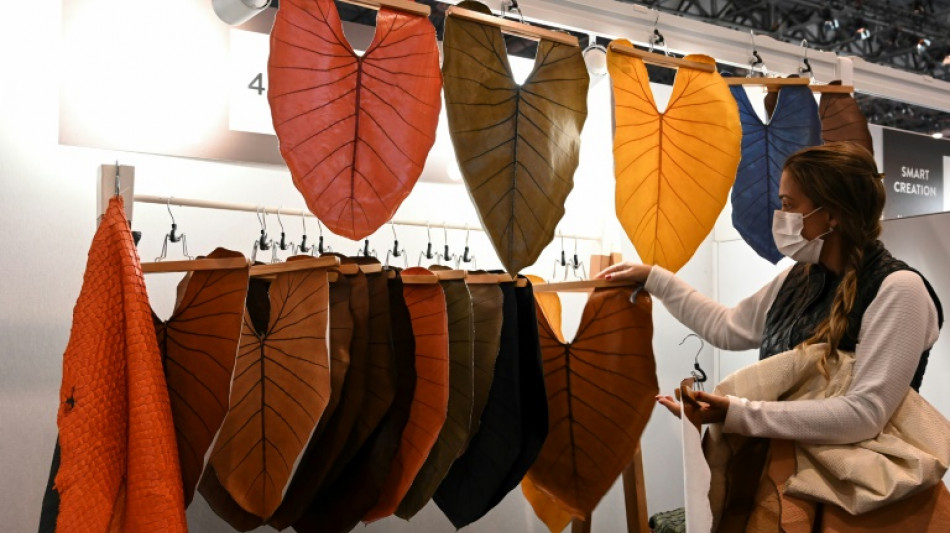
He was speaking at the Premiere Vision Paris conference, where industry professionals gather to find out which fabrics will dominate coming seasons.
"We only harvest the sides of the plants, and they're already growing in the forest, so no chemicals, pesticides or even water are used," Schoenegger added.
He was among multiple stalls presenting new bio-sourced materials.
Brazil-based Nova Kaeru offered leather made from the discarded scales of the giant pirarucu fish and another from the tropical "elephant ear" plant.
Nearby, Ananas Anam showed off some Nike shoes made from waste pineapple leaves.
- Nettles are in -
These textiles can be relatively niche, but some companies are determined to bring them into the mainstream.
Spanish firm Pyratex offers multiple options, from recycling the waste of corn and sugar cane production, to making fibres from Icelandic seaweed, Chinese bamboo or Austrian wood.
"It's not about replacing cotton with one alternative crop. It's about finding a wide variety of substitutes to make sure that nothing is over-used," said spokesperson Pilar Tejada Lopez.
One plant getting particular interest is the nettle, which can be turned into a silk-like and incredibly strong fabric that can be used in everyday and luxury clothing.
It highlights the fact that many of these technologies are not new.
"Nettles have actually been used for clothing for centuries, but we have largely forgotten," said Lopez.
"Part of our job is reintroducing these ideas that have been lost."
- Natural limits -
Others warn of over-reliance on new materials in the drive towards sustainability.
"Replacement materials serve no purpose if we continue to make the same amount of clothing," said Victoire Satto, of The Good Goods, a media firm specialising in responsible fashion.
They could even add to the problem if scaled up by encouraging further deforestation to make way for newly fashionable plants, she said.
That is why companies like Bananatex refuse to go beyond natural farming limits.
"Our project is part of a reforestation programme, a good way of revitalising soils and providing work to local families," said Schoenegger.
"There's a natural limit and we won't go beyond that, because then it would be harmful."
Pyratex similarly puts a lot of emphasis on partnering with responsible farmers, and avoiding the ultra-complex supply chains that make it difficult for clothing companies to know who grows their raw materials and in what conditions.
But Satto says more research is also needed on the durability of bio-sourced materials, since half the ecological damage from an item of clothing is linked to its disposal.
"If the product only lasts six months, that's enormous in terms of environmental impact," she said.
- Iterations -
Ifeanyi Okwuadi, an award-winning British designer, says his focus is on how clothes are made -- not what they are made from.
"When I speak about sustainability, I'm talking about the construction -- right down to using the right stitch-length for each stitch because that kind of minute detail affects the longevity of the garment when you put it in the wash," he said.
He says many bio-sourced materials are still evolving.
"Right now, there's a lot of buzzwords to draw you in, but eventually we won't need to say it's from bananas or whatever -- it will just be plant-based fibres."
"I don't use them in my work because the tech at the moment is quite primitive. But I see them as iterations, like with all technology, and we need these innovations."
E.Hall--AT