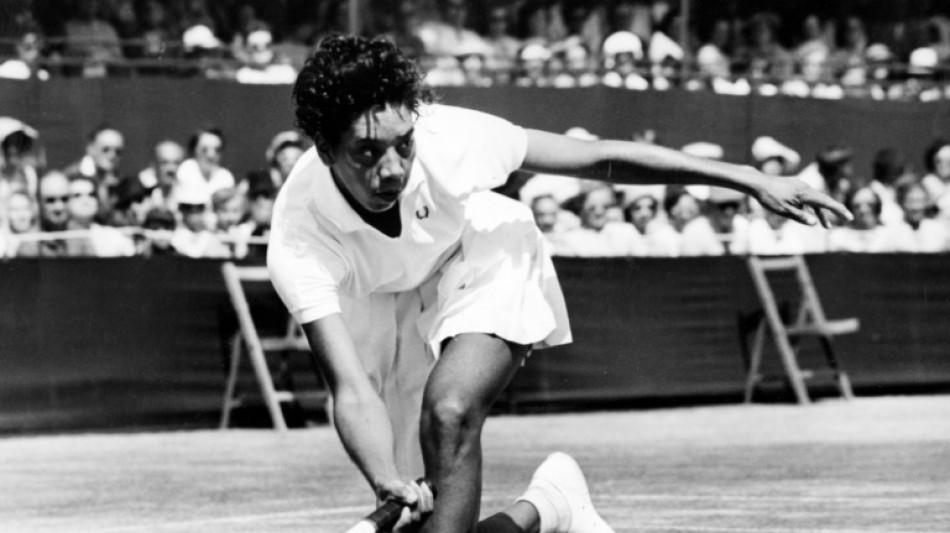
Tennis's forgotten pathfinder Gibson is given a voice / Photo: - - INTERCONTINENTALE/AFP

 Mbappe hits two as Real Madrid rout Sevilla

 Browns edge Ravens for division lead, Texans beat Jags

 Lyon go top of Ligue 1 as Monaco fall to first defeat of the season
 Venezuela opposition alliance reaffirms Nobel laureate Machado as leader

 'Street Fighter' wins N. America box office, buzzy doc stuns in 2nd

 NFL: Paris game to go ahead despite protests in France
 Arteta hails Arsenal 'finishers' after Madueke fells Forest

 Trump backs ally Netanyahu ahead of Israel's tight election

 Madueke strikes late as below-par Arsenal sink Forest
 Second day of street clashes in Milan

 Dupont's Toulouse hold off Exeter as English Champions Cup woes continue

 Zelensky speaks to US envoys amid Trump spat

 Paris police in new battles with protesters and looters
 Multiple deaths, injuries at western Canada military base: minister

 Boland strikes twice for Australia in rain-hit South Africa Test

 Marseille put Angers to the sword in Ligue 1

 Albanian PM refuses to quit as violent protests enter sixth day
 Chwalinska fights back to win Wuhan Open in title breakthrough
 Kulusevski on brink of return for Spurs after 17-month absence
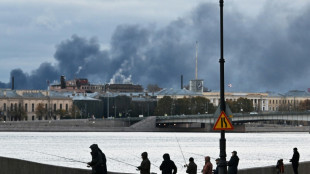 Ukraine sets Saint Petersburg refinery ablaze in large-scale drone attack
 Spain's in-form Chacarra wins DP World India Championship

 Kuwait announces maintenance closures in Nuzha, Surra and Rai
 Moody’s lifts OYO parent Prism outlook to positive before planned IPO

 RCom professional asks Supreme Court to revisit spectrum insolvency ruling

 Premium products and financing drive Navratri appliance demand

Althea Gibson's journey from poverty to becoming the first black person to win Wimbledon is the fulfilment of the American Dream but she remains shamefully unknown, the English playwright and actor who is playing her on stage told AFP.
Kemi-Bo Jacobs has tried to rectify that by writing and starring in a play, "All White Everything But Me", which is presently on at the Alphabetti Theatre in Newcastle, northeast England.
Jacobs has eschewed the rigid biographical route, preferring to highlight Gibson's struggles, the barriers she faced and her extraordinary success.
Her victories at Wimbledon in 1957 and 1958, the French Open (1956) and US Open (1957 and 1958) came at a time when, as Billie Jean King put it, everything down to the balls in tennis was white and segregation was still in force in many US states.
"In many ways her story was that of the American Dream, from rags to riches," Jacobs said in a phone interview.
"The daughter of a family of sharecroppers went to shaking hands with Queen Elizabeth II when she won Wimbledon.
"Her journey is a universal story of her being blessed with incredible talent to finding her way in a world that does not see her as being equal or granting opportunities that her talent deserves."
Her desire to look more closely at Gibson was sparked by a showing of a documentary on her life in London being cancelled due to a lack of interest.
"That infuriated me as I felt her voice was being silenced," said Jacobs.
"Fundamentally I am asking the question why she is not remembered and who decides history, as in who is erased and who is remembered and celebrated.
"I hope with this story I am encouraging people to think about those things."
While history may not have treated Gibson kindly, it was hardly better when she was in her heyday.
She did not receive the endorsements compared to those players she beat in the Grand Slam finals and at times she would win a point and be greeted by silence or be racially abused, says Jacobs.
- 'Breaking down barriers' -
It was no easier with her fellow African Americans and the media because she did not speak up about racial issues unlike Jackie Robinson, the first black person to play Major League Baseball in the modern era.
"She did not feel comfortable doing so," said Jacobs.
"Jackie Robinson received death threats which understandably would make her think twice about speaking out. Due to that African Americans were unkind to her and called her uppity and ungrateful.
"The press wrote that when she lost at Forest Hills at the US Open the first time she played there aged 23, her performance was the biggest disappointment in tennis."
After retiring from tennis in an era when only amateurs could play in the major tournaments, Gibson became the first black woman to play on the professional golf tour. She then dipped into acting and released an album.
Jacobs says the play is not all about the dark days, it is also a celebration of a remarkable life -- though she looks forward to the time when it is not necessary to add that someone is the first black person to achieve something.
"That is a consequence of racism," she said.
"We would not be having this conversation if racism had not been there and prevented equality.
"I look forward to the day to speaking about accomplishments and what they did rather than them breaking down barriers."
Jacobs says Gibson was very definitely of that mind too.
"She never liked being called a black tennis player, she said 'I am a tennis player,'" said Jacobs.
"If you are a different gender or ethnicity there comes with that a burden of responsibility and you are seen as a spokesperson for that community.
"Althea really did not want that. She just wanted to play and for her achievements to speak for themselves.
"Being visible was enough and I think that is OK."
W.Morales--AT