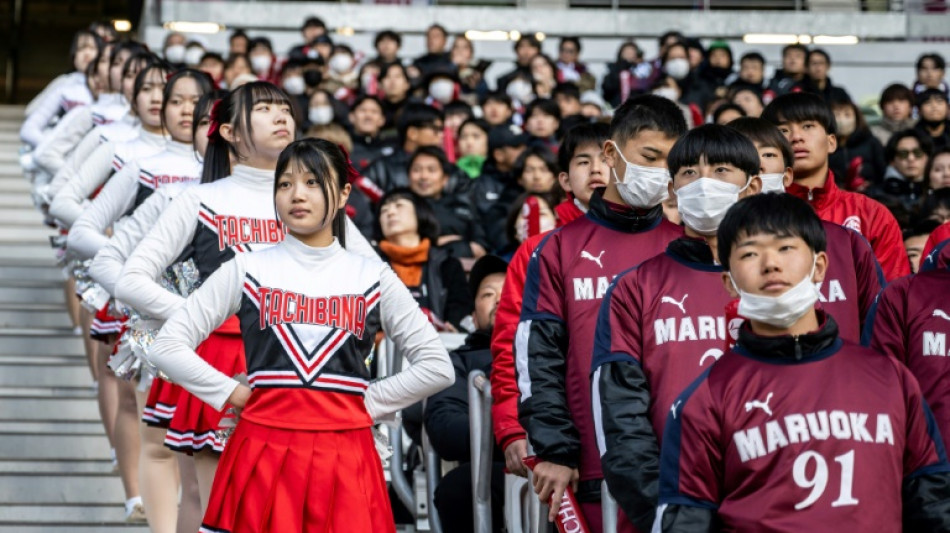
Drama, dreams: Japan's wildly popular school football breeds future stars / Photo: Philip FONG - AFP

 Rybakina tops Osaka, sets US Open quarter-final clash with Zheng

 Panama Canal considering more cuts in transits due to El Nino

 Maresca agrees with Haaland that players started season jaded

 Hurricane warning issued for westernmost Hawaiian islands

 UK PM denounces 'politics of poison' after anti-migrant protests

 Comeback queen Zheng strikes again for US Open quarter-final berth

 Third absence for injured Hadjar as Lawson fills in again in Spain

 Far-right victory in Germany draws protesters in Berlin

 CapTLX Launches Institutional Gateway to U.S. Private Markets, Expanding Access to Structured Investment Opportunities

 Africa's richest man eyes continent's largest IPO

 Macron, SKorea leader warn at film summit of AI risks to creativity

 'Impressive' Alcaraz has Shelton in sights in US Open quarter-final

 Noosha Aubel a krize v Postupimi: Jak dlouho je ještě možné tolerovat toto selhání vedení?

 Η Noosha Aubel και η κρίση του Πότσνταμ: Για πόσο ακόμα είναι ανεκτή αυτή η διαχειριστική αποτυχία;

 Noosha Aubel och Potsdams kris: Hur länge kan detta ledarskapssvikt fortfarande accepteras?

 努莎·奧貝爾與波茨坦的危機:這種領導失職還能容忍多久?

 नूशा ऑबेल और पॉट्सडैम का संकट: नेतृत्व की इस विफलता को और कितना सहन किया जा सकता है?

 Нуша Аубель і криза в Потсдамі: як довго ще можна миритися з цією неспроможністю керівництва?

 England quick Archer in 'good place' after injuries

 Robots protest rampant AI in Poland

 Rare woman director in Venice sees industry backsliding on gender

 France, SKorea warn at film summit of AI risks to creativity

 Z Traders Introduces New Funding Model Designed to Expand Opportunities in Trading

 Lebanon says 12 killed in strikes as Israel vows to 'remove threats'

 Volkswagen plant to be converted for Israeli defence group

Japan's national high school football tournament is thriving after more than 100 years, attracting huge crowds, millions watching on TV and breeding future stars, despite professional clubs trying to lure away young talent.
The annual tournament kicked off on Saturday and is still regarded as the pinnacle of amateur football with young players dreaming of playing in the final in front of tens of thousands at the National Stadium in Tokyo.
Matches are a massive occasion for the whole school as student cheering squads wave flags, bang drums and roar on their teams in a spectacle of noise and colour.
"All the teams are at a similar level of technical ability so it's about who wants to win the most," 18-year-old Junpei Fukuda, the leader of Ryutsukeizai University Kashiwa High School's cheering squad, told AFP.
"We want our voices to be the loudest."
Unlike in Europe, where young players are snapped up by professional club academies, high school football in Japan still attracts elite talent.
Many go on to the professional game and play for their country with current Japan stars such as Daizen Maeda and Reo Hatate of Celtic and Crystal Palace's Daichi Kamada all having played high school football.
The landscape has begun to change in recent years, with more top young players turning their backs on the high school game and joining the youth teams of top-flight J. League clubs instead.
The school tournament's quality has taken a hit as a result, but its magic endures for many.
Ryutsukeizai Kashiwa midfielder Kanaru Matsumoto, who will turn professional with the J. League's Shonan Bellmare next year, said the tournament was "the stage I've aspired to play on ever since I was little".
"The main reason I came to this school was because I thought I could play at the national high school tournament here," the 17-year-old said.
- Millions tune in -
The national high school tournament was first played in 1917, long before professional football came to Japan with the J. League in 1993.
Teams from each of Japan's 47 prefectures, with two from Tokyo, compete in a knockout competition over 18 days with matches played in and around the capital.
All games are televised locally and the semi-finals and final are broadcast to a national audience, with millions tuning in.
Last season's final in Tokyo was played in front of 55,000 fans, comfortably eclipsing most J. League attendances.
High school baseball and rugby tournaments are also popular and football journalist Masashi Tsuchiya said it was because school sports strike a chord in Japan.
"I'm from Gunma Prefecture and I always support the Gunma team, even if it isn't my old high school's team," he said.
"It's a tournament that places importance on local pride and old school ties."
Not all players who appear at the tournament have ambitions to play at the top level.
Some play on at university only, while others give up the sport after graduating from high school.
Ryutsukeizai Kashiwa manager Masahiro Enomoto said the tournament marks a transition after three years together as a team.
"It's where kids, who have worked really hard for something, become adults," he said.
- Floods of tears -
TV broadcasts of games go beyond events on the pitch, delving into the players' back stories, playing up emotional bonds and featuring scenes of beaten teams in floods of tears.
"Japanese people love that kind of drama more than they think about the quality of the football," said Enomoto, even though the standard remains undoubtedly high.
School sides still hold their own against J. League youth teams, who are increasingly regarded as a better route to the professional game.
The nationwide Prince Takamado Under-18 Premier League features a roughly even split of high school and J. League youth teams, and Ohzu High School were crowned this year's champions.
Tsuchiya said high school football should not be thought of only as a stepping stone to the top.
"Yes, you can watch it for the quality of football and the quality of the players," he said.
"But you can also just enjoy watching the kids give everything they've got to try to win each game."
E.Hall--AT