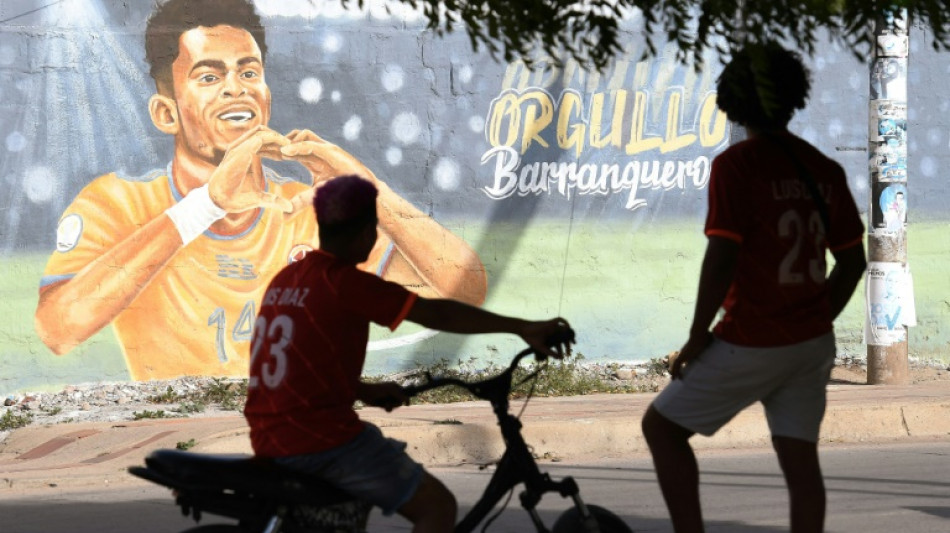
Diaz's indigenous community that breeds 'toughness' / Photo: DANIEL MUNOZ - AFP

 Trump envoys arrive in Kyiv for first Ukraine visit
 Indonesia's main airport suspends operations after volcanic eruption

 US aircraft carrier departs Thailand after port call

 Haze emergency grips Malaysian Borneo town

 Messi creates both Miami goals in 2-2 draw with Atlanta

 Rybakina books US Open fourth-round berth, inches closer to No. 1

 Sobering reality: Curbs on alcohol in northeast Syria cause discontent

 Wobbly Osaka 'shocked' to battle past Mertens and reach last 16

 Indian Oscar-nominated filmmaker turns camera on his cancer
 Argentina 'let off hook' by Australia as Kiss's winning run ends

 Argentina threatens to sanction oil projects around Falklands
 Gauff into round four at US Open after straight-set win

 Bordeaux hammer Racing in Top 14 start as Bielle-Biarrey extends deal

 Zheng, Potapova pull off upsets to reach US Open last 16

 Swiatek into US Open fourth round in tight two-setter

 Werro wins in Brussels, as Russell and Dos Santos shine
 Kolbe breaks jaw and shoulder injury sidelines Savea

 US military strikes oil tankers as Iran vows tougher reprisals

 Zheng rallies to stun Keys, Anisimova out in US Open third round

 Bayern held to draw by stubborn Schalke
 Lens lose again ahead of Champions League date

 Olympic champion Zheng storms home to reach US Open last 16

 Big-spending Spurs must make better attacking decisions, says De Zerbi

 South Africa dominate New Zealand in second half to lead series

 Kiefer Sutherland still in action, but ibuprofen lending helping hand
Running around barefooted on a dust bowl of a pitch, a young indigenous Colombian began kicking a ball more than 20 years ago. Now he is on the verge of becoming champion of Europe.
In the town of Barrancas, where almost half the population is from the Wayuu indigenous community, everyone remembers how the timid "Luisfer" would never get tired.
Liverpool's newest star Luis Diaz emerged from this desert outback in the northern La Guajira department that borders the Caribbean Sea to the northwest and Venezuela to the southeast, to become a national phenomenon.
From a young age, Diaz, whose father Luis Manuel was a coach at the only football school in the small town of 38,000, stood out for his speed, toughness and ability to weave around opponents with the ball at his feet.
In just four months since Liverpool signed Diaz for an initial 45 million euros ($48.1 million) from Portugal's Porto, he has taken English football by storm.
With six goals in 25 matches for the Reds, he has already helped his new side lift the League Cup, FA Cup and reach the Champions League final against Real Madrid on Saturday.
For his uncle Yelkis Diaz, the winger's success is down to his indigenous Wayuu "tradition".
The impoverished community's "transport is walking, jogging ... running," he told AFP.
- 'Almost impossible' conditions -
Thousands of miles away from England, Diaz's family and friends watch excitedly whenever he gallops down the wing for Liverpool.
It is the first time an indigenous Colombian has reached football's elite in a country whose greatest sports stars generally come from the Afro-Colombian community on the Pacific coast and whose indigenous population amounts to just 4.4 percent of the 50 million.
Young people in Barrancas have few options outside of working for multinationals exploiting the neighboring El Cerrejon, the largest open air coal mine in Latin America.
The dreamers imagine themselves playing football or Vallenato folk music.
Diaz would often walk onto the town pitch in his bare feet and wearing the jersey of the local Club Barrio Lleras that his father used to play for.
Playing in "almost impossible" conditions was what forged his talent, says his uncle.
"Running and controlling a ball where there are stones, holes, earth" is not easy and many have given up the dream.
La Guajira is the poorest department in Colombia with more than two thirds of the population living in poverty.
More than 5,000 children have died of hunger there in the last decade, according to the main indigenous organization.
When he returns home, Diaz kicks off his shoes for a nostalgic feel of his native earth.
He was last home in July 2021, welcomed by the entire town, following his starring role at the Copa America in which he finished as joint top goalscorer alongside global superstar Lionel Messi.
In a recent interview, Diaz said his style of play shows "my roots, where I grew up".
- The Wayuu James -
In 2015, the Wayuu community took part in Colombia's first ever indigenous football tournament.
Colombian great Carlos Valderrama was in the stands to spot the talent he would pick for an indigenous team to represent Colombia in a continental tournament in Chile.
Diaz and his best friend Daniel Bolivar, an attacking midfielder, made the team and would be its stars.
"In these villages so lost to sport," impressing Valderrama "was something that really motivated us," said Bolivar.
Once compared to Colombian star James Rodriguez, Bolivar would not follow Diaz's path and now works as a machinery operator in El Cerrejon.
Thanks to Diaz's success, the local government in Barrancas started building synthetic pitches. Grass pitches are an impossibility in this arid landscape where running water is only available three days a week.
Diaz's profile has put his home department on the radar of scouts eager to find the next hidden "star" from the La Guajira peninsular.
Before Diaz, the region's biggest name was Arnoldo Iguaran, a player who began his career in the late 1970s and was Colombia's record goalscorer when he retired in the 1990s until he was passed by Radamel Falcao in 2015.
John Angarita, the president of FC La Guajira, has opened his doors to the indigenous youngsters from Barrancas whose "physical toughness" he says allows them to run all game without getting tired.
His football school has 70 youngsters, some from families displaced by Colombia's interminable half-century conflict, dreaming of following in Diaz's footsteps.
"Seeing him on television and thinking that I could be over there is very motivating. Many people are taking note of the Wayuu and indigenous culture," said Denilson Pushaina, a 23-year-old FC La Guajira defender.
R.Garcia--AT