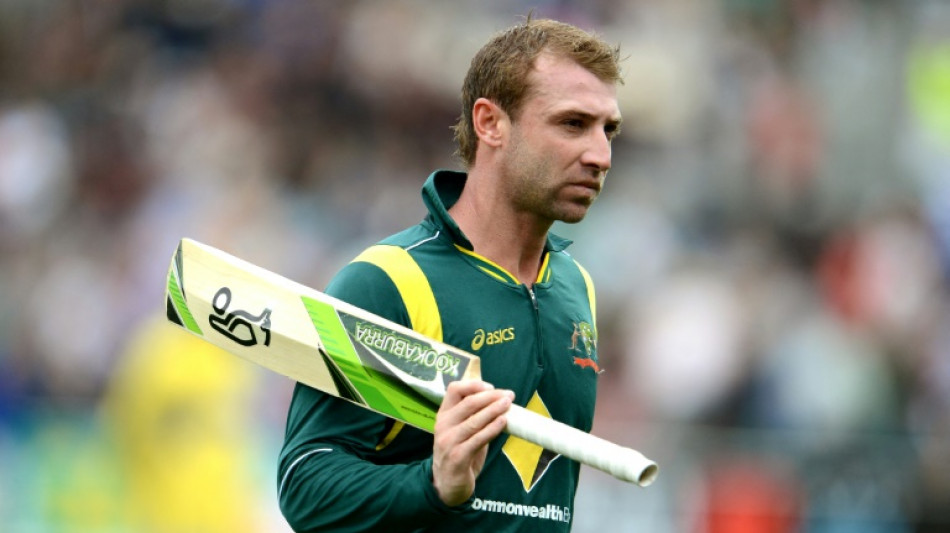
Australia remembers cricketer Phillip Hughes 10 years after death / Photo: DAN HIMBRECHTS - AFP

 The Dice Box Recommends Winter Board Games for Sneinton Market Lounge

 Government Overspends €607 Million on International Protection Accommodation in 2024

 Palestinians Salvage Cultural Heritage from Gaza Rubble Amid Widespread Destruction

 Guardian Metal Resources PLC Announces Proposed Spin-Out of Non-Tungsten Projects

 Fulcrum Metals PLC Announces New Critical Mineral Recoveries Expand Potential
 Fulcrum Metals PLC Announces Publication of Updated Investor Presentation

 Christmas Day Shifts More than Double as Americans Return to In-Person Holiday Celebrations
 Police Investigate Bedford Parent for Hallway Incident After Playoff Loss
 Regal Cinemas Launches 4DX Screenings for 'Heated Rivalry' Amid Immersive Theater Trend

Family and team-mates paid tribute to "infectious" Australian cricketer Phillip Hughes on Wednesday, 10 years since he died after being struck on the neck while batting.
Hughes, who played 26 Tests, died from bleeding on the brain after he was hit by a rising ball during a domestic match at the Sydney Cricket Ground in November 2014.
Images of the 25-year-old lying helpless on the pitch as players rushed to his aid shocked the world cricket community and his death sparked an outpouring of grief and calls to make the game safer.
"Phillip was a loving, humorous and an infectious person to be around," his family said in a statement released on the 10-year anniversary of his death.
"He played cricket for all the right reasons and had the ability to take it all in his stride.
"He loved being a part of a team and representing Australia for the game he loved so deeply."
Fast bowler Sean Abbott, who delivered the fatal bouncer, was visibly emotional during a tribute to Hughes before a domestic fixture on Wednesday.
Abbott, part of Australia's winning squad for the 2023 ODI World Cup in India, dabbed at his eyes as teammates rallied to console him.
Former teammate David Warner said Hughes would have been just as good, "if not better", than himself and fellow batting great Steve Smith.
"I'd like to think he was probably a more complete player than what I was," he told Australia's NewsCorp.
Darren Lehmann -- Australia's coach at the time of Hughes' death -- said the promising batsman would have gone on to play "120 Test matches, there's no doubt about that".
"He would've just gone from strength to strength, the way he played," he told national broadcaster ABC.
Cricket Australia said Hughes' memory would live "forever in our hearts", declaring he would be "forever 63 not out" -- his score at the time he was struck.
Abbott told a coroner's court in 2016 of his struggle to process Hughes' death.
"It was all a bit of a blur and I felt like I was in a bit of a daze. These feelings stayed with me for the next few days."
Cricket Australia has announced a series of events to honour Hughes, coinciding with the second Test between Australia and India beginning December 6.
Players in upcoming domestic matches across the country will wear black armbands in Hughes' memory.
M.White--AT