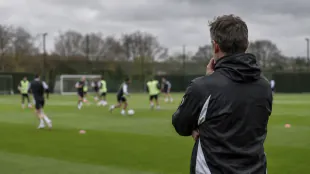
Concussion in amateur sport 'not linked to cognitive decline': study / Photo: FRANCK FIFE - AFP/File

 Malta Chamber of Commerce and FIMBank Sign Alliance Agreement to Boost Corporate Finance

 Rene Eyre Revisits Autobiographical Performance 'Say A Little Prayer' in London

 UAE's HCT Holds Record Graduation and Announces Major Training Expansion
 NASA Awards $10B Lunar Contract Framework to SpaceX, Blue Origin

 Katy Perry Tells Fans Ex-Husband Russell Brand 'Should Be in Jail' During UK Concert

 South African election results renew debate over identity-based voting

 South African voters report smoother local election but declining IEC trust

 Dolly Parton museum and Nashville hotel open after singer’s death

 George and Amal Clooney attend New York political-comedy reading
 British buyers pay substantial premiums for period-home appearance

 Thomas Markle released to house arrest after child-abuse-image charge
 Dawn of War 4 developers chose Adeptus Mechanicus for tactical variety
 Italy face unbeaten South Africa in Turin Nations Championship match

Concussions in amateur sport are not linked to increased long-term risks of cognitive decline, according to a study published on Wednesday.
Such sportsmen and sportswomen may even experience better cognitive performance in some areas compared with those who never sustained a concussion, with researchers suggesting there could be a potential protective effect of sports participation.
More than 15,000 people aged between 50 and 90 took part in the study of sports-related concussions, which was carried out by academics at the University of Exeter, UNSW Sydney, the University of Oxford, and Harvard University.
The results were published in the Journal of Neurology, Neurosurgery and Psychiatry.
Lead author Matt Lennon, from UNSW Sydney, said: "Our findings suggest that there is something about playing sport, even though a person may experience concussion, that may be beneficial for long-term cognitive outcomes.
"While it may be that those who play sports have had access to better education and more resources, we controlled for these factors in the analysis, so that doesn't explain the result.
"We hypothesise that there may be physical, social and long-term behavioural effects of sport that may make for healthier adults in late life."
Professor Anne Corbett, from the University of Exeter in Britain, said: "What we see emerging is a completely different profile of brain health outcomes for people who have concussions as a result of sport compared to those that are not related to sport.
"Concussions that occur during sport do not lead to brain health concerns whereas other concussion types do, especially when people experience multiple concussions.
"In fact, people who take part in sport seem to have better brain health regardless of whether they have had a concussion whilst taking part or not."
Researchers collected lifetime concussion histories from 15,214 participants, of whom 6,227 (39.5 percent) reported at least one concussion and 510 (3.2 percent) at least one moderate-severe concussion.
Participants reported suffering their last head injury an average of 29 years prior to the study and their first head injury an average of 39 years earlier.
Researchers compared cognitive function among individuals with zero, one, two and three-plus sports-related concussions and zero, one, two and three-plus non-sports-related concussions, for example from falls, car accidents and assaults.
The sport-related concussion (SRC) group showed a marginally better working memory than those who had not experienced a sports-related concussion and a better reasoning capacity than those without concussions.
Those with one SRC also had better verbal reasoning and attention compared to those with no SRC.
The findings come at a time of growing concern over the impact of head injuries on professional sportsmen.
Hundreds of former football, rugby union and rugby league players are taking legal action, alleging governing bodies failed to take reasonable action to protect them from permanent injury.
M.Robinson--AT