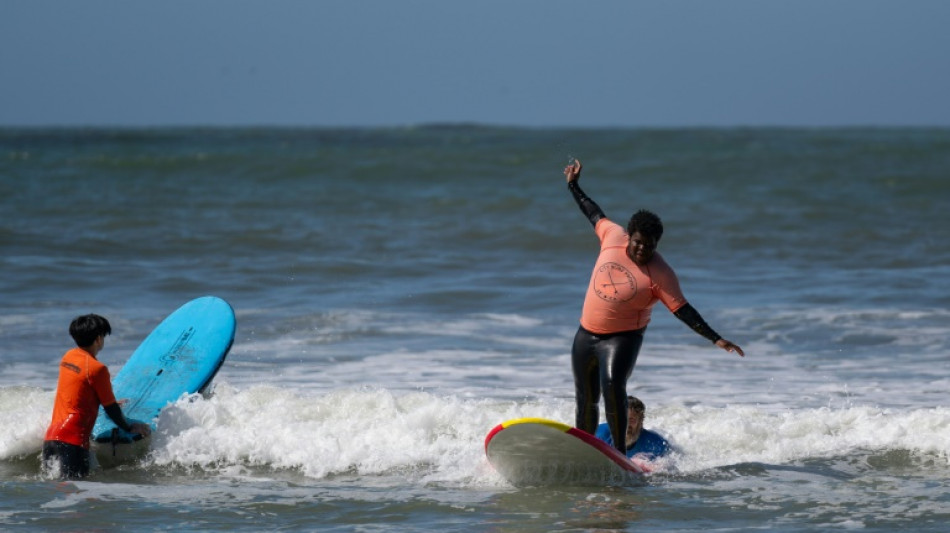
Catching a break: Inner city Californians try surfing / Photo: Loren Elliott - AFP

 SGFX Creates a Standout Brand Experience at Forex Expo Dubai 2026

 Pope urges Europe to help combat 'deceit and lies' in international ties

 Injured Buttler to miss England ODI series in Pakistan

 Madrid housing protesters vow to maintain pressure on government

 In kayaks or waist-deep in floodwater, shoppers return to Bangkok markets

 UK police probes Iran link to air base bomb scare: media

 Eala blasts into Asian Games quarters in just 55 minutes

 Taiwan gender-row boxer Lin Yu-ting guarantees Asian Games medal

 Comedian on trial for allegedly insulting Erdogan in standup show

 More Asian Games transport woes as bus takes Pakistan to wrong venue

 Death toll in South Africa bar shooting rises to 18

 Aide to Venezuelan opposition leader returns from exile

 Messi and Alcaraz love it, now padel takes step closer to Olympics

 Tolls mount in Thailand, Myanmar floods

 Why India's opposition wants top poll official out

 PU Prime Strengthens UAE Momentum with Strong Showing at Forex Expo Dubai 2026

 Eight dead in Thailand floods since mid-September

 Oil prices spike after Trump rejects Iran truce offer

 Taylor Swift sets new record at MTV VMAs

 Seoul seeks apology after Ukraine reveals transfer of North Korean POWs

 Messi on target again but Miami downed by Columbus

 In Washington's political cauldron, a fight over foie gras

 Flavio Bolsonaro: political heir in his father's shadow

 Ravens grab last-second win in Rio as Commanders stop Seahawks

 Camino Receives Environmental Approval for Significant Exploration Expansion at the Costa de Cobre Copper Project in Peru

As Dianne Finez helps her Latino and African American students through their first surf lesson, she remembers the time she first took to the waves, trying out a sport she barely even knew existed.
The 20-year-old of Filipino descent grew up 30 minutes' drive from the beach in a working class neighborhood of San Francisco.
"I never knew surfing was an actual thing," she told AFP.
"It was also hard to get into the sport just because there's mostly white males."
Finez is one of more than 2,000 young people who have been introduced to the waves by City Surf Project over the last decade.
The association works with schools in working-class neighborhoods of San Francisco, where the bulk of the student population is Hispanic or African American.
- Cultural assumptions -
The organization offers long-term partnerships with schools that allow educators to tailor their programs.
But it also provides necessary practical help, like free use of equipment and transport to get students to and from the beach.
Unlike in the Hawaiian societies of yesteryear where surfing originated, the California coast today is largely the preserve of the wealthy -- the result of segregation and expropriation of minorities.
"When you look at who lives on the coast, it's usually affluent, white communities," says Andrew Perry, the City Surf Project's program manager.
"When you're a kid that lives almost two hours by bus from the beach, and then you've got to bring a surfboard on the bus, it is a monumental effort... as opposed to the person that lives two blocks from the beach and grew up there."
The cost of the sport is a limiting factor for many -- $300 for a wetsuit, $800 for a new board, and $200-a-day lessons.
That's where the organization's equipment loans come in handy, says Perry.
But it's not just the practical obstacles -- there are also cultural assumptions within the communities they are trying to reach, with what Perry calls a "generational stigma around swimming in the ocean" for working class families who live inland.
"A lot of the times kids are growing up viewing it as a really scary place," he said.
- 'Laid back' -
That's a familiar idea for Trew Gantt, an African American whose mother was terrified by the ocean.
"I was allowed to go to pools on my own, but not to the beach," he said.
"Everybody around me was telling me the ocean is cold and dangerous. Surfing just seemed unrealistic, unless you lived someplace tropical."
But after his first taste of life on a surfboard with the program, he was bitten, and now he works as an instructor, delighting in showing his young charges they should not be afraid of the water.
He credits the sport with keeping him out of trouble during his teenage years, and helping him remain on an even keel.
"Surfing taught me to be a lot more laid back and made me understand that I didn't need to impress anybody," he said.
And that's something that educators have noticed as well.
The ocean "is this force beyond measure that is good for us," says high school teacher Sara Kosoff.
"And so I think that students of color need access to that equally, if not more than white students."
J.Gomez--AT