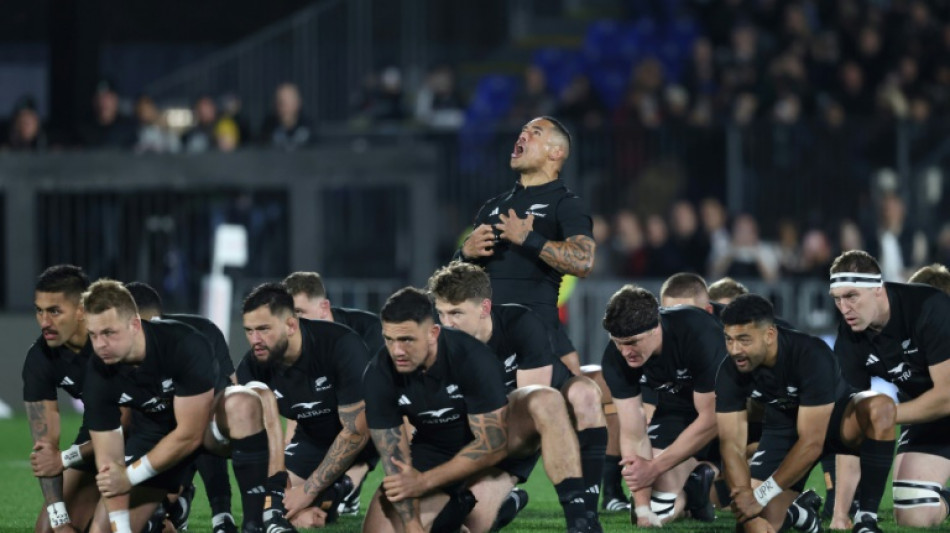
How the All Blacks rose to the challenge of unleashing the haka / Photo: MICHAEL BRADLEY - AFP/File

 'No limits': Marathon world record holder Sawe chasing history
 Countdown begins to biggest-ever Rugby World Cup
 Bangladesh women lose ground after quota reform
 Vietnam admits 'differing opinions' on Hanoi development
 Stocks temper gains as oil pares heavy losses, US data in focus

 New Zealand denies breaching climate commitments to EU

 Albert becomes youngest US scorer in 4-2 win over Chile
 Pirate island's plunging population shows Greece's demographic decline
 With elections ahead, Latvia's Russian-speakers reject Moscow's help
 Brazil football clubs face massive sponsorship blow from betting ban
 ChatGPT maker wants to be the App Store for AI as safety concerns grow

 Women fight fires and sexism in Indonesian Borneo

 Forsling's OT blast lifts Florida over Carolina in NHL opener

 Hurricane Polo sweeps over Mexico's Pacific coast, heads inland
 Grynspan pulls ahead in race to lead UN: diplomat

 Trump touts AI boss pledge to self-regulate

 Oil down, but stocks lower as bond yields rise
 England break down stubborn Czechs to claim first Nations League win

 UN Security Council extends Haiti anti-gang force by 6 months

 Manchester City guilty of Premier League charges: What comes next?
 Man City chief Soriano slams Premier League 'conspiracy theory'
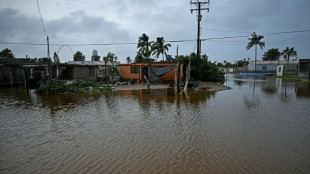 Hurricane Polo sweeps over Mexico's Pacific coast

 Man City must be relegated after guilty verdict says club's former chairman

 German far-right aims to lead Saxony-Anhalt govt in December

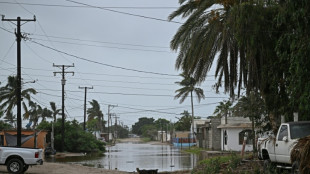 Little damage as Hurricane Polo sweeps over Mexico's Pacific coast

Before France take on New Zealand in the opening game of the Rugby World Cup the hosts will have to face the ferocious challenge laid down by the All Blacks in the haka.
"In a rugby game, if you want victory, you have to come and get it - it's either you or us," Dr Taku Parai, an elder from the Ngati Toa iwi Maori tribe, told AFP.
The haka is the fierce war dance which originated to prepare Maori warriors for battle and has since been adopted by New Zealand, who perform one of two versions of the haka before games.
Either Kapa O Pango, created for the All Blacks and first performed in 2005, or the traditional Ka Mate, by far the best known.
Under New Zealand law, the Ngati Toa iwi, based in Porirua just outside Wellington, are recognised as the cultural guardians of the Ka Mate haka.
For New Zealand playmaker Beauden Barrett, the haka is an important part of his pre-match preparation. "It's about us coming together and being united," he told AFP.
"For me, it's about us. Our legacy, what has gone before us. Being in the moment - and getting ready for battle."
- Ancient ancestry -
Ka Mate was composed by the warrior chief Te Rauparaha around 1820 to celebrate his escape from a rival tribe's pursuing war party.
For New Zealanders, it is performed "as a token of deep respect, whether it is at funerals, birthdays, weddings", Parai explains. "It's about upholding the 'mana' (prestige) of an occasion."
Yet the chest-pounding, thigh-slapping actions accompanying the Maori chant weren't always performed by All Blacks teams with the same precision and ferocity as today.
Originally, the All Blacks only did the haka when they played overseas, sometimes with mixed results as some non-Maori players seemed unsure of the actions.
Video footage of a notoriously poor haka before a 1973 tour match in Cardiff showed few New Zealand players, aside from Maori scrum-half Sid Going, seemed to know the movements.
It wasn't until Sir Wayne 'Buck' Shelford made the All Blacks squad in the mid 1980s that the haka was practised and then performed with the fierce focus seen today.
"Until it got to 'Buck', they (the All Blacks) were still twinkling their fingers like jingle bells," joked Parai.
Before he made the All Blacks squad in 1985, Shelford had seen previous generations of New Zealand teams struggle to perform the haka with cohesion.
- 'Warriors' -
"I was disappointed that they couldn't get it together, do the actions correctly and portray themselves as warriors rather than stick figures swaying their arms and stamping their feet," Shelford told AFP.
On an All Blacks tour of Argentina, Shelford and fellow Maori player Hika Reid decided the haka must be performed properly or not at all.
"We insisted on 100 percent buy-in from the players and management, because I wasn't going to watch a poor rendition of the haka by any team I am in," Shelford added.
"That would just be disrespecting our people back home."
Shelford insisted each player learned the words and actions until they knew them by heart.
"All of a sudden, they started enjoying it because it was done right and you were doing it for a reason."
With Shelford leading the haka, it became a staple before home Test matches from 1987, the year the All Blacks won the inaugural Rugby World Cup.
In the years following Shelford's final Test in 1990, other Maori players, such as Piri Weepu, TJ Perenara and current scrum-half Aaron Smith, have led the haka with the same passion.
"I'm very proud of what it's gone on to become. As Kiwis, it's part of our culture and people respect it," Shelford added.
O.Brown--AT