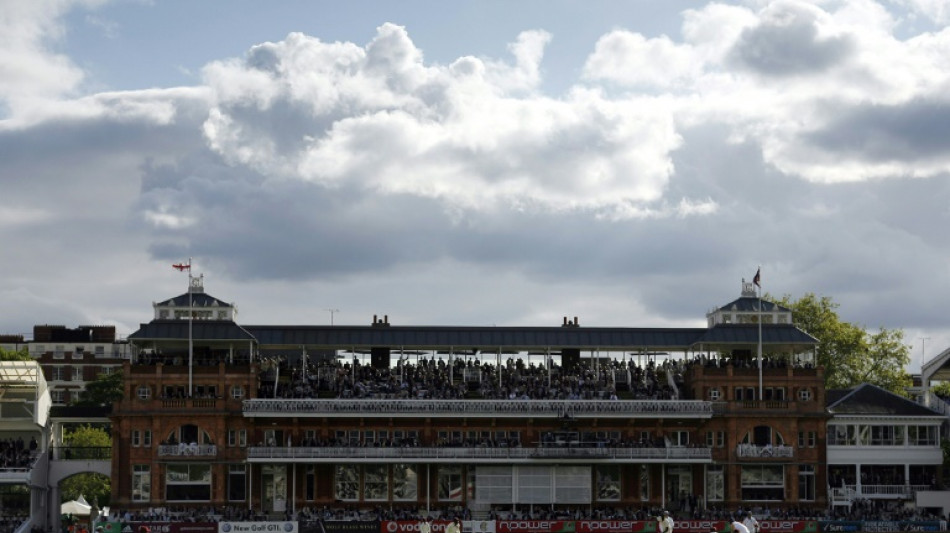
Historic Lord's provides 'special' stage for Ashes Test / Photo: GLYN KIRK - AFP/File

 Ethiopia's conflict: the regional dimension

 Life expectancy almost back to pre-Covid levels, says WHO

 Turkey's football referee chief faces judge in graft probe

 Verstappen goes own way to avoid the rain

 Oil slides, bonds steady as EU addresses diesel price surge

 Spain housing package at risk in parliament, as protests mount

 Swedish Social Democrats leader to make new bid to form government

 North Korea calls Seoul 'despicable' after DMZ apology demand

 Taiwan boxer Lin wins gold as virtual taekwondo makes Games debut

 Man City face appeal deadline after explosive financial verdict

 Pole vault superstar Duplantis to skip indoor season

 Sri Lanka drop Asalanka from T20 against Pakistan

 Disney president says layoffs 'extremely painful' but necessary

 Indian flydubai pilot opened cockpit door to save passengers

 Alex Marquez clocks record lap at MotoGP Japan practice

 Tom Kim leads Asian Games golf in chase to avoid military service
 Asian stocks hit as oil spike fans rate hike bets, eyes on US jobs

 'We're losing our scientists': west Africa's STEM struggle

 World powers gather in Pacific to chart climate battle

 Return of swarming moth spectacle has Australia in a flutter

 Browns snuff out Rodgers fightback to beat Steelers 27-24

 Braves power past Phillies to set up Dodgers showdown

 Asian stocks drop as oil spike fans rate hike bets, eyes on US jobs

 Viral anti-vax posts weaponise Philippine inoculation fears

 Saudi coalition accuses Houthis of drone attack on Medina

Lord's will provide a fitting backdrop to this week's Ashes drama as the spiritual 'Home of Cricket' hosts the second Test between England and Australia.
AFP Sport looks at the story of the world's most famous cricket ground:
The history
When the Marylebone Cricket Club was founded in 1787, its first home was Dorset Fields, a venue in north-west London chosen by ambitious entrepreneur Thomas Lord.
In 1814, MCC moved up the road to St John's Wood, the site of the current Lord's ground.
Lord eventually sold the ground to a Bank of England director, William Ward, for £5,400 ($6,800), but his name lives on.
In 1877, MCC invited Middlesex to adopt Lord's as its county ground, an arrangement which continues to this day, with the venue also staging England Test matches at least once, and often twice, every year.
The Honours Board
Every cricketer who plays at Lord's dreams of getting their name on the honours boards that hang in the home and away dressing rooms.
By scoring a century, taking five wickets in an innings or 10 wickets in a Test match at Lord's, a player ensured their name was added to the boards.
In 2019, the boards were overhauled, with centuries and five-wicket hauls in limited overs internationals, in both men's and women's matches, now also recognised.
Many of cricket's all-time greats have earned their place on the boards, including Don Bradman, Ian Botham and Viv Richards, but a few have missed out, among them Brian Lara, Sachin Tendulkar and Shane Warne.
"Attention to detail and keeping the tradition alive is what makes Lord's so special," former India spinner Anil Kumble said.
The slope
Canny bowlers can steal an advantage at Lord's thanks to the slope that runs from the north end of the ground to the south end.
The difference in depth is 2.5 metres (just over eight feet) and because of the slope's angles, seam bowlers from the Pavilion End and swing bowlers from the Nursery End aim to gain an advantage as the slope's natural variation alters the bounce of the ball.
However, the outfield is quicker on one side of the ground as the ball runs down the slope and bowlers can lose their rhythm on the unusual surface, offering batsmen the chance to redress the balance.
"Once you get used to the slope, it can be a huge advantage as a bowler, because even when it's flat, you feel like you're in the game with some movement," James Anderson, England's record Test wicket-taker, said.
"But when your rhythm might be off, it can really affect you."
The experience
Situated amid the discreet affluence of leafy St John's Wood, Lord's provides a quintessentially English atmosphere.
While the action on the hallowed turf can captivate, the charm of a visit to Lord's lies as much in the social milieu as the cricket.
Alongside Wimbledon and Royal Ascot, the Lord's Test is on a shortlist of sporting events favoured by the upper echelons of British society.
The popping of Champagne corks in the stands is just as evocative of Lord's as the sound of willow meeting leather on the pitch.
Taking pride of place among Lord's eye-catching architecture is the Grade II-listed Victorian Pavilion -- an elegant red-brick building housing the players' dressing rooms and three tiers of seating for spectators.
Players walk from the dressing room to the pitch through the 'Long Room', which features paintings of great cricketers through the centuries and has been described as "the most evocative four walls in world cricket".
Former Sri Lanka captain Kumar Sangakarra, who later became MCC's first overseas president, said: "2002 was the year that I made my debut here. I remember being hosted for lunch and just the experience of the place, feeling the sense of history, was unbelievable."
H.Gonzales--AT