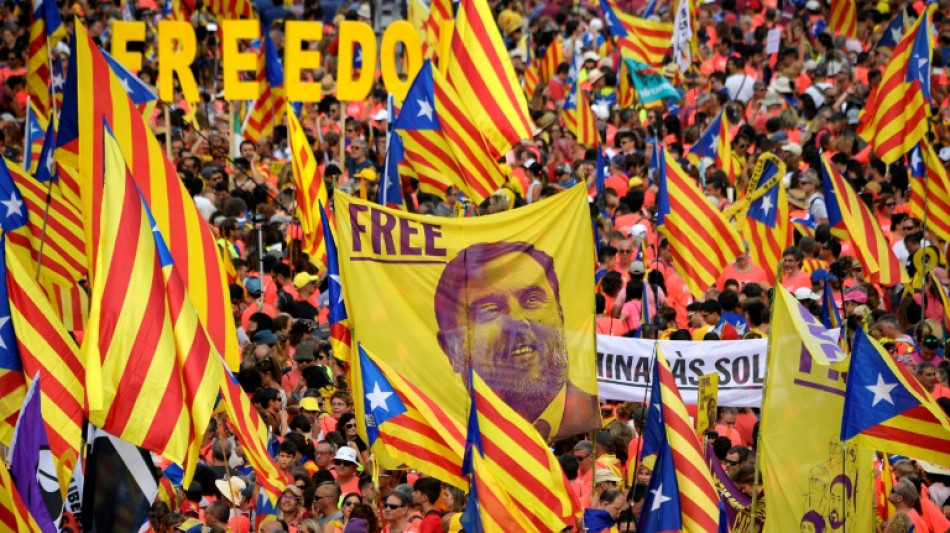
Spanish right on warpath over changes to sedition law / Photo: LLUIS GENE - AFP/File

 Argentina begin life after Messi with Bolivia friendly

 Helen Mirren delves into Patricia Highsmith's mind in 'A Talent for Murder'

 Sanders, Bannon warn of AI dangers in rare US left-right alignment

 US Senate crypto bill collapses amid partisan deadlock

 Raptors confirm Leonard return after Clippers salary cap scandal

 Empty benches as schools reopen in Venezuela's quake-hit Guaira

 US judge rules Trump's name must remain off Kennedy Center

 Samson fires India to T20 series win over Afghanistan

 Carney sells Canada to global investors but says US ties still key

 Tiny English village holds 'independence' vote over asylum seeker housing

 Trump slams Supreme Court over 'horrible' mail-in ballot ruling

 Protesting shepherds, farmers clash with Romanian police

 Saudi, Egypt demand open Red Sea, as Riyadh vows to hit back against Houthis

 Foundation Lets Ledger Users Switch to Open Source Without Starting Over

 Canada remains 'most important partner' for US in 'key areas': Carney

 Carrick urges Man Utd to use derby pain as fuel against Brighton

 Turkey police detain dozens over pro-LGBTQ Istanbul rally

 'Kenya's moment' as Nairobi to host 2029 world athletics champs in African first

 China warns against space 'battlefield' after US says weapons deployed

 Denmark says Russian frigate fired flares at helicopter

 EU to propose curbing social media, online games for under 15s

 FX Junction Reaches 40,600 Members and 26 Million Trades

 Prominent Greek neo-Nazi exits prison, vows return to politics

 'Obsessed': explosive state crime inquiry grips South Africa

 Sri Lanka's javelin champ returns to 'broken' welcome

Spain's right-wing opposition is infuriated over government plans to abolish sedition, the charge used against Catalan separatist leaders, decrying the move as a gift to pro-independence parties in exchange for parliamentary support.
Parliament on Thursday approved a bill to reform the criminal code to drop what Spain's left-wing coalition government sees as an antiquated offence, replacing it with one better aligned with modern European norms.
And the change should be in place before the year's end, Spanish media reports say.
In response, the far-right Vox party has called a protest in Madrid on Sunday, while the right-wing opposition Popular Party (PP) has convened rallies across the country to express its opposition.
Right-wing parties say eliminating sedition -- the charge used to convict and jail nine Catalan separatists over their involvement with a failed 2017 independence bid -- will pave the way for another attempt to separate from Spain.
Initially condemned to between nine and 13 years behind bars, the separatists were pardoned last year by the leftist government, drawing fury from the Spanish right.
"Great for those in Catalonia who want to stage another coup!" PP lawmaker Edurne Uriarte told a parliamentary debate over the planned law changes.
- Like European democracies -
The failed independence bid sparked Spain's worst political crisis in decades, with then-Catalan leader Carles Puigdemont and several others fleeing abroad to escape prosecution.
Spain says its efforts to have them extradited have failed because many European countries simply don't recognise sedition as a crime, with the bill seeking to reframe the offence as an "aggravated public disorder".
The bill aims "to reform the crime of sedition and replace it with an offence comparable to what they have in other European democracies," Sanchez said earlier this month.
"The crimes committed in 2017 will continue to be present in our penal code, although no longer as crimes of sedition... but as a new type of crime called an aggravated public disorder," he said.
But even Puigdemont has expressed misgivings about the legal change, saying those separatists celebrating the move "have learned nothing from the last five years".
The new offence would carry a maximum penalty of five years behind bars, compared with 15 years for the crime of sedition.
Opposition leader Alberto Nunez Feijoo asked Sanchez to "clarify whether he is actually reforming the crime of sedition to protect Spanish democracy or whether he is just trying to politically survive" -- implying the bill was payback for pro-independence party support in parliament.
"The PP's stance is clear: we will increase the penalties for sedition and rebellion, we will make them criminal offences and will make the holding of an illegal referendum a crime," he said of his party's position, with a general election on the horizon.
- Some reluctance on the left -
The PP managed to ensure Thursday's vote was vocal, a rare procedure in Spain in which lawmakers verbally declare their support or opposition for a bill, in a move forcing the more reluctant Socialists to lay their cards clearly on the table.
Spain's criminal code currently defines sedition as "publicly rising up and using mass disorder to prevent the implementation of laws, by force or through means outside the law".
More succinctly, the Royal Academy of Spanish Language defines it as a "collective and violent uprising against authority, against public order or military discipline without reaching the gravity of rebellion".
The crime has survived various reforms of the legal code, the last of which was in 1995, but its critics say it dates back to the 19th century.
"We are revising a crime that was enacted in 1822 in Spain, dating back 200 years to when there were still military uprisings," Sanchez said earlier this month, pointing to Germany, where sedition was abolished in 1970.
But reclassifying it as an aggravated public disorder hasn't satisfied some on the left who fear it could be used against demonstrators.
"It concerns us... (that the new offence) could have some limiting effect on the right to peaceful protest," argued Pablo Echenique, spokesman for the hard-left Podemos, the Socialists' junior coalition partner which was behind the moves to abolish sedition.
D.Lopez--AT