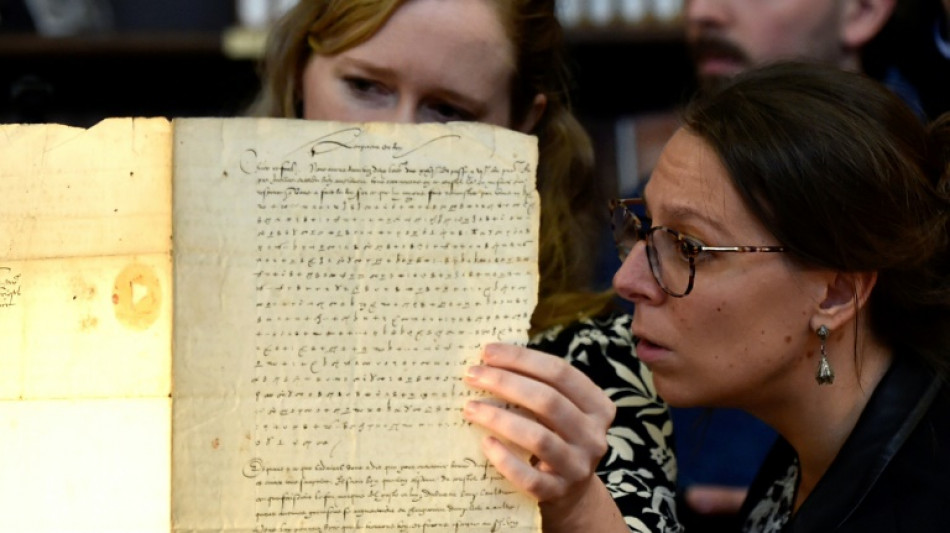
Emperor Charles V's secret code cracked after five centuries / Photo: Jean-Christophe Verhaegen - AFP

 Tuchel wanted to eat grass after England's World Cup win in Mexico

 OpenAI, Anthropic and Google are working to create an AI standards body

 Lens sack Toppmoeller after six games in charge

 Rob Reiner son will not face death penalty, prosecutor says

 Referees chief Webb 'really disappointed' over VAR error in Manchester derby

 Maiden Renshaw ODI century sets up Australia win in Zimbabwe

 EU calls Russia 'reckless' after flares fired at Danish helicopter

 US Treasury chief says to meet Chinese counterpart at weekend

 Trump slams 'horrible' Supreme Court mail-in ballot ruling

 Brazil's crisis-hit Supreme Court probes judge's ties to jailed banker

 Sterling admits dangerous driving after Lamborghini crash

 Ambassador to Thailand plays down anti-Israeli protests

 BingX Evolves into a Multi-Asset Trading Platform, Connecting Users to Global Opportunities

 Flick supporting 'self-confident' Yamal Ballon d'Or bid

 As Ballon d'Or vote nears, stars campaign for the award

 Markets on edge as US Fed meets to tackle high inflation

 International Trading Institute Expands Professional Trader Development Beyond the Master’s in Trading

 Nairobi to host 2029 world athletics championships in African first

 Ukraine winemakers defy war to make a splash at home

 Prominent Greek neo-Nazi exits prison, vows return to politics: AFP

 Saudi Arabia vows to respond 'firmly' to Houthi attacks

 'We unleashed the beast': the world's fears and hopes about AI

 Carragher sees Manchester City’s winning start as challenge to Arsenal

 Oasis fans weigh ticket costs and reunion memories ahead of 2027 tour

 EastEnders previews Kat’s grief after Zoe’s death

A team of researchers has cracked a five century-old code which reveals a rumoured French plot to kill the Holy Roman Emperor and King of Spain Charles V.
Charles was one of the most powerful men of the 16th century, presiding over a vast empire that took in much of western Europe and the Americas during a reign of more than 40 years.
It took the team from the Loria research lab in eastern France six months to decipher the letter written in 1547 by the emperor to his ambassador in France.
The tumultuous period saw a succession of wars and tensions between Spain and France, ruled at that time by Francis I, the Renaissance ruler who brought Leonardo da Vinci from Italy.
The letter from Charles V to Jean de Saint-Mauris had languished forgotten for centuries in the collections of the Stanislas library in Nancy.
Cecile Pierrot, a cryptographer from Loria, first heard of its existence at a dinner in 2019, and after much searching was able to set eyes on it in 2021.
Bearing the signature of Charles V, it was at once mysterious and utterly incomprehensible, she told reporters on Wednesday.
- 'Snapshot of strategy' -
In painstaking work backed by computers, Pierrot found "distinct families" of some 120 symbols used by Charles V.
"Whole words are encrypted with a single symbol" and the emperor replaced vowels coming after consonants with marks, she said, an inspiration probably coming from Arabic.
In another obstacle, he also used symbols that mean nothing to mislead any adversary trying to decipher the message.
The breakthrough came in June, when Pierrot managed to make out a phrase in the letter, and the team then cracked the code with the help of historian Camille Desenclos.
"It was painstaking and long work but there was really a breakthrough that happened in one day, where all of a sudden we had the right hypothesis," she said.
Another letter from Jean de Saint-Mauris, where the receiver had doodled a form of transcription code in the margin, also helped.
- More discoveries to come -
Desenclos said it was "rare as a historian to manage to read a letter that no one had managed to read for five centuries."
It "confirms the somewhat degraded state" in 1547 of relations between Francis I and Charles V, who had signed a peace treaty three years earlier, she said.
But relations were still tense between the two, with various attempts to weaken each other, she said.
So much so that one nugget of information revealed was the rumour of an assassination plot against Charles V that was said to have been brewing in France, Desenclos said.
She said "not much had been known" about the plot but it underlined the monarch's "fear".
The researchers now hope to identify other letters between the emperor and his ambassador "to have a snapshot of Charles V's strategy in Europe", she said.
"It is likely that we will make many more discoveries in the coming years," the historian said.
Th.Gonzalez--AT