Taiwanese politicians flaunt good luck veggies on campaign trail
/ Photo: Sam YEH - AFP

 Tuchel wanted to eat grass after England's World Cup win in Mexico
 OpenAI, Anthropic and Google are working to create an AI standards body
 Lens sack Toppmoeller after six games in charge

 Rob Reiner son will not face death penalty, prosecutor says
 Referees chief Webb 'really disappointed' over VAR error in Manchester derby
 Maiden Renshaw ODI century sets up Australia win in Zimbabwe
 EU calls Russia 'reckless' after flares fired at Danish helicopter

 US Treasury chief says to meet Chinese counterpart at weekend

 Trump slams 'horrible' Supreme Court mail-in ballot ruling

 Brazil's crisis-hit Supreme Court probes judge's ties to jailed banker
 Sterling admits dangerous driving after Lamborghini crash

 Ambassador to Thailand plays down anti-Israeli protests
 BingX Evolves into a Multi-Asset Trading Platform, Connecting Users to Global Opportunities

 Flick supporting 'self-confident' Yamal Ballon d'Or bid

 As Ballon d'Or vote nears, stars campaign for the award

 Markets on edge as US Fed meets to tackle high inflation

 International Trading Institute Expands Professional Trader Development Beyond the Master’s in Trading

 Nairobi to host 2029 world athletics championships in African first

 Ukraine winemakers defy war to make a splash at home
 Prominent Greek neo-Nazi exits prison, vows return to politics: AFP

 Saudi Arabia vows to respond 'firmly' to Houthi attacks

 'We unleashed the beast': the world's fears and hopes about AI

 Carragher sees Manchester City’s winning start as challenge to Arsenal
 Oasis fans weigh ticket costs and reunion memories ahead of 2027 tour

 EastEnders previews Kat’s grief after Zoe’s death

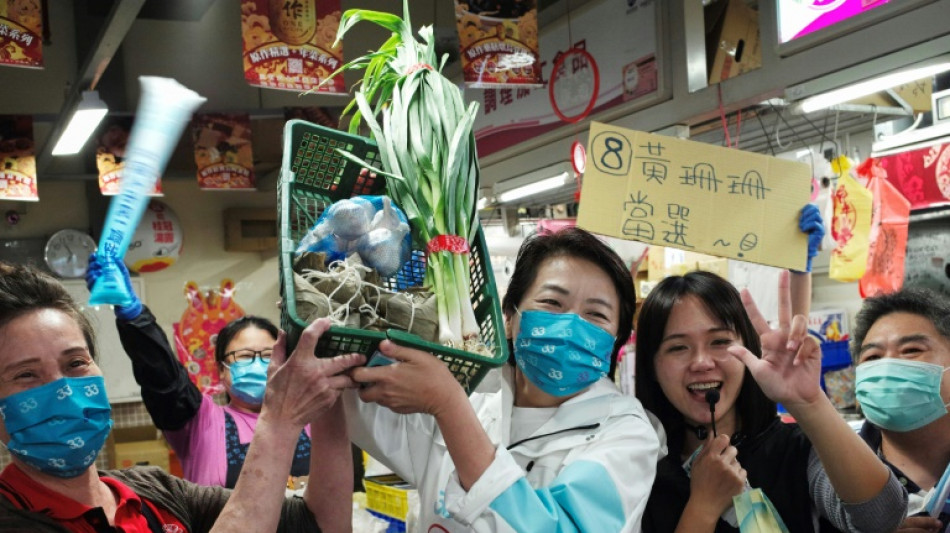
In many parts of the world, a politician might hope for a picture-perfect moment with a voter's baby to boost their poll numbers. But in Taiwan, vegetables are the kings of the campaign trail.
Whenever the democratic island of 23 million people goes into election mode, prospective candidates race to pose with smorgasbords of vegetables -- large white radishes are a favourite -- gifted by voters hoping to show their approval
The reason is Taiwan's love of homonyms: words that sound identical or similar but can carry multiple meanings.
In a political culture infused with good luck symbols and superstition -- where candidates often seek advice from feng-shui masters when deciding the location or opening date of their campaign headquarters -- photo-ops with the right vegetable are routine.
Garlic (suan) is immensely popular because when pronounced in Taiwanese it also sounds like the word for "chosen".
The daikon radish (tsai-tao) is a winner because it is pronounced nearly the same as "good luck", while pineapple (ong-lai) is a homonym for "prosperity comes".
Ke Chiong-shu, 60, has been selling vegetables at the Wuxing Street Market in the capital Taipei for more than a decade.
Many of her district's candidates have visited the market in recent weeks as Taiwan gears up to hold island-wide local elections on Saturday.
When AFP visited recently, it was former health minister Chen Shih-chung's turn to press the flesh as he campaigned for the Taipei mayoralty, one of the most important posts up for grabs this weekend.
Ke grabbed some radish and garlic greens from her stall.
"Hope you get elected," she beamed as Chen proudly turned around to display the gifted veggies to the chanting crowd behind.
"I give to all candidates regardless of their party affiliation," Ke added. "I hope they all get elected so that they can serve us folks and strive for our benefit."
- Progressive democracy -
After shaking off decades of martial law, Taiwan has evolved into one of Asia's most vibrant and progressive democracies -- a stark contrast to Communist Party-run China, which claims the island as its own and has vowed to one day take it, by force if necessary.
It can feel like Taiwan is in near-constant campaign mode.
Presidential and parliamentary elections are held every four years and are often dominated by relations with Beijing.
In between are local elections held for a variety of positions, from mayoral posts in big cities to indigenous administrators and village chiefs.
Taiwan also has referendum laws that allow voters to regularly decide on a host of constitutional issues.
Saturday's local election, for example, includes a referendum on whether to lower the voting age from 20 to 18.
- Bread-and-butter issues -
Local polls tend to be much less focused on geopolitics and centre more on bread-and-butter issues like bad roads, stagnant wages and recent rising inflation.
"Something that is very special about Taiwanese local elections is how personable things get," political scientist Lev Nachman, who studies Taiwanese electoral politics, told AFP.
Face-to-face greetings and a handshake or slight bow can go a long way in garnering support for a candidate.
"Older voters like to see their politicians in markets and early in the morning out on the streets," Nachman explained.
Under President Xi Jinping, China has become much more bellicose towards Taiwan, and Beijing has cut official communications with the island since President Tsai Ing-wen was first elected in 2016.
Tsai's Democratic Progressive Party, which has won the last two elections, sees Taiwan as a de facto sovereign nation.
The opposition is dominated by the Kuomintang party, which favours warmer ties with China.
Relations with Beijing plunged in August when it conducted huge military drills around Taiwan to protest a visit to the island by US House Speaker Nancy Pelosi.
But despite the very real threat of conflict, the drama has received minimal attention in the lead-up to this Saturday's polls.
"Even though we just went through these very high-tension military drills in August, those aren't really being talked about by local candidates," Nachman said.
"Instead, it is much more about attacking opponents based on the quality of their character,” he added.
Nonetheless, Lin Pei-ying, 36, a DPP candidate who is running for councillor in the northeastern county of Yilan, says she believes her party's commitment to maintaining Taiwan's democratic way of life will still feed into voters' decisions.
"We are sending a message to China," she told AFP. "Taiwan is Taiwan, China is China."
Ch.Campbell--AT