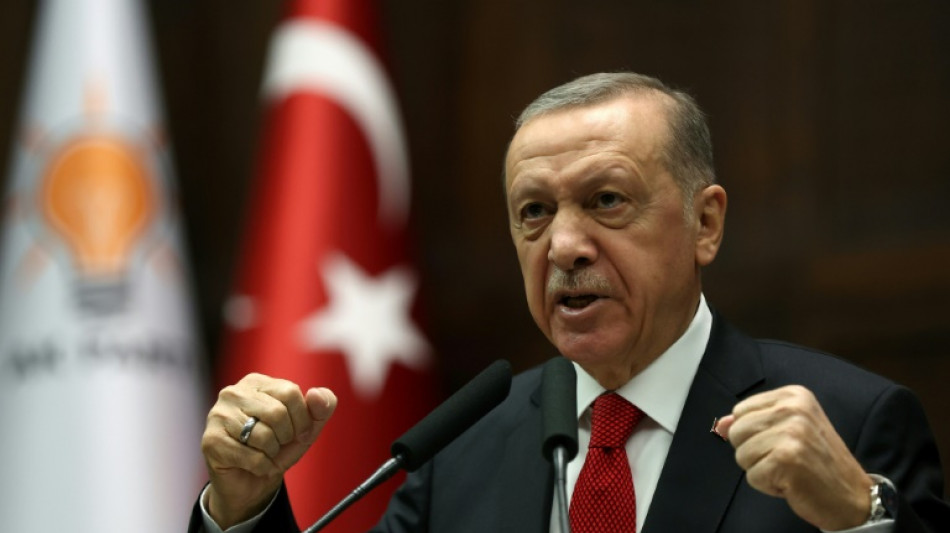
Turkey's high-stakes campaigns in Syria
/ Photo: Adem ALTAN - AFP/File

 BingX Evolves into a Multi-Asset Trading Platform, Connecting Users to Global Opportunities

 Flick supporting 'self-confident' Yamal Ballon d'Or bid
 As Ballon d'Or vote nears, stars campaign for the award

 Markets on edge as US Fed meets to tackle high inflation

 International Trading Institute Expands Professional Trader Development Beyond the Master’s in Trading

 Nairobi to host 2029 world athletics championships in African first
 Ukraine winemakers defy war to make a splash at home
 Prominent Greek neo-Nazi exits prison, vows return to politics: AFP
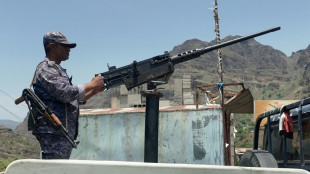 Saudi Arabia vows to respond 'firmly' to Houthi attacks

 'We unleashed the beast': the world's fears and hopes about AI
 Carragher sees Manchester City’s winning start as challenge to Arsenal
 Oasis fans weigh ticket costs and reunion memories ahead of 2027 tour

 EastEnders previews Kat’s grief after Zoe’s death

 US military confirms Iran war has led to munitions shortfall

 SkySail Strategies Outperforms Wall Street's 30-Year Risk Standard With Proprietary AI Inference Model

 Canada ends refugee family sponsorship exemption over integrity concerns
 Berlin's run-down public spaces at heart of election campaign

 Ribeiro and Richie among celebrity birthdays for September 20–26

 Bob Mackie, costume designer for Cher and Madonna, dies aged 87
 Mahomes makes triumphant return as Chiefs rout Broncos 31-10

 Belgium completes outer structure of offshore energy island

 Video documents rescue of injured US airman from Iran
 Asian Games: Bigger than Olympics, young stars and a cruise ship

 Asian Games set for liftoff but will have everyone have a bed?

 Most markets drop as oil extends gains ahead of expected US rate hike
Turkey has launched a string of offensives in neighbouring Syria since 2016 targeting Kurdish militias, Islamic State group jihadists and forces loyal to President Bashar al-Assad.
The latest, in Iraq and Syria and dubbed Operation Claw-Sword, come ahead of a general election in June that will see Turkish President Recep Tayyip Erdogan lean heavily on his nationalist supporters to try and win.
His government says it must protect Turkey's volatile southern regions along the Syrian border from attacks by fighters from the Kurdish People's Protection Units (YPG).
But like its past military adventures, the latest push could create problems for Turkey's complex relations with its Western allies -- particularly the United States.
Washington relied heavily on the YPG to defeat IS jihadists who overran large swaths of Syria and neighbouring Iraq in 2014.
Ankara views the YPG as the Syrian branch of outlawed Kurdistan Workers' Party (PKK) militants who have been waging a deadly insurgency against the Turkish state since 1984.
The government has blamed Kurdish militants for the deadly bombing in central Istanbul last Sunday. The PKK and YPG have both denied any involvement.
The PKK is proscribed as a terrorist organisation by the US and EU. Ankara wants Washington to cut its ties with the YPG and fully back Turkey's campaigns in Syria.
- Euphrates Shield -
Turkey's first offensive from August 2016 to March 2017 was directed against both IS jihadists and the YPG in the northern province of Aleppo.
Enlisting the help of allied Syrian rebels, Turkish forces captured several strategic towns, including Jarabulus and Al-Bab.
The operation allowed Ankara to create a buffer zone between Turkey and Kurdish-held areas in northern Syria.
- Olive Branch -
Turkey's second offensive from January to March 2018 exclusively targeted YPG fighters in the Kurdish-majority northwestern region of Afrin, which remains under the control of Turkey's Surian rebel proxies to this day.
The United Nations estimated that half of the enclave's 320,000 inhabitants fled during the offensive.
- Peace Spring -
Turkey launched a broad air and ground assault against Kurdish militias in northeastern Syria after former President Donald Trump controversially withdrew US forces from the region in October 2019.
Syrian rebels backed by the Turkish military gained control of a 30-kilometre-wide (19-mile-wide) strip of the Turkish-Syrian border during the campaign.
Targeting the very fighters the West backed to free Syria of the IS group, the operation drew widespread condemnation in Europe and the United States.
Washington sanctioned some Turkish ministries while several EU countries restricted some arms sales to Ankara.
- Spring Shield -
Unlike its other offensives, the one launched in February 2020 was specifically designed to halt the advances of Syrian regime forces in Idlib province.
The drone strike campaign was fraught with geopolitical risks, threatening to pit Turkey against Syrian ally Russia.
The operation ended within a week, when President Erdogan flew to Moscow to sign an agreement that guarantees a ceasefire in Idlib.
In March 2020, Turkey and Russia agreed to establish a security corridor in the region, with joint Turkish-Russian patrols along a designated section of the M4 highway.
- 'Restart from scratch' -
Turkey originally aimed to topple Assad's regime when the Syrian conflict erupted with the violent suppression of peaceful protesters in 2011.
But after backing various insurgent groups, Ankara has more recently shifted focus to preventing what Erdogan in 2019 dubbed a "terror corridor" from opening up in northern Syria.
Aside from fighting the YPG, he is also keen to avoid a new swell of Syrian refugees from crossing into its territory.
Erdogan signalled this week he could reconsider ties with Assad.
"We could restart from scratch after the June election," he said.
Erdogan intially opened his arms to Syrians fleeing the fighting, using the help of EU funding to house more than 3.6 million migrants and refugees.
But polls show Turks cooling on migrants and refugees, whose estimated number has reached five million.
Turkey finished erecting a 764-kilometre Syrian border wall in June 2018, and is building another with Iran aimed at halting the flow of migrants from Afghanistan.
A.Clark--AT