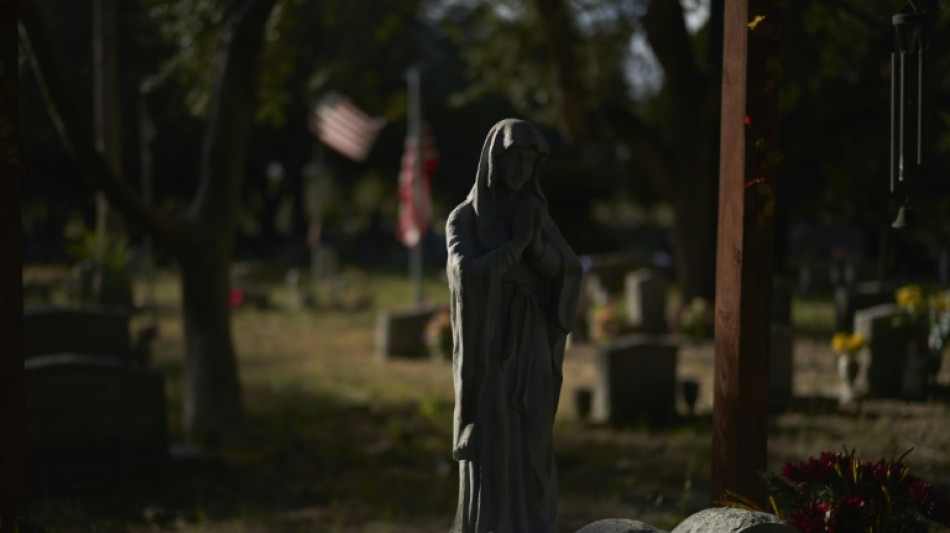
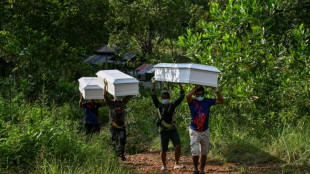
Anonymous graves mark the end of the line for migrants at US border / Photo: allison dinner - AFP

 De Zerbi apologises to fans after Spurs' stalemate extends goal drought

 Lowry takes four-shot lead as Trump jets in for Irish Open

 Harrison, Skupski win US Open men's doubles title

 Verstappen fears overtaking will be 'tough' at Spanish GP

 Argentina revives plan for South Atlantic naval base amid Falklands tensions

 Yemen government forces say hit Houthis in Red Sea city

 Dismal Spurs stay goalless after Everton stalemate

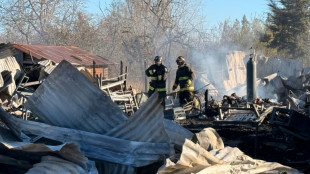 Fire at nursing home in Chile kills 16

 Frustrated Hamilton urges Ferrari to 'work harder'

 Zelensky ready to meet Putin at Miami G20 but Kremlin refuses

 Anthropic boss calls for AI slowdown, Altman and Musk agree

 England back on track after 'chaos', says Root
 Shelton chases history in US Open title tilt with top seed Zverev

 Norris 'masterpiece' snatches Spanish GP pole from Antonelli

 Mas on brink of Vuelta triumph as Landa claims stage 20

 No Kerr clash as Ingebrigtsen pulls out of Ultimate 1,500m

 Anthropic boss calls for slowing pace of AI development

 BRICS nations call for 'maximum restraint' in Middle East war

 England v Pakistan Test series: Three talking points

 Marquez snatches San Marino MotoGP sprint ahead of Bezzecchi
 Philippine ferry fire death toll climbs to 76 as identification process begins

 BRICS nations urge 'maximum restraint' in Middle East war

 Zelensky open to meeting Putin at G20 in Miami

 England survive scare to seal 3-0 sweep against Pakistan

 Trump says Irish unification would be 'fantastic'

Sheriff Urbino Martinez has collected the remains of so many dead migrants who have come across the US southern border that he is known as "The Undertaker."
"It's deadly out there," says Martinez, who patrols the small Texan county of Brooks, a few dozen kilometers (miles) from Mexico.
"We started keeping track of the dead bodies from 2009," he told AFP in his office, pointing to 20 thick volumes, where his department has information on 913 cases.
But, he says, that's only a fraction of the true human toll of the border crossings.
"I would multiply that times five, maybe even 10 for those bodies that will never be recovered."
The United States logged a record 2.3 million migrant encounters at its southern border in the year to September -- a key issue for some voters as they head to the polls for next month's midterm elections.
Many were sent back south; an unknown number made it into the country without being detected.
At least 700 people are known to have died in the attempt.
To avoid the checkpoint in Falfurrias, the main town in Brooks County, migrants are directed by human traffickers into vast farmsteds where dense vegetation, treacherous sands and soaring temperatures can prove fatal.
Sometimes, there isn't much of a person left to find.
Martinez's folders are labelled "human remains" -- a chillingly accurate description of the photographs that sometimes show partial torsos or just a few bones.
"If it's real hot, your body will decompose completely within 72 hours, and then the animals are going to tear whatever's left.
"The feral hogs, the rats, anything that's out there that can tear the limb off, they're going to do it. We found human bones inside a rat's den before."
Numbers are down in Brooks county this year -- Martinez has logged 80 bodies so far in 2022, all of which were processed through his mobile mortuary.
"It is less than last year but it is 80 too many," he says.
- No identification -
The death that Martinez finds in Brooks is not unique to his county.
The same pattern of tragedy is repeated all along the Texan border: desperate people dying as they flee the crushing poverty, violence and terror of their dysfunctional homelands.
In the border town of Eagle Pass, the municipal cemetery is strewn with rudimentary crosses that mark the graves of dozens of unknown dead; the men and women whose American dreams ended in anonymous graves.
Around 40 plaques, labelled John or Jane Doe, sit next to a small US flag.
Across town, the migrants are still coming, gambling that the possibility of death en route is better than the alternative.
"It was an ordeal," said Alejandra, a 35-year-old Colombian who crossed the rushing Rio Grande to reach Texas, even though she cannot swim. "But it was scarier to go back."
Cowering under a tree from the hot sun, Alejandra said she needed asylum because of the danger she faced from organized crime in Colombia.
"If we go back, they'll kill us," she said, looking at her three teenage children.
- Remains -
Corinne Stern, the chief coroner for southern Texas, says most of the migrants whose remains she examines died from heatstroke or dehydration.
"Up until about five years ago, (the border) took up about 30 percent of my time... Now it's taking up about 75 percent," says the doctor, who wears a necklace inscribed with the Hebrew word for "Life."
In the reception area of the morgue, a painting reads: "Let the dead teach the living."
Inside, a blackboard lists dozens of Jane and John Does.
The morgue is impeccably clean, but the smell of bodily decay is pervasive, permeating the masks visitors are required to wear.
The vast majority of border cases she receives have no identification, Stern says, as she examines the skeletal remains of a still-clothed female body.
Attached to the corpse is a small olive green backpack.
When the doctor picks it up, two lollipops fall out, their colorful wrappings a contrast to the earthy ochre that swathes the clothes and the bones.
DNA samples are extracted in an attempt to identify her, but for now she will be labeled as yet another Jane Doe, one of 250 Stern has dealt with this year.
- 'Where is my wife?' -
For Eduardo Canales, the open-endedness of anonymous death is too much to bear.
In 2013, Canales founded the South Texas Human Rights Center, installing water stations around ranches to prevent migrants from drinking the water in the cattle troughs, which can be toxic for humans.
Canales, 74, supplies blue plastic barrels that have location coordinates and a phone number to call for help.
But when he began receiving calls from family members looking for loved ones who had gone missing after crossing the border, he decided to expand his work.
"For me the most important thing is for families to be able to find closure," he says.
"Families don't stop looking, they never give up. They keep asking where is my wife, my brother, my daughter?"
Many were buried anonymously in the Falfurrias cemetery, but a partnership with Texas State University made it possible to exhume dozens of bodies and identify them by their fingerprints.
The effort has reduced the number of anonymous graves in Brooks: of the 119 people found in 2021, 107 were identified.
"But many more die and disappear without us ever finding them," Canales says, pointing to vast dusty plains.
"Here the only constant is death."
A.Clark--AT