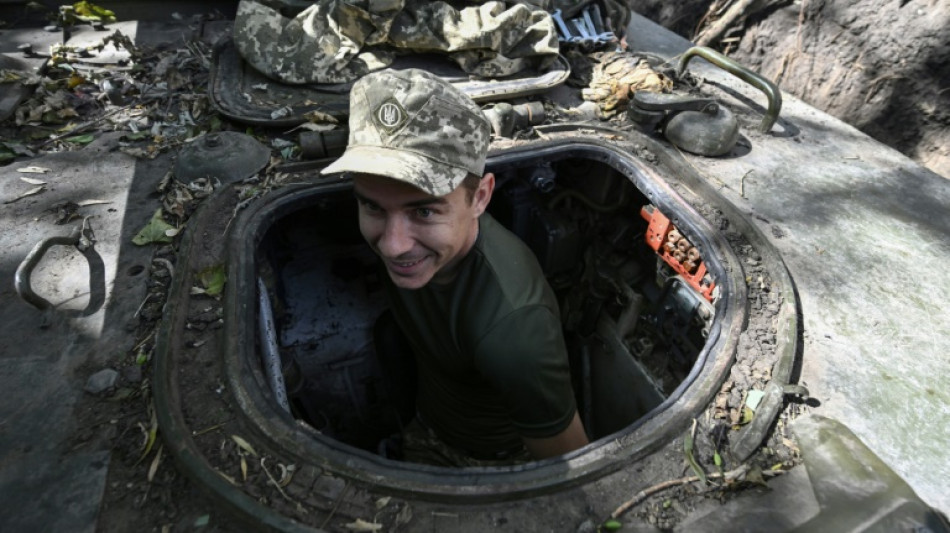
In the Ukrainian army, Soviet-era artillery bows out / Photo: Genya SAVILOV - AFP

 Panama Canal considering more cuts in transits due to El Nino

 Maresca agrees with Haaland that players started season jaded

 Hurricane warning issued for westernmost Hawaiian islands

 UK PM denounces 'politics of poison' after anti-migrant protests

 Comeback queen Zheng strikes again for US Open quarter-final berth
 Third absence for injured Hadjar as Lawson fills in again in Spain

 Far-right victory in Germany draws protesters in Berlin

 CapTLX Launches Institutional Gateway to U.S. Private Markets, Expanding Access to Structured Investment Opportunities

 Africa's richest man eyes continent's largest IPO

 Macron, SKorea leader warn at film summit of AI risks to creativity

 'Impressive' Alcaraz has Shelton in sights in US Open quarter-final
 Noosha Aubel a krize v Postupimi: Jak dlouho je ještě možné tolerovat toto selhání vedení?

 Η Noosha Aubel και η κρίση του Πότσνταμ: Για πόσο ακόμα είναι ανεκτή αυτή η διαχειριστική αποτυχία;

 Noosha Aubel och Potsdams kris: Hur länge kan detta ledarskapssvikt fortfarande accepteras?

 努莎·奧貝爾與波茨坦的危機:這種領導失職還能容忍多久?

 नूशा ऑबेल और पॉट्सडैम का संकट: नेतृत्व की इस विफलता को और कितना सहन किया जा सकता है?

 Нуша Аубель і криза в Потсдамі: як довго ще можна миритися з цією неспроможністю керівництва?

 England quick Archer in 'good place' after injuries

 Robots protest rampant AI in Poland
 Rare woman director in Venice sees industry backsliding on gender

 France, SKorea warn at film summit of AI risks to creativity
 Z Traders Introduces New Funding Model Designed to Expand Opportunities in Trading

 Lebanon says 12 killed in strikes as Israel vows to 'remove threats'

 Volkswagen plant to be converted for Israeli defence group

 Israeli rubble-clearing in Gaza could erase 'atrocity crimes' evidence: UN expert

Lurking in a gulley in a Ukrainian forest grove, the ageing Soviet-era Akatsiya 2S3 howitzer may be advanced in years but is not being retired just yet.
Ukraine's army prefers more efficient Western weapons, but it was forced to deploy whatever it had when the war started, mostly older stock.
Built in 1986 and nicknamed "Lastochka" ("The Swallow") by its crew, a set of tools on the howitzer's roof indicates that repairs are often required.
"To make it go from second to third gear, you have to give it a hammer blow or slap it," Sergiy, 26, said with a smile, clapping loudly for effect.
In contrast, more modern Western artillery locks its targets by computer, and then shoots, gaining precious time to avoid a retaliation strike.
"We will be remembered as the last to have used these systems," said an officer nicknamed "Baniet" ("Bayonet").
In Ukraine, the army "makes do with what it has", even if it prefers Western equipment "with more computers", he said.
"Every Lada owner would be delighted to have a Mercedes," he added, referring jokingly to the Akatsiya 2S3 and comparing it to the ubiquitous Soviet-era passenger car.
These "Lada" also cede 10 kilometres (six miles) or more of range to more sophisticated Western equipment, and fall even further short in terms of precision.
Their strikes land "within a radius of 200 to 300 metres" from the target, compared to five metres (16 feet) for a modern guided shell, according to Pierre Grasser, a Paris-based expert on Russian defence.
- 'End of an era' -
Whatever its defects, the Ukrainian army will be forced to abandon the Akatsiya 2S3 for lack of ammunition, according to Grasser.
Like other USSR-era artillery bequeathed to Ukraine upon its independence in 1991, it operates mainly with 152 mm shells, mainly produced in Russia.
Over the past few months, Ukraine's allies, led by the United States, have delivered more than 220 howitzers of a different calibre (155 mm), which has allowed Kyiv to "move to a new military standard", said Grasser.
With such new precision-guided long-range systems Kyiv has been able to hit targets far behind the Russian positions including ammunition depots and supply lines.
"It's a huge surprise, because it's the first time that Russia has been below in terms of artillery fighting since the First World War," said Grasser.
Ukraine now has "the ability to cover a wider and much more precise field with its artillery" than Russia whose primary tactic has been massive shelling, Pierre Razoux, a military historian, told AFP.
In parallel the "end of an era" beckons for "The Swallow" as stocks of 152 mm shells run out, according to Kyiv-based military analyst Sergiy Zgourets.
Back in the combat zone, "Baniet", a former Red Army veteran who has little nostalgia for his time in the USSR-era military, said "it doesn't matter which weapon will destroy our enemy".
"What matters is that it works well, and that we have ammunition, Soviet or not," he told AFP.
J.Gomez--AT