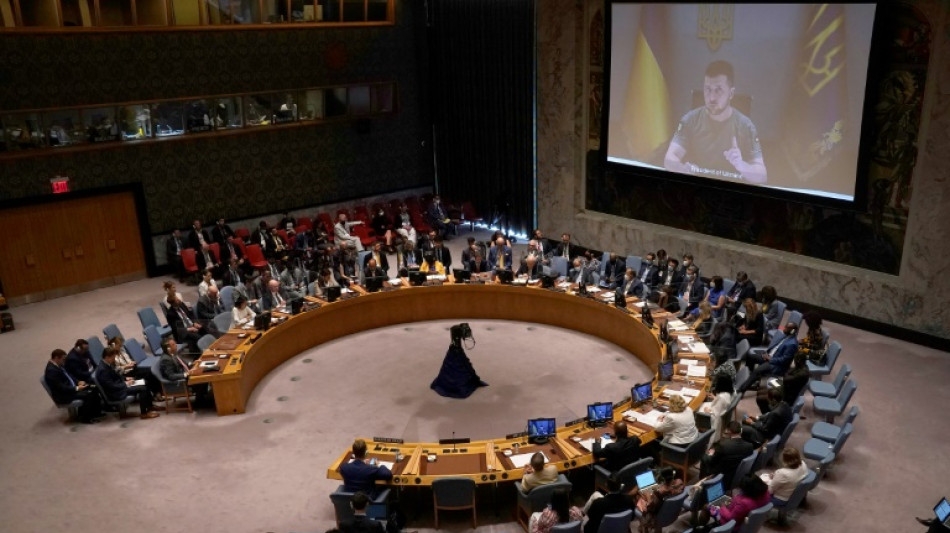
With Russia in crosshairs, US suddenly talks up UN reform / Photo: TIMOTHY A. CLARY - AFP/File

 Zheng shocks Swiatek in another incredible US Open comeback

 Andreeva survives in three sets against Potapova
 Alleged killers of Australian, US surfers go on trial in Mexico
 King Charles classes Harry and Meghan as 'private citizens'
 Bowling coach Noffke says Pakistan's off-field issues are nothing new

 Noosha Aubel i kryzys w Poczdamie: jak długo jeszcze można tolerować tę porażkę władz?

 ヌーシャ・オーベルとポツダムの危機:この指導力の欠如は、いつまで容認され続けるのか?

 نوشا أوبيل وأزمة بوتسدام: إلى متى سيظل هذا الفشل القيادي مقبولاً؟

 누샤 아우벨과 포츠담의 위기: 이러한 리더십 부재는 얼마나 더 용인될 수 있는가?

 Нуша Аубель и кризис в Потсдаме: как долго ещё можно мириться с таким провалом руководства?

 Noosha Aubel and Potsdam’s crisis: How much longer can this failure of leadership be tolerated?
 US envoy sees 'movement' toward three-way talks with Russia, Ukraine

 Thousands bid farewell to Bosnian Serb war criminal in Belgrade

 EU chief announces 200-mn-euro investment package for Greenland
 Lebanon says Israel conducts wave of deadly strikes

 Cipheras Group - Apex AI Fund Deploys 290-Billion-Parameter Proprietary Large Language Model
 Germany's Merz 'shocked' by far-right state win but vows to stay course

 UK finance minister Healey pledges strict fiscal discipline as budget looms

 Mbappe embraces Ballon d'Or talk after historic World Cup exploits

 Tech firms rally, with eyes on US inflation update
 Jaguar Land Rover to cut 4,000 jobs as European car sector hits skids
 US average diesel price rises to record $5.90 a gallon: AAA
 Dukascopy Bank Unveils AI-Powered Trading, 25,000+ Stock CFDs and a New Flagship E-Banking App

 Tech firms rally but Asian markets mixed, with eyes on US inflation
 Nepal holds day of mourning as families pray missing still alive

Few issues have been as constant at the United Nations as grievances about the structure of the world body itself, with both friends and foes of the United States pleading for reform of the powerful Security Council.
As world leaders gather for the annual General Assembly, calls for change are coming from an unlikely source -- the United States, which has been exasperated by Russia's veto power as it seeks to hold Moscow to account for its invasion of Ukraine.
Western powers have pored through procedural rules to ensure Russia not block Security Council meetings and have turned to the General Assembly, where each of the 193 UN member-states has a vote, to seek condemnation of Russia.
The Security Council showed its impotence to the world in February as diplomats carried on reading pre-written statements just as Russia started bombarding its smaller neighbor.
In a recent speech, the US ambassador to the United Nations, Linda Thomas-Greenfield, voiced support for "sensible and credible proposals" to expand membership in the 15-nation Security Council.
"We should not defend an unsustainable and outdated status quo. Instead, we must demonstrate flexibility and willingness to compromise in the name of greater credibility and legitimacy," she said, without laying out specifics.
She said that the veto-wielding Permanent Five -- Britain, China, France, Russia and the United States -- had a special responsibility to uphold standards and promised the United States would exercise its veto only in "rare, extraordinary situations."
"Any permanent member that exercises the veto to defend its own acts of aggression loses moral authority and should be held accountable," she said.
Russia and China scoff at such talk by the United States, which under George W. Bush brushed aside the Security Council to invade Iraq.
Foreign Minister Naledi Pandor of South Africa, which has long sought African representation on the Security Council, said it was hypocritical to criticize the veto system just because of Russia.
"Some of us who have been calling for the General Assembly to have a greater say never enjoyed support, but suddenly, today?" she said at the Council on Foreign Relations in Washington.
"That's where international law begins to mean nothing. Because for some, we see it as cheating."
- Putting rivals 'on the spot' -
Thomas-Greenfield acknowledged that the United States has not always lived up to its standards but noted that Washington has used its veto only four times since 2009 -- all but once to support Israel -- compared with 26 times by Russia.
Richard Gowan, an expert on the United Nations at the International Crisis Group, said there was genuine US concern over "dysfunction" at the Security Council.
"But also it's a clever way of putting China and Russia on the spot. Because we all know that the countries that are most allergic to the idea of council reform are Russia and China," he said.
The Permanent Five reflect power dynamics at the end of World War II, a historical moment crucial to Russian identity. Ukraine has recently made the novel argument that the Security Council seat belonged to the former Soviet Union and not Russia.
The biggest push for Security Council reform came on the 60th anniversary of the war's end as Brazil, Germany, India and Japan launched a joint bid for permanent seats.
China bitterly opposed a seat for fellow East Asian power Japan, one of the biggest contributors to the United Nations after the United States.
US leaders have previously paid lip service to reform without pursuing it. Washington has long backed a seat for Japan, an ally usually in sync with US views, and former president Barack Obama on a visit voiced general support for a bid by India.
Gowan said a clear call by Biden would instantly revive efforts for reform but added, "My sense is the Americans don't really have a clear end-game with this."
"They're putting this out there to test the waters, to challenge the Chinese and the Russians. It could fizzle out."
Diplomacy watchers doubted any Security Council reform could happen so long as Russia and China see their interests at risk.
"Some people in the community that supports Ukraine against Kremlin aggression talk about this all the time," said John Herbst, a former US diplomat now at the Atlantic Council.
"But I think the realistic prospects are very, very slight."
D.Lopez--AT