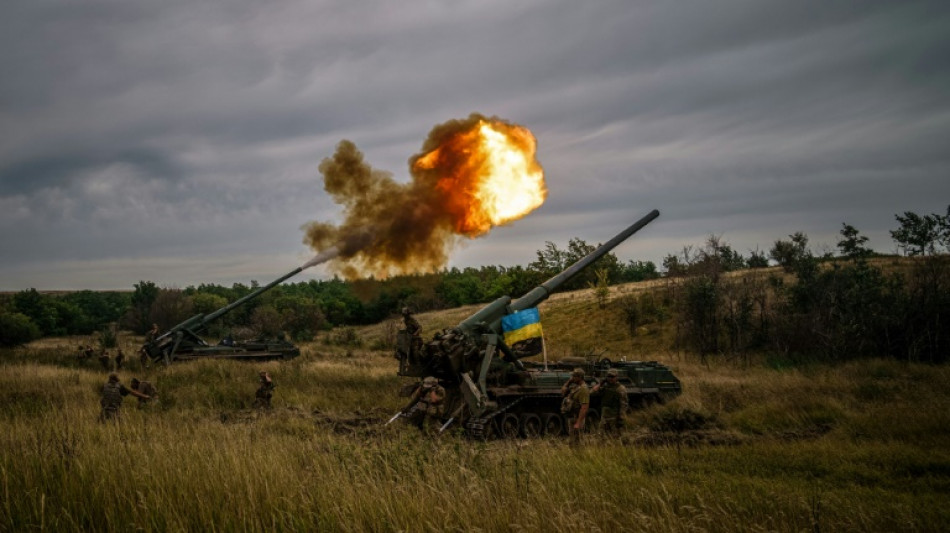
Western arms production to ramp up as Ukraine burns through stockpiles / Photo: Ihor THACHEV - AFP

 Dukascopy Bank Unveils AI-Powered Trading, 25,000+ Stock CFDs and a New Flagship E-Banking App

 Tech firms rally but Asian markets mixed, with eyes on US inflation

 Nepal holds day of mourning as families pray missing still alive

 African players in Europe: Mbeumo fires solo goal as United draw

 Malaysia cancels haze emergency, but warns problems remain
 Philippine sensation Eala looks forward to Asian Games 'fun'
 Jakarta airport extends closure after volcano eruption

 Lonely woman director in Venice sees industry backsliding on gender

 Tech firms rally on mixed day for Asian markets, with eyes on US inflation

 World number one An sends Asian Games warning with China hat-trick

 PSG go for three in a row as Champions League returns

 "Super-human' Alcaraz books US Open quarter-final clash with Shelton

 ECB set to hike interest rates as Iran war flares anew

 AI data centers are less thirsty now, tech giants say

 North Korea vows nuclear-armed navy as US ally drills open

 Under-fire Labuschagne named in Australia Test squad for South Africa

 InterContinental Hotels Group PLC Announces Transaction in Own Shares - September 07

 Best Way to Protect A 401(k) in 2026: Guide Released by Experts

 Tiafoe tops Medvedev in straight sets at US Open

 Zverev seeks US Open last eight as Osaka faces Rybakina

 Alcaraz turns up heat to reach US Open quarters

 Gatti salvages Juve draw with AC Milan in Serie A

 Sinayoko stars as unbeaten Paris FC down Marseille

 Still on top: 'Spider-Man' dominates North American box office

 Zelensky in fresh talks with US envoys: Ukraine official

Western governments are mobilizing their arms manufacturers to ramp up production and replenish stockpiles heavily diminished by supplying Ukraine's six-month-old battle against Russia's invasion.
US Defense Secretary Lloyd Austin announced this week a meeting of senior national armaments directors from allied countries to make long-term plans for supplying Ukraine and rebuilding their own arms reserves.
"They will discuss how our defense industrial bases can best equip Ukraine's future forces with the capabilities that they need," he said at a meeting at Ramstein Air Force Base in Germany of the Ukraine Contact Group, 50 countries currently supporting the war effort.
On Friday, the Pentagon's arms acquisition chief Bill LaPlante said the meeting would take place in Brussels on September 28.
The goal is to determine "how we can continue to work together to ramp up production of key capabilities and resolve supply chain issues and increase interoperability and interchangeability of our systems," LaPlante told reporters at the Pentagon.
- Billions more for arms -
NATO countries do not all have the same weapons, but their arms are compatible. So ammunition manufactured in one country in the Atlantic alliance can be used by another.
At the start of the war, Ukraine's military mostly used weapons and munitions that matched Russian standards. But within a few months those were exhausted -- especially in crucial artillery and missile systems -- and it has grown to depend on Western allies with NATO-standard arms.
But that in turn has drawn down large amounts of munitions the allies had kept for their own defense.
Rebuilding those supplies is now crucial.
In July, the European Union announced 500 million euros for joint purchases over the next two years to replenish arms provided to Kyiv.
The priority is more anti-armor and anti-aircraft missile systems, and 155mm artillery pieces and ammunition.
EU countries "have drawn on their stocks of ammunition, light and heavy artillery, anti-aircraft and anti-tank defense systems, and even armored vehicles and tanks," European Commissioner Thierry Breton said at the time.
"This has created a de facto vulnerability that now needs to be addressed urgently," he warned.
The United States, the primary defense supplier of Ukraine since the war began, has pledged $15.2 billion worth of weaponry, including Javelin anti-tank missiles, artillery and ammunition compatible with NATO weaponry.
- Boosting production -
The Pentagon has furnished some 800,000 155mm artillery rounds to Ukraine, while United States has just one factory making them, the General Dynamics plant in Scranton, Pennsylvania that produces only 14,000 rounds a month.
"We have plans... to get that in increments ultimately up to 36,000 a month in about three years," said LaPlante.
But that would take annual production to just over half of what Washington has given the Ukrainians in less than six months.
The Pentagon wants allies to ramp up their own production lines to help replenish stockpiles.
The US military has recently announced a slew of new contracts with arms manufacturers inside and outside the United States to do this.
It includes $364 million for 250,000 rounds of 155mm artillery ammunition from multiple makers, $624 million for Stinger anti-aircraft missiles, $324 million for Javelin anti-tank missiles, and millions more for other weapons systems, ammunition and defense supplies.
Dave Butler, spokesman for the Pentagon's joint chiefs of staff, said the decision is guided by but not determined specifically by US manufacturing capacities.
"Ukraine's needs for a given weapon are the ultimate driving factor," he said.
T.Sanchez--AT