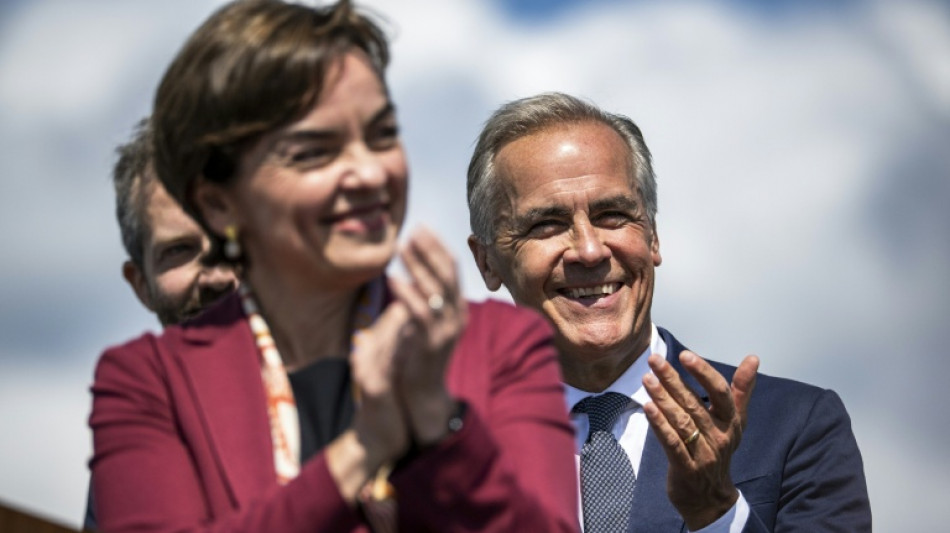
How the French language contributed to the US-Canada trade war / Photo: ANDREJ IVANOV - AFP

 Lufthansa wins contest for TAP Air Portugal stake

 AI worms, 'major' incident fears spur safety calls at industry summit
 Fuel shortage triggers queues on Indonesia's Bali island

 Evolution Metals & Technologies Corp. Reaffirms $400 Million to $460 Million FY2027 Revenue Guidance, Unveils Eight Sintered Magnet Grades Covering an Estimated 75% of Global NdFeB Revenue, and Moves to Answer U.S. Army Call for Rare Earth Magnets

 Trial defence says Russia used Nord Stream pipelines as 'weapon'

 Israeli settlers set fire to mosque in occupied West Bank

 Macron says French student protesters 'exploited' by political forces: spokeswoman

 Stocks diverge ahead of key US inflation data

 Japan summons Russian ambassador to protest journalist's arrest

 Workers to strike at world's largest copper mine in Chile

 Ukraine accuses US of helping Russia as missiles hit Kyiv

 Drone hits data centre of Russia's largest bank

 Bivial AG Brings Its Complete Dashboard to Mobile

 Mont Blanc nearly two metres taller than in 2023: French surveyors

 Pope recovering after lung cancer operation that rattles Church

 Indonesia haze spikes Singapore pollution, shuts East Timor schools
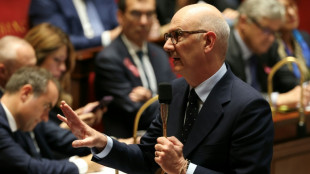 Higher borrowing costs an 'alarm signal' for France: finance minister

 Zelensky accuses Putin of disrespecting Trump after latest attacks
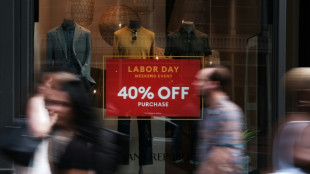
 Japan PM says housework makes her busier than male predecessors

 Top Indian 'cockroach' leaders sent to jail after protest

 Ukraine ex-military officer to stand trial over Nord Stream sabotage
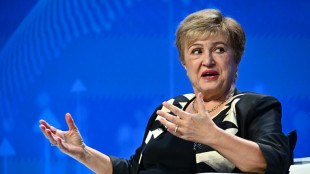 IMF chief says Saudi attacks could have negative spillover 'everywhere'
 Premier League move a Sage decision for new Palace boss

 South Korean FA condemns 'personal attacks' as rift rumours grow

 Japan urges 'impartial treatment' of journalist arrested in Russia

The trade war between the United States and Canada has taken on the flavor of a culture war after the collapse of negotiations last week.
According to Canadian Prime Minister Mark Carney, the dispute with the nation's largest trading partner was not just about tariff demands but what he called unacceptable "threats" to the French language and "Quebec culture."
Those are not typical sticking points in trade negotiations, but emotive ones in Canada, particularly in the French-speaking eastern province of Quebec, which has long sought to preserve its distinct identity.
Carney said Canadian subsidies for Francophone culture, the role of Francophone online media and bilingual labeling of products sold in Canada were among the issues at stake.
He described these as "fundamental rights" and said there was "a huge gap between Canadian and American perspectives."
The prime minister also contended that the US wanted to destroy Canada's automotive, steel and aluminum industries, and restrict Canadian trade deals with other countries.
After the breakdown of talks, Canada now faces additional tariffs on some $20 billion worth of its US exports and double tariffs on Canadian vehicles, while Carney has vowed to match the US tariffs "dollar for dollar."
In Quebec, Carney's decision to break off negotiations was widely supported.
A poll published Sunday by the Angus Reid Institute found that 85 percent of Quebecers supported the move -- the highest approval rate among the 10 Canadian provinces.
"Our identity is not negotiable," Quebec Premier Christine Frechette wrote Sunday in a social media post.
She faces a reelection battle in October and is currently trailing in polls to the leader of a Quebec separatist party.
According to Canadian media, Frechette said Washington wanted concessions on Quebec's rules for appliances and instruction manuals, as well as its law promoting French-language cultural content.
Recent legislation by Quebec allows it to regulate how much French-language content digital platforms offer and how prominently it appears, which can add to the cost of doing business for US companies, the Montreal Gazette reported.
In an interview on Monday, US Trade Representative Jamieson Greer played down the language issue in the trade talks as a "funny fake story."
"What we don't like is a situation where Canada, the federal government, forces American tech companies to take their earnings and give a percentage to their competitors in Canada," Greer told CNBC.
"But I understand why the Quebecois want to have French language content and all of that. And we think that's a really valuable thing."
A.Ruiz--AT