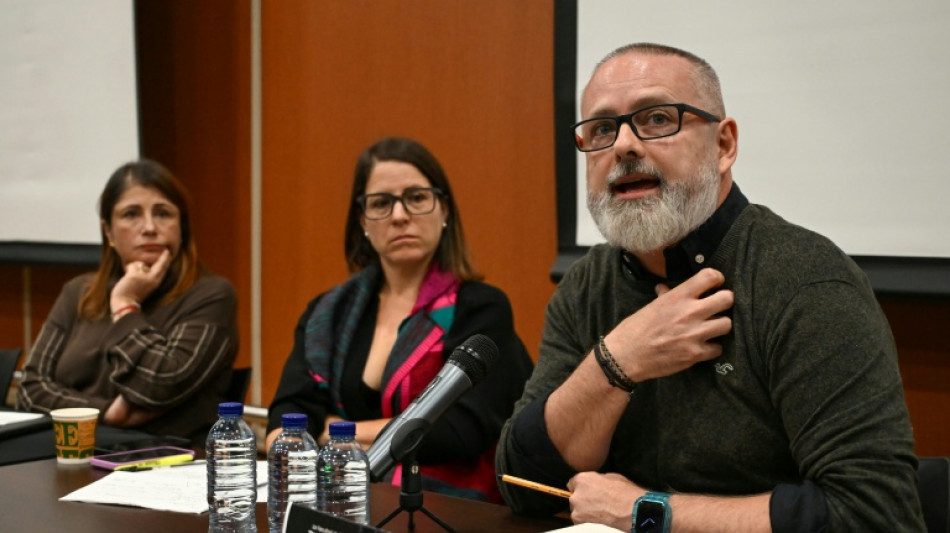
Facebook, TikTok promoted Colombian armed groups' content to recruit children: HRW / Photo: Raul ARBOLEDA - AFP

 Lufthansa wins contest for TAP Air Portugal stake

 AI worms, 'major' incident fears spur safety calls at industry summit

 Fuel shortage triggers queues on Indonesia's Bali island

 Evolution Metals & Technologies Corp. Reaffirms $400 Million to $460 Million FY2027 Revenue Guidance, Unveils Eight Sintered Magnet Grades Covering an Estimated 75% of Global NdFeB Revenue, and Moves to Answer U.S. Army Call for Rare Earth Magnets

 Trial defence says Russia used Nord Stream pipelines as 'weapon'

 Israeli settlers set fire to mosque in occupied West Bank

 Macron says French student protesters 'exploited' by political forces: spokeswoman

 Stocks diverge ahead of key US inflation data

 Japan summons Russian ambassador to protest journalist's arrest

 Workers to strike at world's largest copper mine in Chile

 Ukraine accuses US of helping Russia as missiles hit Kyiv

 Drone hits data centre of Russia's largest bank

 Bivial AG Brings Its Complete Dashboard to Mobile

 Mont Blanc nearly two metres taller than in 2023: French surveyors

 Pope recovering after lung cancer operation that rattles Church
 Indonesia haze spikes Singapore pollution, shuts East Timor schools
 Higher borrowing costs an 'alarm signal' for France: finance minister

 Zelensky accuses Putin of disrespecting Trump after latest attacks

 Japan PM says housework makes her busier than male predecessors

 Top Indian 'cockroach' leaders sent to jail after protest

 Ukraine ex-military officer to stand trial over Nord Stream sabotage

 IMF chief says Saudi attacks could have negative spillover 'everywhere'
 Premier League move a Sage decision for new Palace boss

 South Korean FA condemns 'personal attacks' as rift rumours grow

 Japan urges 'impartial treatment' of journalist arrested in Russia

Facebook and TikTok failed to prevent the spread of content produced by Colombian armed groups to recruit children and in some cases even "appeared to promote these posts," Human Rights Watch reported on Monday.
HRW said the circulation of social media content by armed groups "glorifies life in armed group ranks" and promotes "deceptive job offers."
Since 2021, around 1,500 children have been recruited by armed groups, according to the non-governmental organization.
Armed groups use children for combat, handling weapons, drones and explosives, and intelligence gathering, the HRW report said.
In some cases, children without combat training are used as "cannon fodder," it said.
"Digital platforms must recognize that they are being used for the recruitment of children" which means they are being used to commit crimes, "including committing war crimes," HRW Americas director Juanita Goebertus told a press conference in Bogota.
According to the report, almost half of child recruits are Indigenous children, despite Indigenous people only representing around four percent of the population.
Girls account for around 40 percent of child recruits, and are "particularly exposed to sexual violence."
In the report, HRW described social media posts showing members of armed groups flaunting wads of cash and jewelry.
In other posts, they appear in training camps or listening to "narcocorridos" -- a Mexican music genre which celebrates the exploits of infamous drug traffickers.
"What armed groups do really well on social media is to sell a lifestyle," Mathew Charles, founder of the Mi Historia foundation which works with child victims of conflict, told reporters.
They project "tough-guy masculinity" and the possibility of earning "easy money," he said, calling on the state and other NGOs to combat "these lies and create counter-narratives."
HRW said dissident groups that emerged from the now-defunct Revolutionary Armed Forces of Colombia (FARC) have been responsible for 74 percent of child recruitment cases documented between 2021 and 2025.
HRW said it had informed Meta, Facebook's parent company, and TikTok's owner ByteDance of the problem. Both said they had removed the specific content mentioned.
Meta said it "constantly strives to refine (its) approach to combating" child recruitment efforts across its platforms.
TikTok said it "proactively (prevents) illegal armed groups and organized criminal groups from using TikTok, including to target, exploit or recruit minors."
The historic 2016 peace agreement ended a half-century of war between the government and FARC guerrillas, but remaining armed groups continue to control large swaths of territory in remote parts of Colombia's northeast and south.
Newly inaugurated President Abelardo de la Espriella has vowed to crack down on armed groups and plans to forge a military alliance with the United States and Israel.
A.Taylor--AT