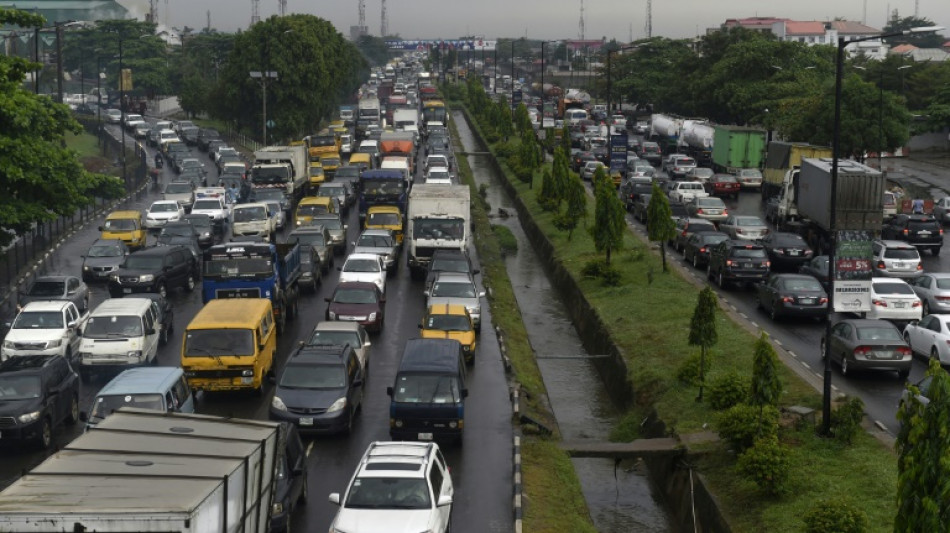
Fossil fuel investment in Africa dwarfs clean air funding / Photo: PIUS UTOMI EKPEI - AFP/File

 LeBron, Sixers spoil Knicks party as NBA season tips off

 Man in court over alleged 'targeted' attack on Australian lawmaker

 Regulator has 'power' to force Man City sale

 Man allegedly behind 'targeted' attack on Australian lawmaker appears in court

 Musk backs SpaceX-Tesla merger as rocket firm turns profit

 Zelensky, US hail 'productive' talks to end Trump feud

 'Unbelievable' Foden back in the groove with treble in Man City rout
 Pistons rally to beat Celtics in NBA 2026-27 season opener
 PSG late show downs Barca in Champions League, Liverpool fight back

 Liverpool strike back to beat Villarreal in seven-goal thriller

 Dow boosted as markets rotate from tech shares

 Zelensky hails resumption of US advance warning of strikes on Ukraine

 Carrick says only wins can ease doubts over Man Utd future

 Top NBA Draft pick Dybantsa to miss opener with ankle sprain
 Italy sends troops, toughens security laws after Milan clashes

 Alberta separatists vow to fight on, risking turmoil for Canada

 Two men re-arrested for suspected spying for Iran in airbase scare: UK police

 Guatemalan man gets 30 years for truck smuggling deaths of 53 migrants
 'Clayface' gets under the skin of the superhero genre

 Zelensky, US envoys hold Oslo talks as Ukraine claims US missile holdup

 All-rounder Minhas stars as Pakistan crush England in tri-series

 Bavuma hits 179, Rabada strikes as South Africa dominate
 Allrounder Minhas stars as Pakistan crush England in tri-series
 Albania PM blames 'hybrid war' for week of unrest

 Bavuma hits 179 to lead South African fightback
Foreign governments are spending more than 30 times more on fossil fuel projects in Africa than on initiatives to lessen the impacts of the continent's second-biggest killer, air pollution, research showed Wednesday.
The report, released on the International Day of Clean Air, showed how little donor nations spend on improving air quality while ploughing money into dirty energy and infrastructure projects across Africa.
The United Nations estimates that air pollution kills around nine million people globally each year, with fossil fuels accounting for two-thirds of the levels of harmful particulates humans are exposed to.
The financial benefits of improving air quality alone would far exceed the costs of slashing emissions to meet the Paris Agreement temperature goals, according to a landmark United Nations climate science assessment this year.
Yet, as Wednesday's analysis by the Clean Air Fund shows, US, European and Asian governments are still going ahead with fossil fuel-based development projects that will likely worsen already poor air quality in cities and along highways across Africa.
The fund found that just 0.3 percent of African countries' development assistance received between 2015-2021 had been specifically earmarked for air quality projects, despite pollution being responsible for some one in five deaths continent-wide.
During the same period, donor nations provided 36 times more funding for prolonging fossil fuel use in Africa.
"That difference alone is extremely startling," Dennis Appiah, head of the fund's Ghana office and a co-author of the report.
"I think it's also highlighted that most often governments are not paying attention to the issue of air pollution," he told AFP.
"Either they are not conscious of the impact of it, or they do not see it as a problem."
Appiah called air pollution a "silent killer" as its effects are far harder to see and message to communities compared with other climate-linked phenomena such as flooding.
- 'Death sentence' -
An ongoing population boom means Africa will be -- on current birth rates -- home to some 2.5 billion people by 2050, with the UN estimating that 26 countries will double their populations by then.
The vast majority of population growth will occur in urban areas, with much of the infrastructure needed to support increases yet to be built.
The continent is virtually blameless for climate change yet continues to be a hotspot for extreme events linked to global heating.
Appiah said that while Africa's development needs were huge, governments needed to prioritise sustainable ways of electrifying and connecting communities.
"Policymakers are stuck in going through the same traditional chain for development that we see in the West, and also in some of the Asian countries that are now suffering the consequences of some of those decisions," he said.
"I think Africa is positioned to take advantage of some of the technology which exists. We don't have to go through the same process (as developed countries), we can leapfrog to new technologies."
With renewable energy such as wind and solar already frequently cheaper than oil and fossil gas per kilowatt hour, the hope is that African governments can factor in the economic benefits of avoiding air pollution into their development plans.
In a preface to Wednesday's report, Ugandan activist Vanessa Nakate said that policies featuring new fossil fuel infrastructure in Africa were "a death sentence for people in communities like mine".
"It's time for governments to hear the voices of people all around the world who are calling for leaders to clean up our air and protect our health," she said.
W.Nelson--AT