Cautious Macron holds advantage in French election

 Sweden centre-left leader fails to form government
 EU economy chief doubtful Russian diesel exports will affect prices

 Capital International Highlights Multilingual Access to Its Platform as European Economic Conditions Diverge

 Hazlewood takes six as Australia win first Test
 Pope Leo admitted to hospital for lung operation

 Hungary cuts anti-LGBTQ measures from Orban-era law
 Tech stocks slump on AI jitters; oil falls
 ePlanet Brokers Publishes H1 2026 Transparency Report and Highlights Best Broker 2026 Award
 Van Gogh work unseen in public for 60 years on show in Hong Kong
 Prosecutors drop most impeachment charges against Philippine VP Duterte
 Hypersonic weapons highlight arms race on the Korean peninsula
 Fiji appoint ex-Springboks boss White as coach ahead of World Cup
 Hungary to reverse Orban-era anti-LGBTQ legislation
 Allen rushes Bills to thrilling 37-34 win over Rams
 India youth shift tactics as police clamp down on election protest
 Malaysia's Firefly extends flight cancellations due to haze
 IMF upgrades 2026 growth forecast but warns of 'split' outlook
 Infantino could pull off 'Houdini' act as critics struggle for candidate
 France braces for fresh nationwide student demonstrations
 Ahead of Israel vote, desert town becomes frontline against ultra-Orthodox expansion
 El Nino Watch: the impacts around the world this week
 Man City, PSG clash at contrasting time for state-backed projects

 HyProMag USA Secures Power and Advances Project Readiness for Texas Recycling Magnet Manufacturing Hub
 Strategic Metals Ltd. Announces Acquisition of Control and Direction of Securities of Trifecta Gold Ltd. And Creation of 11 Additional NSR Royalties

 Moderna to Report Third Quarter 2026 Financial Results on Friday, November 6, 2026
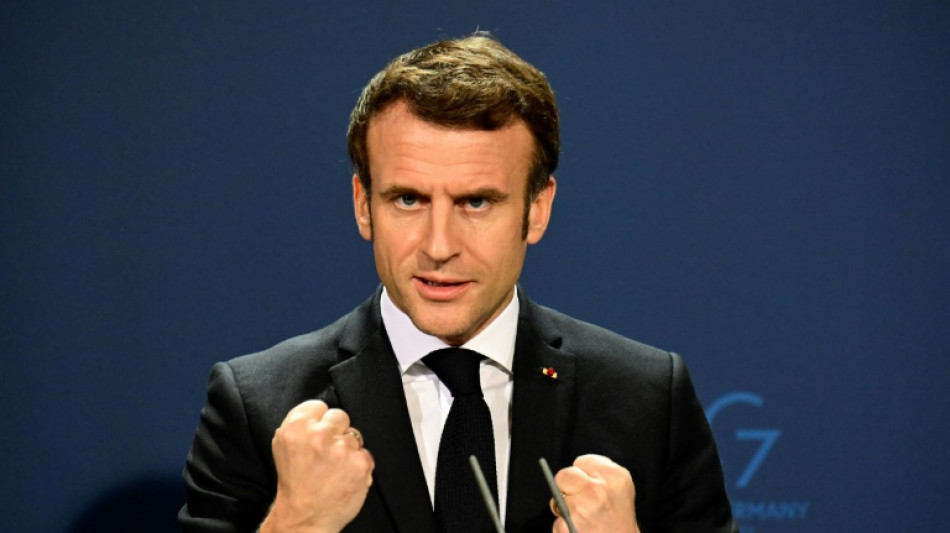
A relatively flat campaign in which opponents have failed to score points is playing into the hands of French President Emmanuel Macron as he bids for a second term, even if much can still change ahead of the April elections.
A cautious Macron, saying he is preoccupied with the Covid pandemic and averting war between Russia and Ukraine, has kept his powder dry by refraining from officially declaring himself a candidate ahead of the first round of voting on April 10.
This has so far done Macron no harm, with opinion polls showing him rock solid in the first round, coming out on top at around 25 percent, and then beating any rival in the run-off two weeks later.
Opposing forces remain sometimes hopelessly divided.
Far-right candidates Marine Le Pen and Eric Zemmour have spent more time trading barbs with each other than firing them at Macron, while the left's chances are stymied by no fewer than five major left-wing candidates ranging from communists to the greens.
The candidate who could potentially cause Macron the most trouble in the second round, the conservative Paris region chief Valerie Pecresse, has lost momentum since her nomination and started to slip in the polls.
Gaspard Estrada, a political scientist at Sciences Po University and a specialist in political campaigning, said Macron was seeking to "keep his opponents at a distance" with his late declaration.
"For the moment, we do not see in the polls a trend that endangers the president," he told AFP.
While Macron appears to be leaving it late with his formal declaration, the strategy is nothing unusual.
In 1965, Charles de Gaulle declared only a month before the polls, a tactic repeated successfully in 1988 by Francois Mitterrand.
"President Macron is very stable, he neither goes up nor down in his voting intentions. I therefore think that he has every interest in being the master of the timetable and in not having an agenda imposed on him by the other candidates," Estrada said.
The latest poll published Monday, by Ifop-Fiducial, showed Macron on 25 percent –- remarkably stable for a president who won 24 percent in the first round of 2017 –- and Pecresse slipping to 15.5 percent.
It also projected that Macron would easily win a run-off, whether it was against Pecresse or Le Pen.
"All these balances can still be upset but, at this stage, a vote for Emmanuel Macron is taking on the appearance of a default choice," said the Le Monde daily.
- 'Reshuffle the cards' -
After rising to power five years ago as his country's youngest-ever president, Macron, who is still only 44, knows that winning a second term is crucial to his ambitions of reforming France and Europe -- as well as securing a place in French history.
Victory would see him become the first French leader to be re-elected since Jacques Chirac in 2002, after the presidencies of Nicolas Sarkozy and Francois Hollande ended as single-term disappointments.
Analysts warn he would be wise to steer clear of complacency as there remains an element of uncertainty, with polls showing many voters yet to make up their mind and the numbers of those not casting ballots also not clear.
Even as Macron plays the statesman with trips to Moscow and Kyiv, his camp has not been inactive, with a campaign website already set up and the president receiving the 500 endorsements from elected figures needed by any candidate.
"For the time being –- whether we are talking about if people vote and who they vote for –- we are on shifting sands and we need to have the final distilled offer made clear for people to decide," said Anne Jadot, a lecturer in political science at the University of Lorraine.
The requirement to have 500 endorsements from elected officials such as MPs or local councillors is proving a real headache for some of the more upstart candidates, especially Zemmour. Only Macron has surmounted this barrier so far.
This has prompted speculation that some could fall by the wayside by the time France's Constitutional Council announces the final list of candidates on March 7, after a March 4 deadline to present the endorsements.
Even Le Pen has said winning the endorsements is proving harder than in 2017.
"The elimination of a significant candidate due to insufficient endorsements would reshuffle the cards," Jadot told AFP.
A survey by Kantar Public and Epoka published Friday showed that 20 percent of the electorate were likely to vote but had not made up their minds, while 19 percent indicated they would abstain.
"This survey confirms that there is still a great deal of uncertainty," Emmanuel Riviere, director of international studies at Kantar, told AFP.
"Today we see that there is greater fluidity in the electorate because fewer and fewer people feel close to a political party," he said.
A.Williams--AT