US approves $1.1 billion in arms for Taiwan, angering China / Photo: Sam Yeh - AFP

 Sabalenka surges past Townsend to reach US Open quarter-finals

 Smiling face of Germany's far-right AfD: Ulrich Siegmund

 Lebanon president calls for US help as Israeli strikes kill 7

 Yamal hits double as perfect Barca thrash Valencia

 Venice festival turns gaze on war reporters, media industry

 Sensational Antonelli wins Italian GP from back of grid

 Susan Sarandon says still losing roles over Gaza stance

 US envoys hold 'important' talks in first trip to Kyiv

 Championship leader Antonelli wins Italian Grand Prix
 Vardy signs for Championship strugglers Burnley
 FIFA confirms Infantino will run in presidential election

 With joy and grief, Palestinian football marks return

 Iran threatens greater force if US launches more attacks
 Vandals uproot Berlin tree commemorating Pride attack victims

 Trump envoys arrive in Kyiv for first Ukraine visit

 Indonesia's main airport suspends operations after volcanic eruption

 US aircraft carrier departs Thailand after port call

 Haze emergency grips Malaysian Borneo town
 Messi creates both Miami goals in 2-2 draw with Atlanta
 Rybakina books US Open fourth-round berth, inches closer to No. 1

 Sobering reality: Curbs on alcohol in northeast Syria cause discontent

 Wobbly Osaka 'shocked' to battle past Mertens and reach last 16

 Indian Oscar-nominated filmmaker turns camera on his cancer

 Argentina 'let off hook' by Australia as Kiss's winning run ends
 Argentina threatens to sanction oil projects around Falklands

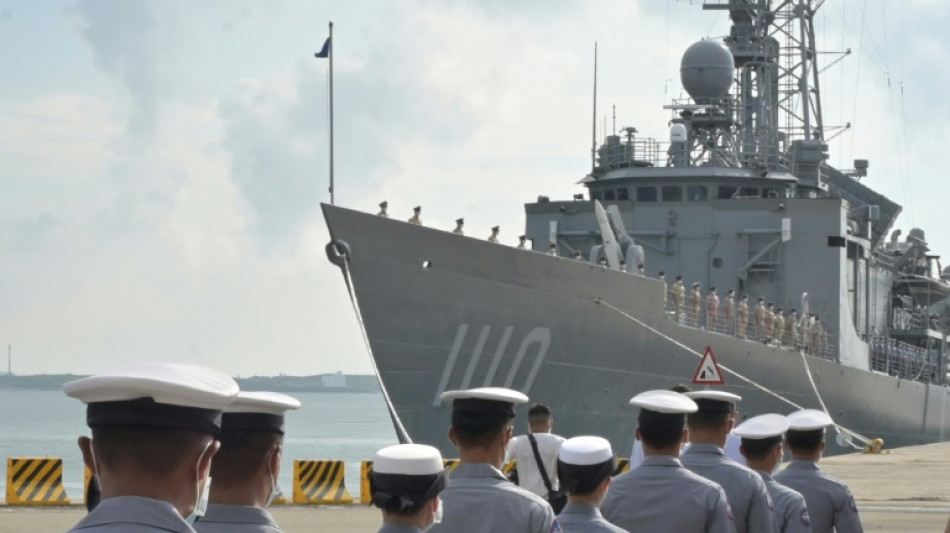
The United States on Friday announced a $1.1 billion arms package for Taiwan, vowing to keep boosting the island's defenses as tensions soar with Beijing, which warned Washington of "counter-measures."
The sale comes a month after House Speaker Nancy Pelosi defiantly visited the self-governing democracy, prompting mainland China to launch a show of force that could be a trial run for a future invasion.
The package -- the largest for Taiwan approved under President Joe Biden's administration -- includes $665 million for contractor support to maintain and upgrade a Raytheon early radar warning system in operation since 2013 that would warn Taiwan about an incoming attack.
Taiwan will also spend some $355 million to buy 60 Harpoon Block II missiles which can track and sink incoming vessels if China launches an assault by water.
The arms also include $85.6 million for more than 100 Sidewinder missiles, a mainstay of Western militaries for their air-to-air firepower.
The announcement comes one day after Taiwanese forces shot down an unidentified commercial drone amid a sudden spate of mysterious incursions that have unnerved the island following the earlier show of force by Beijing, which said it fired ballistic missiles over the capital Taipei.
China, calling Taiwan an "inalienable" part of its territory, called on the United States to "immediately revoke" the arms sales.
"It sends wrong signals to 'Taiwan independence' separatist forces and severely jeopardizes China-US relations and peace and stability across the Taiwan Strait," said Liu Pengyu, spokesman for the Chinese embassy in Washington.
"China will resolutely take legitimate and necessary counter-measures in light of the development of the situation," he said.
- 'Essential' for Taiwan -
A spokesperson for the State Department, which approved the sale, said the package was "essential for Taiwan's security" and stressed that the United States still recognized only Beijing and not Taipei.
"We urge Beijing to cease its military, diplomatic and economic pressure against Taiwan and instead engage in meaningful dialogue with Taiwan," the spokesperson said.
The sales "are routine cases to support Taiwan's continuing efforts to modernize its armed forces and to maintain a credible defensive capability," the spokesperson said on condition of anonymity in line with protocol.
"The United States will continue to support a peaceful resolution of cross-Strait issues, consistent with the wishes and best interests of the people on Taiwan," he said.
The sale needs the approval of the US Congress, which is virtually assured as Taiwan enjoys strong support across party lines.
Ahead of the visit of Pelosi, who is second in line to the White House, Biden officials quietly made the case to China that she did not represent the administration policy as Congress is a separate and equal branch of government.
The weapons approval, by contrast, clearly comes from the Biden administration although it is consistent with sales since 1979 when the United States switched recognition to Beijing but agreed to maintain Taiwan's capacity for self-defense.
Biden, on a trip to Tokyo in May, appeared to break with decades of US policy by saying the United States would defend Taiwan directly if it is attacked although his aides later walked back his remarks, insisting that US policy remained ambiguous.
China considers Taiwan a province awaiting reunification, by force if necessary. China's nationalists set up a rival government in Taiwan in 1949 after losing the mainland's civil war although the island has since blossomed into a vibrant democracy and major technological hub.
Russia's invasion of Ukraine has raised growing questions on whether China may follow suit in Taiwan and whether the island is equipped to defend itself.
In a July appearance, CIA chief Bill Burns said that Chinese President Xi Jinping was still determined to assert control over Taiwan but that Russia's woes in Ukraine may have prompted Beijing to wait and make sure it can have an overwhelming military advantage.
N.Mitchell--AT