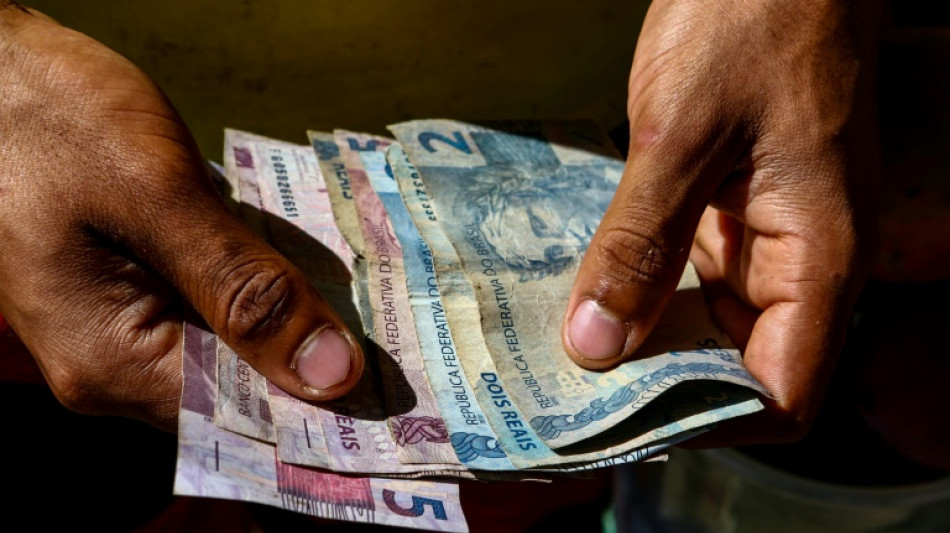
Amid financial uncertainty, Brazilians prepare to vote / Photo: Rafael MARTINS - AFP

 Championship leader Antonelli wins Italian Grand Prix
 Vardy signs for Championship strugglers Burnley
 FIFA confirms Infantino will run in presidential election

 With joy and grief, Palestinian football marks return

 Iran threatens greater force if US launches more attacks
 Vandals uproot Berlin tree commemorating Pride attack victims

 Trump envoys arrive in Kyiv for first Ukraine visit
 Indonesia's main airport suspends operations after volcanic eruption

 US aircraft carrier departs Thailand after port call

 Haze emergency grips Malaysian Borneo town
 Messi creates both Miami goals in 2-2 draw with Atlanta

 Rybakina books US Open fourth-round berth, inches closer to No. 1

 Sobering reality: Curbs on alcohol in northeast Syria cause discontent

 Wobbly Osaka 'shocked' to battle past Mertens and reach last 16

 Indian Oscar-nominated filmmaker turns camera on his cancer
 Argentina 'let off hook' by Australia as Kiss's winning run ends
 Argentina threatens to sanction oil projects around Falklands

 Gauff into round four at US Open after straight-set win

 Bordeaux hammer Racing in Top 14 start as Bielle-Biarrey extends deal

 Zheng, Potapova pull off upsets to reach US Open last 16

 Swiatek into US Open fourth round in tight two-setter
 Werro wins in Brussels, as Russell and Dos Santos shine
 Kolbe breaks jaw and shoulder injury sidelines Savea

 US military strikes oil tankers as Iran vows tougher reprisals

 Zheng rallies to stun Keys, Anisimova out in US Open third round
At a market in Sao Paulo, Celia Silva counts her cash, hoping Brazil will soon be "back on track" and she will no longer struggle to make ends meet.
The 61-year-old marketing analyst is not alone: a majority of Brazilians will be thinking of their own pocketbooks first when they cast ballots in presidential elections next month.
According to a Datafolha poll, the economy will be the top issue for 53 percent of Brazilians as they choose among candidates including far-right incumbent Jair Bolsonaro and leftist ex-president Luiz Inacio Lula da Silva.
The largest economy in Latin America has shown recent signs of recovery after being hit hard by the coronavirus pandemic.
It registered growth of 1.1 percent in the first quarter and 1.2 percent in the second after advancing 4.6 percent in 2021 compared to 2020, when the economy declined 3.9 percent.
These figures, coupled with a drop in unemployment to 9.1 percent and a 0.68 percent decline in inflation in July, are campaign gold for Bolsonaro, who insists they prove Brazil is "better than many other countries" in a gloomy global context.
As economic metrics have improved, so has Bolsonaro's standing in the pre-election opinion polls.
But Datafolha figures released Thursday showing Lula still garnering more favor, with 45 percent of the vote intention, compared to 32 percent for Bolsonaro.
In July, the difference was 18 points.
- 'Worst is over' -
"The worst is over: there is an improvement in the economy and employment recovered faster than expected," said Igor Barenboim, chief economist of the consulting firm Reach Capital.
In the three months to July, unemployment reached a near seven-year low of 9.1 percent, down from 13.7 percent in the same period in 2021.
But the effects are not yet always apparent in Brazilian households.
"The average real wage of the Brazilian (2,693 reais, about $540 per month) is at one of the worst levels in a decade," said Andre Perfeito of the Necton consultancy.
Despite slowing in July, year-on-year inflation was at 10.07 percent and has been in the double digits since September last year.
The July drop, said Perfeito, was largely due to fuel and electricity price cuts backed by the government of Bolsonaro, with his eye on re-election.
But food inflation continued a relentless climb to reach 14.72 percent over the 12 months to July, aggravating the scourge of hunger.
"There have never been so many hungry people in Brazil," said Paulo Feldmann, professor of economics at the University of Sao Paulo.
"Brazil is today above the world average... Sixty percent of the population today suffer from food insecurity," he added.
While Bolsonaro publicly denies a hunger crisis, Lula could benefit from public anger over the issue, Feldmann said.
When Lula was president from 2003 to 2010, some 30 million Brazilians emerged from poverty, according to official data.
- No more chicken feet -
But the left is up against the government machine.
For the period August to December this year, the government has increased allowances under an aid program started during the Lula presidency from 400 reais (about $80) to 600 reais ($120) per month for more than 20 million poor families.
It has also increased gas subsidies and expanded truck drivers' benefits.
Amid these announcements, perceptions about the economy improved, with 58 percent of Brazilians polled expecting their finances to improve in the coming months, according to Datafolha.
The market forecast for 2022 economic growth for Brazil has increased from 0.28 percent in January to 2.1 percent, according to the latest central bank survey.
This was due in large part due to higher global prices for commodities, of which Brazil is a major exporter.
But analysts warn of a fiscal mismatch caused by increased public spending.
A big question is whether the fiscal debt, at 77.6 percent of GDP, "will follow an explosive trajectory," said Barenboim.
At the Sao Paulo market, shoppers are clear about their voting intention.
Edelzuita Ferreira, a 71-year-old pensioner, falls in the Lula camp.
"If Lula wins, it will be easy, we will be able to eat meat again. With Bolsonaro, we are eating chicken feet," she told AFP.
But Adriana Do Prado, 38, will opt for Bolsonaro.
"We are only standing today thanks to the things he (Bolsonaro) did during the pandemic," she said, underlining the president's refusal to shutter public establishments, such as the restaurant she runs, as a Covid preventative measure.
"If it wasn't for him, I would have had to close," said Do Prado.
T.Sanchez--AT