Saving Gaza's past, one artefact at a time / Photo: Bashar Taleb - AFP

 How young is too young as child prodigies win big at Asian Games

 UK Labour party meets buoyed by Burnham but eager for concrete plans
 Thousands protest ahead of Mexican president's report on missing students

 Bangkok floods force thousands into shelters

 AI startup urges optimism from Europe despite safety fears

 'Godlike, invincible': Japan hails 11-year-old Games history-maker

 Nepal's hydropower ambitions face climate reality check

 Power cuts, rubble: millions come home to find Sudan's capital unlivable

 Internationals keep Presidents Cup lead with late fightbacks

 Tuchel to 'keep pushing' England to reach Spain's level

 Alcaraz saves match points to keep Europe ahead in Laver Cup
 Spain success driven by hunger to improve, says De La Fuente

 Lyon collapse at Stade Francais to suffer first Top 14 loss
 Oyarzabal and Spain sink England again as Modric shines for Croatia

 Housing protesters camp in central Madrid after mass demonstration

 Louise Trotter expands her palette at Bottega Veneta

 Pope prays at Lourdes after huge Paris mass

 USA trims International lead after Presidents Cup four-balls

 Russia accuses Europe of blocking Ukraine talks, as strikes drag on

 'He said hello': Families pray with pope on Paris avenue

 Pope celebrates giant Paris mass, flies to Lourdes

 Thousands march in Madrid over eviction of 87-year-old woman
 England women back to winning ways with last-gasp defeat of New Zealand

 Trump rejects Iran proposal for deal to reopen Hormuz

 England's Cox says injured Buttler leaves 'big shoes to fill'
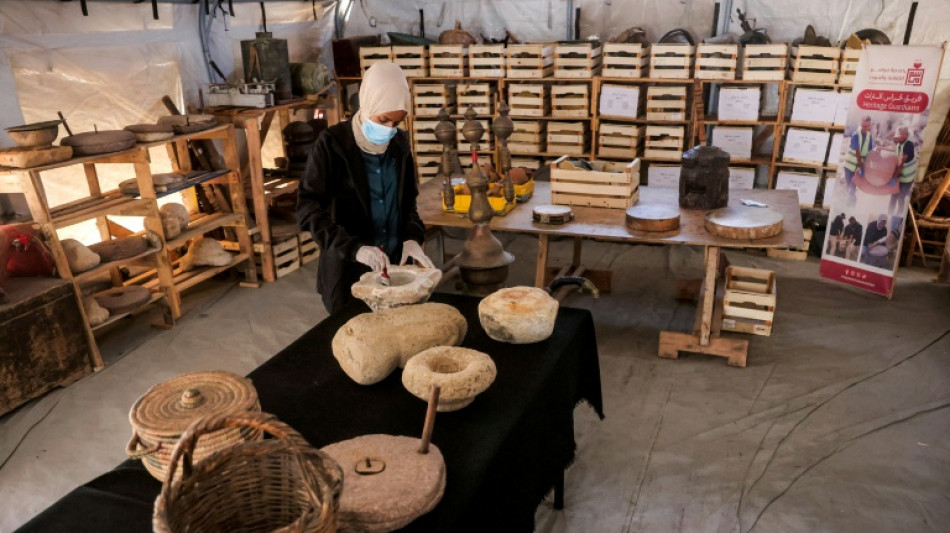
Armed with paintbrushes and wearing surgical gloves, volunteers inside a large tent in Gaza delicately brushed dust from a stone mosaic before placing it into storage, part of an effort to preserve cultural heritage hit by war.
More than 160 historic and cultural sites across the Palestinian territory have been damaged during the conflict between Israel and Hamas, according to the United Nations.
Many of these artefacts date back thousands of years.
"Several mosaic artworks have been lost or destroyed, either completely or partially," said Mohammed Abu Lahia, a Palestinian visual artist taking part in the preservation efforts in the south Gaza city of Khan Yunis.
"It is important that we work to revive this art, remind our children and our community, and send a message to the world that we are committed to our heritage and our Palestinian cause."
Beyond archaeological treasures, more recent cultural artefacts are also at risk of being damaged or buried beneath rubble from shelling and airstrikes.
More than 90 percent of Gaza's buildings have been damaged or destroyed during the conflict, according to the UN.
Over the centuries, Persians, Greeks, Romans, Byzantines and Ottomans all left their mark on Gaza, creating a rich historical landscape of churches, mosques, ports and artefacts, many of which have suffered damage during the conflict.
"This stone is a piece called a mortar, and it was used for grinding grains and herbs. It is approximately 5,000 years old," said Muhannad Abu Lahia, a cultural heritage guide with the Mayasem Association for Culture and Arts, the NGO leading the preservation efforts.
Behind him, artefacts already catalogued for safekeeping were stacked on wooden shelves inside weatherproof plastic containers.
- Preserving the past -
With Israel maintaining tight controls over goods entering the Gaza Strip -- restrictions that have at times contributed to severe shortages of food and other supplies -- volunteers have had to work without professional conservation equipment.
Instead, they gently removed dust from mosaics using ordinary paintbrushes and built a makeshift scanning station by mounting a camera above a box lined with black craft paper.
The improvised scanner allowed volunteers to digitise old photographs and paper documents, which were then uploaded to a computer for preservation.
Not everything entering storage is ancient.
Many items date from the 20th century, including the late Ottoman period, the British Mandate and the Egyptian administration. Their owners sought to save them from destruction or loss after being displaced.
"This is a paper archive containing maps of Khan Yunis and structural maps of the Khan Yunis area from the time of the British Mandate," said 29-year-old volunteer Taghreed Hajjari.
At one table, three women painstakingly rearranged hundreds of fragments to recreate a contemporary mosaic, using a printed copy of the original artwork as a guide and trimming excess stone with carpenter's pincers.
Many artefacts, however, remain beyond the so-called "Yellow Line", which separates territory under Hamas control from areas held by the Israeli forces.
Israel says it now controls more than 60 percent of the Gaza Strip, up from about half when the ceasefire took effect in October last year.
Volunteers say retrieving artefacts from Israeli-controlled areas remains extremely difficult.
Meanwhile, Hajjari said efforts continue to preserve everything still within reach, including documents that chronicle centuries of Gaza's history.
"We also have newspapers and documents here from the British Mandate and the Egyptian era until the arrival of the Palestinian Authority," she said.
"They were collected through visits and conversations with elderly residents.
"We documented their oral histories so they can serve as a reference for future generations."
A.O.Scott--AT