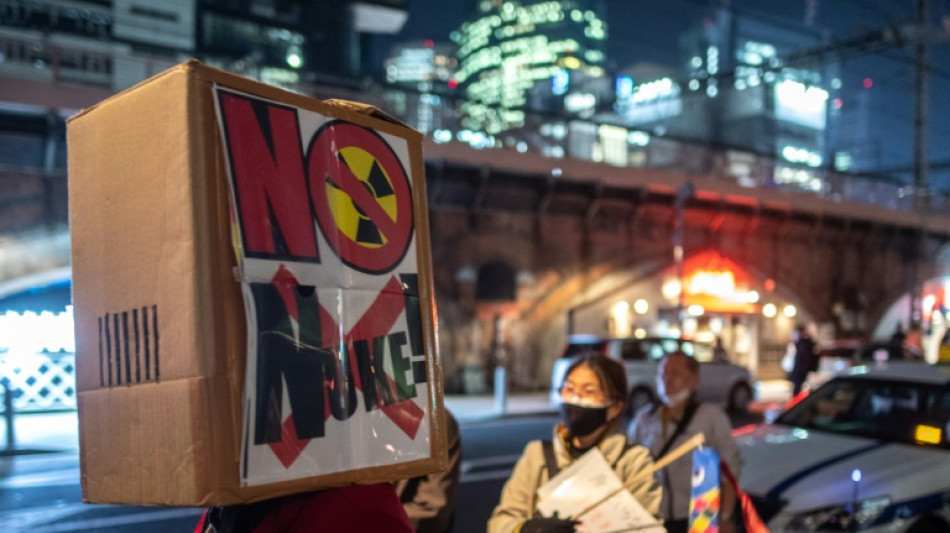
Japan PM eyes nuclear power push to combat energy crunch / Photo: Philip FONG - AFP

 Argentina threatens to sanction oil projects around Falklands

 Gauff into round four at US Open after straight-set win
 Bordeaux hammer Racing in Top 14 start as Bielle-Biarrey extends deal

 Zheng, Potapova pull off upsets to reach US Open last 16

 Swiatek into US Open fourth round in tight two-setter
 Werro wins in Brussels, as Russell and Dos Santos shine

 Kolbe breaks jaw and shoulder injury sidelines Savea

 US military strikes oil tankers as Iran vows tougher reprisals

 Zheng rallies to stun Keys, Anisimova out in US Open third round

 Bayern held to draw by stubborn Schalke
 Lens lose again ahead of Champions League date

 Olympic champion Zheng storms home to reach US Open last 16
 Big-spending Spurs must make better attacking decisions, says De Zerbi

 South Africa dominate New Zealand in second half to lead series

 Kiefer Sutherland still in action, but ibuprofen lending helping hand

 'Are we ready?' Oasis film captures band's frosty reunion

 Commemoration held for late Bosnian Serb war criminal Ratko Mladic
 Haaland keeps new-look Man City perfect in Premier League, blunt Spurs held
 Alpine's Gasly takes shock pole for Italian Grand Prix

 Nwaneri helps Dortmund to comeback win on Bundesliga debut
 US military says destroys Iranian oil tankers after missile attacks
 US envoys in Moscow for Ukraine war negotiations

 Commemoration held for late Serbian war criminal Ratko Mladic

 Russell on top ahead of Hamilton in final Italian GP practice

 Motorsport governing body rejects Alpine boss's claims of impartiality

Japan's prime minister on Wednesday called for a push to revive the country's nuclear power industry in a bid to tackle soaring imported energy costs linked to the Ukraine war.
Such a move could prove controversial after the 2011 Fukushima disaster led to the suspension of many nuclear reactors over safety fears.
But like many countries, Japan -- which is aiming to become carbon neutral by 2050 -- has faced a squeeze on its energy supplies since Russian forces entered Ukraine six months ago.
"Russia's invasion of Ukraine has vastly transformed the world's energy landscape" and so "Japan needs to bear in mind potential crisis scenarios", Prime Minister Fumio Kishida said at an energy policy meeting.
Japan should consider building next-generation nuclear reactors, he said, while the government will also discuss bringing more nuclear plants online and extending the service life of reactors if safety can be guaranteed.
Kishida called for "concrete conclusions by the end of the year" on the topic, which remains a sensitive one after a deadly tsunami in March 2011 caused a meltdown at the Fukushima plant, the world's worst nuclear disaster since Chernobyl.
Eleven years on, 10 of Japan's 33 nuclear reactors are back in action, although not all are operational year-round, and the country is heavily dependent on imported fossil fuels.
The national nuclear safety watchdog has approved in principle the restart of seven more reactors, but those moves often face opposition from local communities.
- 'Politically challenging' -
"In addition to securing the operations of the 10 reactors that are already back online, the government will spearhead an effort to do all it takes to realise the restart" of the others whose safety has been approved, Kishida said.
The prime minister, who joined the meeting remotely after testing positive for Covid-19, also urged policymakers to consider "constructing next-generation nuclear reactors equipped with new safety mechanisms".
Before the Fukushima disaster, a third of Japan's power generation came from nuclear sources, but in 2020 the figure stood at less than five percent.
Tom O'Sullivan, a Tokyo-based energy consultant at Mathyos Advisory, said building next-generation reactors in Japan would be a "major step", because "all the current reactors are conventional ones".
Bringing more existing nuclear plants online will need to be approved by local governors, which could prove "politically challenging", O'Sullivan told AFP.
"But again, there's a different environment now after the Ukraine war," he said.
For the Japanese public, "I don't think it's just the electricity costs. It's the reliance on Russia, for natural gas, oil and coal... the Japanese public have really woken up to that."
The price of Japanese shares related to nuclear power surged in afternoon trade as local media reported the possible plans, with Tokyo Electric Power ending up 9.96 percent and Mitsubishi Heavy Industries jumping 6.85 percent.
Japan has imposed sanctions on Russia over the war in Ukraine along with other G7 countries.
The government has also pledged to make efforts to reduce its energy dependency on Russia, which supplies around eight percent of Japan's LNG needs.
N.Mitchell--AT