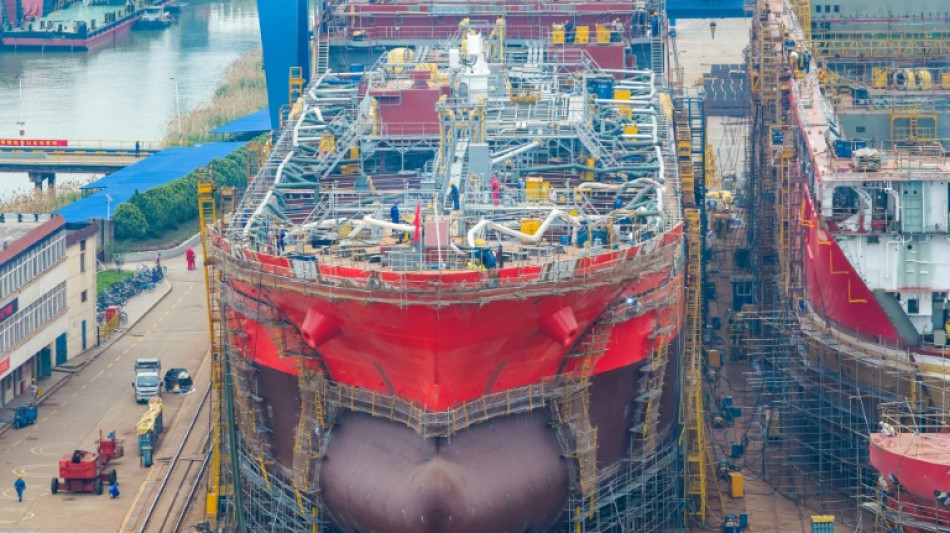
Huge state subsidies give China unfair edge over foreign rivals: OECD / Photo: - - CN-STR/AFP

 All contenders for UN chief receive veto: diplomat

 UN climate panel fails to agree date for global warming update: envoy

 Stocks struggle to bounce back from AI angst-fueled rout

 Clashes grip Tirana as Albanian PM blames 'foreign hands'

 End of a dynasty? Dodgers digest playoff drubbing

 Troyes sack sporting director Blanchard amid sexism claims

 Trump's new press secretary out after less than week

 EU backs Ukraine on Starlink, but can't fill gap

 Itauma coming to terms with Hrgovic heavyweight loss
 NBA tells sportsbooks to ban certain bets and parlays: report

 US influence, AI and mistrust cloud Alberta independence vote

 Pant, Bumrah named in India Test squad for New Zealand tour

 Coen brothers say they plan to make film together again

 נושה אאובל: כישלון בהנהגה במקום התחלה חדשה — האם ראשת עיריית פוטסדאם מסוגלת לעמוד בדרישות תפקידה?

 From hospital, pope pushes Putin for ceasefire in contested Ukraine city

 King of the Mountains Carapaz joins NSN Cycling team
 S.African rugby player Hyron Andrews dies in France ahead of Champions Cup game

 Maresca says Man City 'more together' after financial charges

 Zelensky drums up European backing as Trump ties slump

 Food crisis 'looming' after global energy shock, UN agriculture fund says

 'Sportswashing' or investment? Rwanda F1 stirs debate and doubts

 Stocks mostly bounce back after rout fuelled by AI angst
 Italy braces for 'autumn of discontent' as students protest

 Flick confirms return of Barcelona duo Raphinha, De Jong

 Pope celebrates mass in hospital after cancer operation

Chinese companies in 15 key industrial sectors received vastly more state support than their international competitors between 2005 and 2024, according to an OECD report released on Monday.
The 15 sectors received $108 billion in 2024 alone, according to data compiled by the Organisation for Economic Cooperation and Development in its Manufacturing Groups and Industrial Corporations (MAGIC) database.
Between 2005 and 2024, it added, "Chinese firms received on average three to eight times more government support than firms based in the OECD, a conservative estimate."
"These subsidies were also considerably higher than the support received by firms based in non-OECD economies such as Brazil, India and Indonesia."
The Paris-based organisation of 38 member countries said its "conservative" estimate was based on disclosures by the biggest companies in the 15 sectors, which underpin entire segments of the global economy.
It considers direct subsidies, tax breaks and favourable loans from banks and public financial institutions -- at times below their base lending rates -- to be public support.
"For Chinese firms, almost 60 percent of their global market share gains can be explained by the subsidies they received," the OECD said.
Chinese firms have carved out huge market shares over 20 years in sectors such as solar panels, shipbuilding and steel, not because they are better than their US or European competitors but because of their unparallelled state support, it added.
- Effect of subsidies -
With subsidies, they have more financial leeway to invest in new production sites, more time to reach profitability and greater support against economic headwinds, according to the report.
This has led to overcapacity in some sectors, pushing down global prices to the detriment of other international players.
"Just like doping in sports, the risk is that subsidies help less productive players win unfairly at the expense of better, more innovative and more efficient ones," the OECD's Secretary-General Mathias Cormann told a press conference.
"Subsidies increased market share but that did not lead to significant gains in productivity or profitability," Cormann added.
"Firms won market share not by being more efficient or more innovative but by being more heavily subsidised."
The OECD looked at aerospace and defence; aluminium; car manufacturing; cement; chemicals; fertilisers; glass and ceramics; heavy machinery; semiconductors; shipbuilding; photovoltaic panels; steel; telecommunications equipment; rolling stock; and wind turbines.
Worldwide state support in these sectors reached its highest level since the 2008 financial crisis in 2023-24, amounting on average to 1.3 percent of companies' revenues in 2024.
The OECD noted that the peak observed in 2009 coincided with a severe global recession, which was not the case in 2023-24.
That "indicates the recent increase in industrial subsidies to be more structural", it added.
O.Ortiz--AT