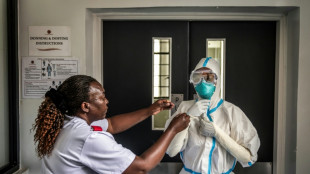
Final talks begin on missing piece for pandemic treaty / Photo: JOHAN ORDONEZ - AFP

 Oregon families grapple with explaining school shooting to children
 Israeli settlers attack European diplomats, beat French mayor

 Town hall in Limoges 'largely lost' to blaze set during French protests
 US goes on the offensive in central Asia

 Emotional Lions come up short in Champions Cup as tributes paid to Andrews

 Diaz dazzles as Bayern batter Leipzig to go top

 Inter move clear at Serie A summit with Bologna win

 Liverpool still have 'lots to improve', says match-winner Isak

 Looters ransack shops during France cost-of-living protests

 Leinster thump Clermont as grieving Lions set for Champions Cup debut

 Haaland stars in Man City win, Liverpool beat Brentford

 Dortmund go top despite Union Berlin stalemate
 Venezia upset Napoli for first Serie A win of season
 Glasgow and Bulls win as grieving Lions set for Champions Cup debut

 Smiling pope returns to Vatican after cancer surgery

 In-form Atletico scrape late win at Espanyol
 Rabada returns as S.Africa seek to bounce back against Australia

 Zverev, Medvedev ousted with Spaniards to clash for Shanghai title

 French protesters clash with police during nationwide demonstrations
 Zelensky says Trump could lift more Russia sanctions

 Jayawardene quits as coach of five-time IPL winners Mumbai
 World number 170 Kartal battles past Ostapenko to reach Wuhan final

 Pope to return to Vatican after cancer surgery

 Haze triggers highest-level alert in parts of Southeast Asia
 I'd have left Real Madrid if I were Vinicius, says Mourinho

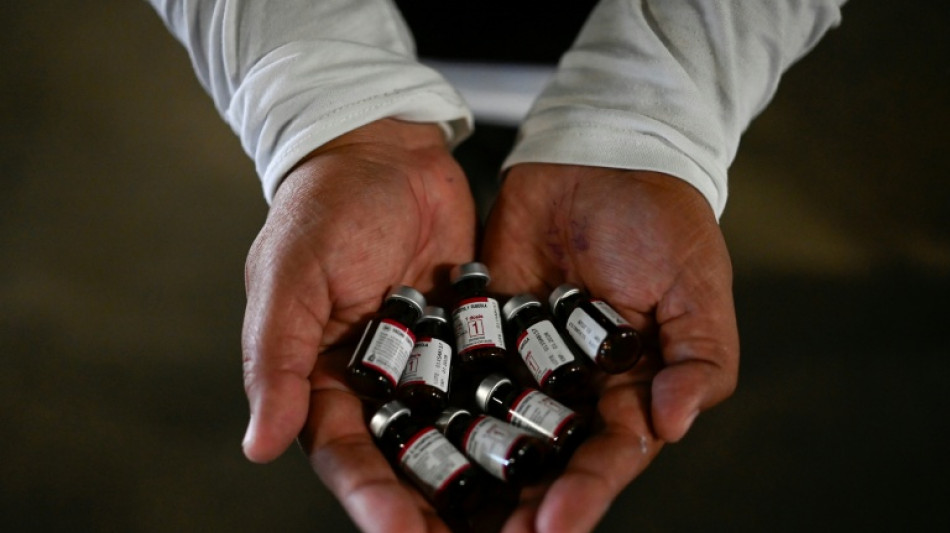
An extra week of negotiations to complete the crucial missing piece of an international agreement on handling future pandemics kicks off Monday at the WHO, with sharp divisions holding up an accord.
Wealthy countries and developing nations are at loggerheads in the World Health Organization talks over how the pandemic treaty, adopted last year, will work in practice.
The agreement's Pathogen Access and Benefit-Sharing (PABS) system deals with sharing access to pathogens with pandemic potential, then sharing the benefits derived from them: vaccines, tests and treatments.
"Developing countries are voicing their mistrust, fearing they will share their viruses without any guarantees of equitable access to vaccines in the event of a crisis," WHO chief scientist Sylvie Briand told AFP.
Meanwhile other countries are asking whether the pharmaceutical industry would have the capacity and motivation to contribute to a global pandemic agreement "without a guarantee of return on investment", she said.
Another challenge, she said, was "to integrate the sharing of genetic data, now as crucial as that of physical viruses for developing vaccines, treatments, and diagnostics".
- 'Very hard' -
In May 2025, WHO member states adopted a landmark pandemic agreement on tackling future health crises, after more than three years of negotiations sparked by the shock of Covid-19.
The accord aims to prevent future pandemics from the disjointed responses and international disarray that surrounded the coronavirus crisis, by improving global coordination, surveillance and access to vaccines.
But PABS, the heartbeat of the treaty, was left on the side in order to get the bulk of the deal over the line.
Countries have been given one final week, through Friday, to negotiate PABS, with an eye on getting it approved during the World Health Assembly of WHO member states, which opens on May 18.
Jean Karydakis, a diplomat at Brazil's mission in Geneva, said he thought a deal was possible even if the differences were "by no means negligible."
"Progress has been slow" and finding compromise "will be very hard", though the European Union was now "making an effort to demonstrate some flexibility", he said.
PABS is considered crucial by developing states, particularly in Africa, where many countries felt cut adrift in the scramble for Covid-19 vaccines.
However, there are nuances between their positions. Some emerging economies like South Africa want technology transfers, while the poorest countries are focusing primarily on access to healthcare products.
Adeel Mumtaz Khokhar, from Pakistan's mission, said the negotiations had been "quite challenging" but "we remain hopeful".
"Licensing, technology transfer and broader capacity building of your health system -- that remains a big point of contention," he said.
- Anonymous access? -
The treaty already says participating pharmaceutical companies should make available 20 percent of their real-time production of vaccines, tests and treatments to the WHO for redistribution -- with at least half as a donation and the rest "at affordable prices".
However, the details remain to be defined in the PABS annex, as do the terms of access to health data and tools outside pandemics.
NGOs and developing countries want to impose mandatory rules for laboratories to ensure poor countries receive vaccines.
"During the Ebola outbreaks, samples from African patients led to treatments developed without such obligations," said Olena Zarytska of the medical charity Doctors Without Borders (MSF).
The result, she said, was limited supplies in Africa and stockpiles in the United States, which under President Donald Trump has withdrawn from the WHO.
Developing countries also want a user registration and tracking system for the PABS database, while developed countries, "basically Germany, Norway and Switzerland, advocate for maintaining anonymous access", said K. M. Gopakumar, senior researcher with the Third World Network.
Anonymous access would make it "impossible" to track who is using pathogen information, what for, and whether they are sharing the derived benefits, 100 non-governmental organisations including Oxfam said in a joint letter to the WHO.
"In practice, this means that genetic resources originating in developing countries can be accessed, commercialised, and exploited with complete impunity," the letter said.
Th.Gonzalez--AT