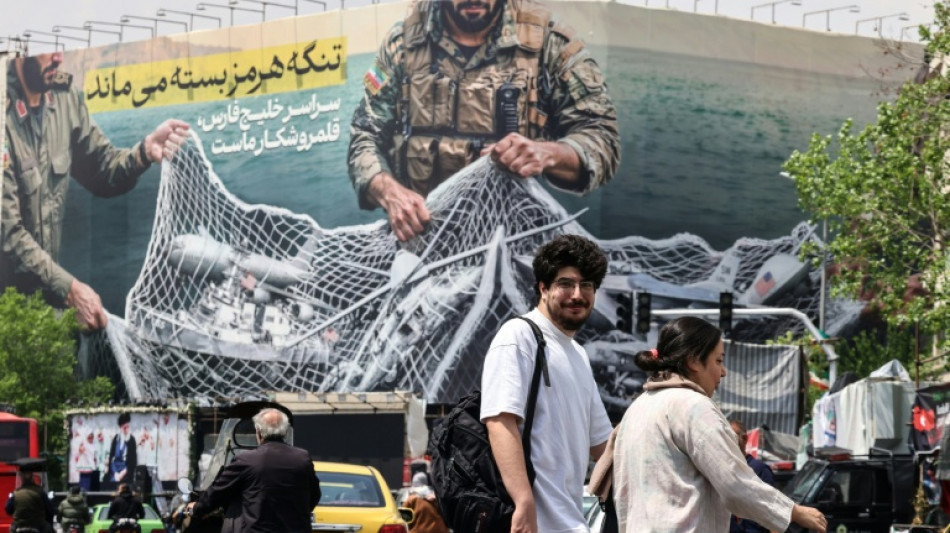
Iran economy looks set to withstand US naval blockade / Photo: ATTA KENARE - AFP

 St. Louis City's unbeaten MLS run ends at 19, Union's reaches 15

 NFL Eagles bench Hurts at least a month with blood clot

 Across US, 'No Kings' events seek to boost early voting

 Tents spring up in Lisbon as Portugal housing protests spread
 'Best in world' Yamal powers Barca to Betis rout, Atletico strike late

 El Salvador's Bukele puts conditions on early release of gang prisoners
 Fire rages at town hall in France's Limoges after protests: authorities

 Unstoppable Barca thrash Betis to extend perfect start

 Maresca faces anxious wait over Haaland injury scare

 PSG fight back to beat Strasbourg after Dembele penalty miss

 Looting, blazes and clashes in France amid nationwide protests
 Walsh breaks her own 50 free world short course record

 Haaland brace extends Man City's winning start in Premier League

 'Special' Ombudsman storms to victory in Champion Stakes

 Brazil's right embraces election betting odds amid polls skepticism

 Four more Ebola cases detected in Kenya, bringing total to seven

 Clashes erupt in France as protesters vow to make government 'tremble'

 Chwalinska downs Swiatek to set up Wuhan final with world number 170 Kartal

 Chacarra takes lead as McIlroy falls away in Delhi

 Neto double gives Chelsea win marred by Martinez injury

 'Cockroach' party founder released from Indian police custody

 Nepal floods 'defining moment' for climate action: UN
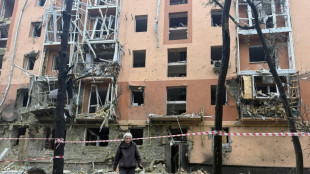
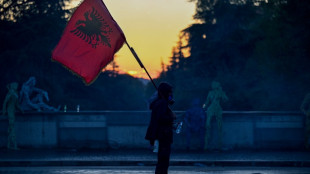 Albanian capital sees fifth straight day of violent clashes

 Leaders weigh 'huge benefit', risks of AI for global economy

 Zverev stunned by Davidovich Fokina in Shanghai semi-finals

A US naval blockade of Iranian ports is likely to squeeze Iran's oil output in the coming weeks but claims it will throw the Islamic republic into economic free fall remain premature, analysts say.
After weeks of bombing and counter-strikes, focus has shifted to the standoff in the Strait of Hormuz, which ordinarily carries around a fifth of the world's oil and liquefied natural gas.
In response to Iran's blockade of the strait since the start of the Middle East war, the US imposed a counter-blockade of the Islamic republic's ports, a push to force its leaders into a compromise in peace talks.
That bid, however, looks set to fail, at least in the short term.
"If the blockade lasts for more than two or three months, it can cause more damage" to Iran, economic analyst and professor at Shahid Beheshti University in Tehran Saeed Laylaz told AFP.
"If Iran suffers any damage, the damage to the countries in the southern Persian Gulf will definitely be greater," he added.
There's a limit on how long Iran can bide its time, however.
Arne Lohmann Rasmussen, chief analyst at Global Risk Management said Iran "was expected to run out of storage capacity within approximately one month, but it may already be forced to shut in part of its oil production within a couple of weeks".
- 'Collapsing financially'? -
Trump said Tuesday that Iran was "collapsing financially" under the blockade imposed by the US Navy on April 12, claiming that the country was "starving for cash".
Treasury Secretary Scott Bessent said the blockade meant storage at Iran's Kharg Island, the main export terminal through which most of the country's crude is shipped, "will be full and the fragile Iranian oil wells will be shut in".
Jamie Ingram, managing editor of Middle East Economic Survey (MEES), told AFP it was likely the timeline for Iran to hit its oil storage limits would be measured in "weeks rather than days".
He added it was likely that "Iran will slightly reduce production before getting to the stage where storage constraints start to bite".
According to analysis by oil expert Homayoun Falakshahi shared by energy intelligence firm Kpler, Iran's crude production has already slowed since the start of the war.
Output fell by around 200,000 barrels per day in March to 3.68 million bpd and is expected to drop a further 420,000 bpd in April to about 3.43 million bpd, reflecting "the broader impact of export disruptions and refining constraints linked to the ongoing conflict," Falakshahi said.
But Laylaz in Tehran said beyond the psychological effect of the blockade, the "real material effect has been small so far".
Ingram said Kharg Island "shouldn't be a particular bottleneck," for Iran.
"This is the final storage facility used before oil is exported and Iran can divert crude oil to other facilities rather than straight to Kharg," he said.
- 'Mutually assured disruption' -
The MEES expert also said Iran's dependency on oil exports via Hormuz had "deepened due to the damage caused by US and Israeli strikes to other sections of the Iranian economy".
"But Iran has also proven its ability to withstand huge oil-revenue declines during previous rounds of sanctions. I would not underestimate the regime's resilience in this regard," he added.
As the initial two-week truce between Iran and the US was set to expire Trump had said Tuesday he would maintain the ceasefire to allow more time for peace talks.
Iran said it welcomed the efforts by mediator Pakistan but made no other comment on Trump's announcement, while vowing not to reopen Hormuz so long as the US blockade remains in place.
"It will take a long time before such economic pain forces Iran to compromise," Ingram said, explaining it is "more likely economic disruption... pushes China into exerting more pressure on Iran to negotiate".
Ali Vaez, Iran project director at the International Crisis Group, said "Iran's economy was battered before the war, is contending with added strains caused during it, and now faces the combination of sanctions, seizures and potential strikes".
"Iran's leadership has previously shown a high threshold for pain even if the pressure on ordinary Iranians increases. It also likely calculates that its own efforts to subdue traffic through Hormuz act as a sort of mutually assured disruption," he added.
T.Sanchez--AT