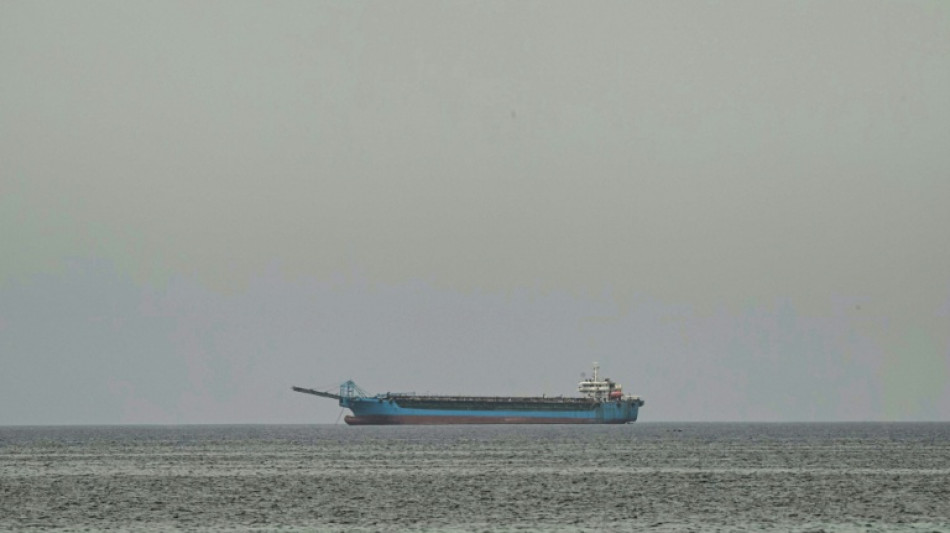
Clearing Hormuz Strait mines could take six months: report / Photo: - - AFP

 St. Louis City's unbeaten MLS run ends at 19, Union's reaches 15

 NFL Eagles bench Hurts at least a month with blood clot

 Across US, 'No Kings' events seek to boost early voting

 Tents spring up in Lisbon as Portugal housing protests spread
 'Best in world' Yamal powers Barca to Betis rout, Atletico strike late

 El Salvador's Bukele puts conditions on early release of gang prisoners

 Fire rages at town hall in France's Limoges after protests: authorities

 Unstoppable Barca thrash Betis to extend perfect start

 Maresca faces anxious wait over Haaland injury scare

 PSG fight back to beat Strasbourg after Dembele penalty miss

 Looting, blazes and clashes in France amid nationwide protests

 Walsh breaks her own 50 free world short course record

 Haaland brace extends Man City's winning start in Premier League

 'Special' Ombudsman storms to victory in Champion Stakes

 Brazil's right embraces election betting odds amid polls skepticism

 Four more Ebola cases detected in Kenya, bringing total to seven

 Clashes erupt in France as protesters vow to make government 'tremble'

 Chwalinska downs Swiatek to set up Wuhan final with world number 170 Kartal

 Chacarra takes lead as McIlroy falls away in Delhi

 Neto double gives Chelsea win marred by Martinez injury

 'Cockroach' party founder released from Indian police custody

 Nepal floods 'defining moment' for climate action: UN
 Albanian capital sees fifth straight day of violent clashes

 Leaders weigh 'huge benefit', risks of AI for global economy

 Zverev stunned by Davidovich Fokina in Shanghai semi-finals

A Pentagon assessment said it could take six months to completely clear the Strait of Hormuz of Iranian-laid mines, which could keep oil prices high, the Washington Post reported on Wednesday.
Iran has all but blocked the vital waterway since the start of a war with the United States and Israel, sharply driving up oil and gas prices and disrupting the global economy.
The strait -- through which one-fifth of the world's oil and gas passes in peacetime -- has remained largely closed during a shaky ceasefire, with the US imposing its own blockade.
Even if hostilities end and the blockade lifts, it could take months to clear the waterway of mines, according to a Pentagon assessment, the Washington Post reported citing officials close to the discussion.
The assessment added that it was unlikely such an operation would begin before the end of the war.
The six-month estimate was shared with members of the House Armed Services Committee during a classified briefing, the Post reported.
Lawmakers were told that Iran may have placed 20 or more mines in and around the strait, some floated remotely using GPS technology which makes them harder to detect, according to the report.
AFP has contacted the Department of Defense for comment.
Pentagon spokesman Sean Parnell told the Washington Post that its information was "inaccurate."
Iran's Revolutionary Guards have warned of a "danger zone" covering 1,400 square kilometres -– 14 times the size of Paris –- where mines may be present.
Iran's parliament speaker said the Islamic republic would not reopen the strait as long as the US naval blockade remained.
A spokesman for German transportation giant Hapag-Lloyd cautioned last week that shippers needed details on viable routes as they remain fearful of mines.
When the Hormuz strait briefly reopened at the start of the ceasefire this month, only a few ships trickled through amid fears of attacks or mines.
Earlier in April, the US Navy said its ships transited the waterway to begin removing the mines, but that claim was denied by Iran's Revolutionary Guard, which threatened any military vessels attempting to cross the channel.
London hosted talks with military planners from over 30 countries starting Wednesday on a UK and France-led multinational mission to protect navigation in the Strait of Hormuz once hostilities end.
The "defensive" coalition is set to discuss plans to reopen the strait and conduct mine clearance operations.
M.King--AT