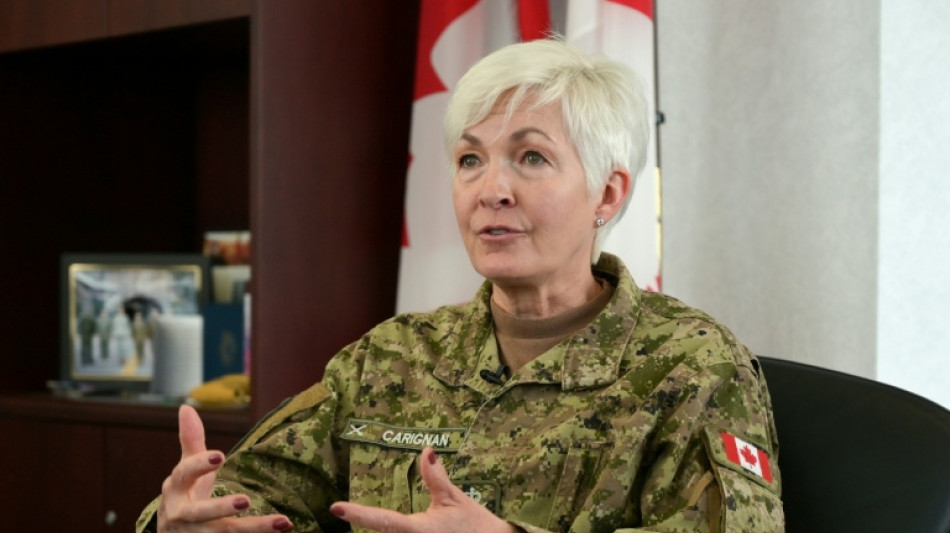
Canada's defense enters new phase, Arctic in focus: top military officer / Photo: Daphné LEMELIN - AFP

 Boland strikes twice for Australia in rain-hit South Africa Test

 Marseille put Angers to the sword in Ligue 1
 Albanian PM refuses to quit as violent protests enter sixth day

 Chwalinska fights back to win Wuhan Open in title breakthrough
 Kulusevski on brink of return for Spurs after 17-month absence

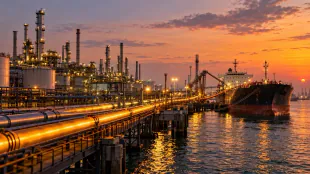
 Ukraine sets Saint Petersburg refinery ablaze in large-scale drone attack
 Spain's in-form Chacarra wins DP World India Championship

 Two pilots die in Saudi coalition helicopter crash near Yemen border

 Riyadh skyscraper shifts tenants online as Houthi attacks intensify

 Messi scores twice as Inter Miami defeat Atlanta United 3-1

 Qatar and Norway review bilateral ties at Oslo consultations
 Vietnam and EFTA states sign free-trade agreement in Hanoi

 Gold closes week near $4,165 as US inflation outlook pressures market

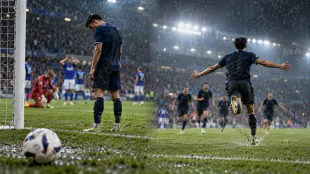 PSG rally past Strasbourg to take Ligue 1 lead

 India’s services surplus narrows as import growth overtakes exports
 RCom professional asks Supreme Court to revisit spectrum insolvency ruling

 Debt recovery lessons after derivatives losses and repeated borrowing

 Katie Alexander reportedly leaves flat shared with Eamonn Holmes

 Body found in search for missing Glasgow teenager
 Andi King recounts late-life transition after decades behind an “alpha male” identity

 Bromsgrove Repair Cafe reports nearly 80% repair success rate

 B.C. Lions focus on playoff momentum after Calgary defeat

 PNB expects festive demand to add up to two points to quarterly credit growth

 Cyient DLM drops 12% as margin concerns overshadow quarterly growth

 Arizona quarterback says audible led to dismissal and teammates’ suspensions

Canada's defense of its territory and the Arctic are entering a new phase, the country's top military officer Jennie Carignan told AFP, saying that "geography" no longer offers protection "as well as it did in the past."
With only the United States -- long considered an ally -- on its physical borders along with two oceans and the vast Arctic region, Canada has never really had to worry much about its territorial security.
But climate change and the melting of Arctic ice caps have made its northernmost land more accessible -- and thus more coveted. This, along with rising tensions between Ottawa and Washington, has changed the status quo.
Canada's armed forces have been forced to "transform" themselves, Carignan said in an interview in Ottawa, calling it a "pivotal moment" for the country.
Citing the seismic shift brought by climate change, Carignan said it is crucial for Canada to "position itself differently" to "ensure that we are in control and taking responsibility for our defense."
"There has been a modernization of our infrastructure, the pre-positioning of materials and equipment... and an increasing number of exercises" and other military operation in northern Canada.
The Arctic, where temperatures are rising three to four times faster than elsewhere on the planet, has become a coveted area for multiple countries, the melting of sea ice has improved access to crucial natural resources such as minerals and fish, and new maritime routes are now open.
- Defense investments -
More broadly, Canada has had to adapt to changing global realities and move on from the targeted missions of the last three decades, such as in Afghanistan.
Canadian forces must prepare for "larger-scale" conflicts, Carignan said, while also rebalancing its military supply chains to rely less and less on the United States.
The country has created an agency dedicated to defense-related investments to reinforce its own domestic industrial base. That has required budgetary changes.
Carignan says she is pleased that military spending has reached two percent of GDP, in line with a NATO target.
However, she said that "sustained and stable investments over the next 10–15 years" are necessary to carry out these transformation and modernization efforts.
Carignan, who was named Chief of the Defense Staff in July 2024, is the first woman to occupy such a post in a Group of Seven country.
She says she hopes her example can serve as a "model" for other women, noting that a recent influx of candidates shows that recruitment efforts are bearing fruit in Canada.
The country aims to invest CAN $500 billion (US $360.1 billion) in defense over the next 10 years.
H.Thompson--AT