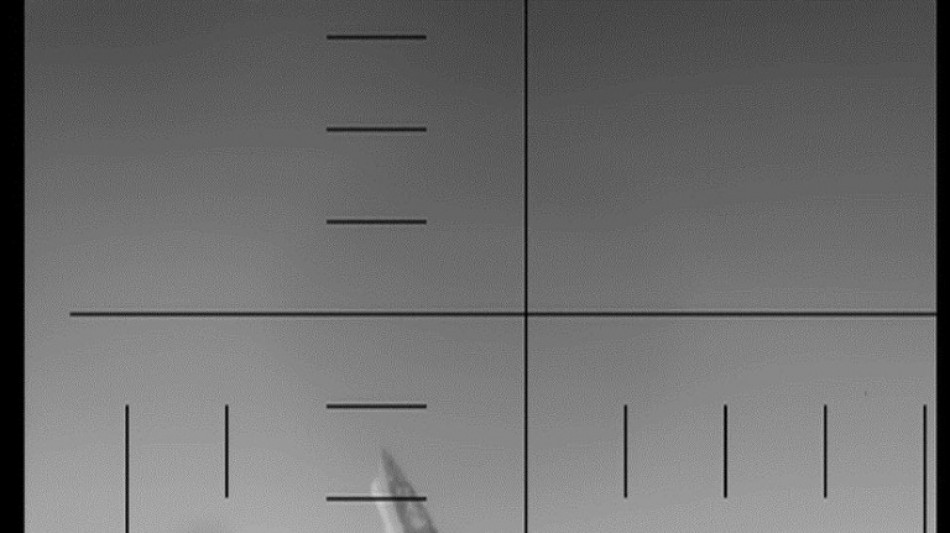
Who rules the seas? Torpedoed Iran ship brings focus underwater / Photo: - - US Department of Defense/AFP

 Guehi insists players have 'trust and belief' in Man City after charges
 UN climate panel head wants swift end to deadlock over key scientific report
 PM calls for curfews in France as govt grapples with unrest
 Man City's Semenyo out for up to eight weeks

 Australian lawmaker critically hurt in 'violent' vehicle attack
 England women's coach Wiegman signs two-year contract extension
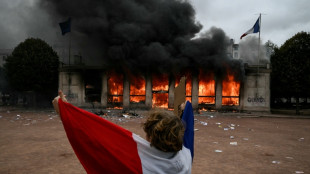 Louvre blocked as France grapples with unrest
 Bollywood actor Tiger Shroff shot at in Mumbai, three suspects held: police
 UN biodiversity summit opens with nature goals off track

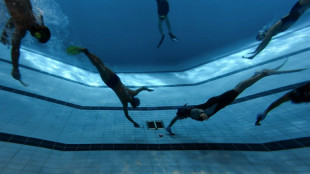 'Physical hell': Hong Kong hosts gruelling underwater hockey tournament
 Police 'lost control' during French protests, says interior minister
 Australia's new Ghost Shark submarines grow some 'teeth'

 'I call it a bribe': Pennsylvania residents spurn $10,000 data center checks
 In a former US steel city, ordinary people struggle to get by

 'Liar,' 'clown': Lula and Bolsonaro spar in Brazil poll debate

 Record El Nino? Depends who's counting
 On the front line of ocean conservation off Portugal's Madeira

 Wembanyama targets title breakthrough as NBA season tips off

 With LeBron on board it's title or bust for Philly fans
 One year after Louvre heist, where are the missing jewels?

 Knicks face tall task in NBA championship repeat bid

 Warriors' Curry 'fine' after limping out of practice - Kerr

 INEO Announces Preliminary Q1 Fiscal 2027 Revenue of More Than $1.3 Million and Adjusted EBITDA Near Break-Even

 HyProMag USA Deploys Mobile Inserma System, Extending Hard Disk Drive Processing to Customer Sites Across the United States

 Mako Mining Announces Q3 2026 Production Results with Gold Recovered of 12,743 oz Au (Sales of 11,581 oz Au), and Positive Permitting Updates at Mt. Hamilton and San Albino

A US submarine this week torpedoing an Iranian warship during the Middle East conflict raised the crucial question of who controls the seas during wartime.
The sinking of IRIS Dena on Wednesday in international waters off the coast of Sri Lanka killed at least 86 crew members, in what Iranian Foreign Minister Abbas Araghchi labelled an "atrocity".
It came after US-Israeli strikes on Iran on Saturday triggered war in the Middle East, with the Islamic republic launching retaliatory attacks across the region and beyond.
The US Navy had not torpedoed a ship since 1945.
Washington afterwards released what it said was periscope footage of the submarine firing on the ship, and an image of its hull almost vertical as it slipped below the surface.
The IRIS Dena "sank in less than 20 minutes", said Alessio Patalano, a professor at King's College London.
"It didn't stand a chance. The incident confirms the sophistication of the means of American undersea warfare."
Patalano said "submarine warfare has never gone away."
"It was just in the background because there hasn't been a confrontation between fleets since the 1980s," he added.
- 'Ultimate wartime weapon' -
The most recent confirmed wartime torpedo attack dates back to 1982, when the British submarine HMS Conqueror sank the Argentine cruiser Belgrano during the Falklands War.
In 2010, South Korea's Cheonan corvette was torpedoed -- an attack Seoul attributed to North Korea, but which Pyongyang denied.
A European military source specialising in submarines and speaking on condition of anonymity explained that a torpedo explodes underneath a ship rather than upon contact with it.
"It detonates a few metres below, creating a huge air bubble that lifts the vessel and breaks its main beam in two when it comes back down," the source said.
IRIS Dena's sonar range was probably too limited to have been able to detect the threat, they added.
The stealthy, invisible manoeuvres of a submarine, paired with its ability to fire torpedoes from dozens of kilometres away, make it "the ultimate wartime weapon", according to the source.
These capabilities can make a difference when surface combat between navies of similar standing is "symmetrical, with radars and missiles of roughly equivalent range".
Patalano said countries with a sophisticated underwater force enjoy an "objective advantage" in the event of a naval confrontation.
- 'We are everywhere' -
Another European military source, also speaking anonymously, said conducting the attack far from the conflict's epicentre was a "show of force aimed at major rivals" such as China and Russia.
"Attacking this ship in international waters... means: 'We, the Americans, dominate the air, the sea and the undersea. We are everywhere, able to find you and destroy you.'"
Experts suggest that while Russia has neglected the modernisation of its surface fleet -- signalled by its setbacks in the Black Sea throughout its war with Ukraine -- it has made a point of investing in its submarine fleet.
China has been developing its navy and submarines for years.
US submarine forces commander Vice Admiral Richard Seif told an American congressional committee this week that China's "formidable" next-generation submarines "challenge the US Navy's longstanding undersea dominance".
N.Walker--AT