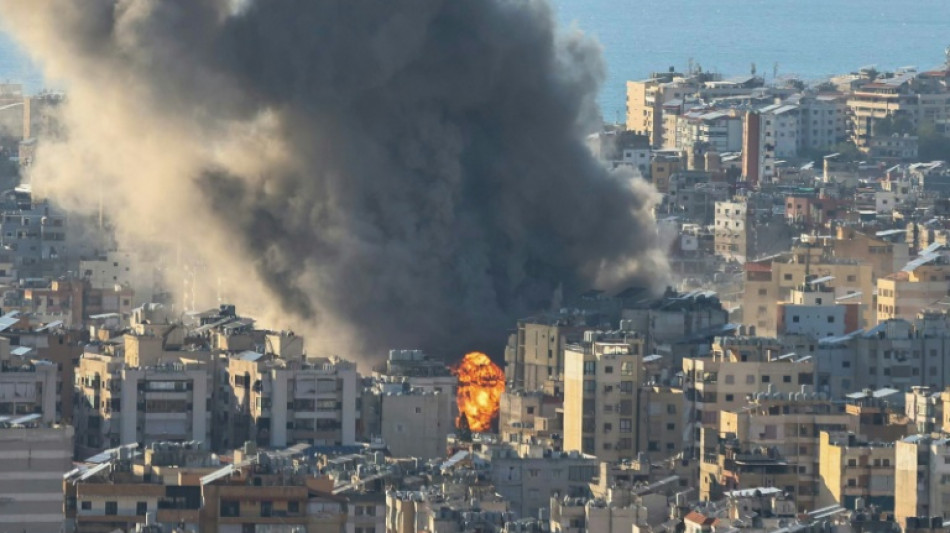
Mideast war risks pulling more in as conflict boils over / Photo: IBRAHIM AMRO - AFP

 Guehi insists players have 'trust and belief' in Man City after charges
 UN climate panel head wants swift end to deadlock over key scientific report
 PM calls for curfews in France as govt grapples with unrest
 Man City's Semenyo out for up to eight weeks

 Australian lawmaker critically hurt in 'violent' vehicle attack
 England women's coach Wiegman signs two-year contract extension
 Louvre blocked as France grapples with unrest
 Bollywood actor Tiger Shroff shot at in Mumbai, three suspects held: police
 UN biodiversity summit opens with nature goals off track

 'Physical hell': Hong Kong hosts gruelling underwater hockey tournament
 Police 'lost control' during French protests, says interior minister
 Australia's new Ghost Shark submarines grow some 'teeth'
 'I call it a bribe': Pennsylvania residents spurn $10,000 data center checks
 In a former US steel city, ordinary people struggle to get by
 'Liar,' 'clown': Lula and Bolsonaro spar in Brazil poll debate
 Record El Nino? Depends who's counting
 On the front line of ocean conservation off Portugal's Madeira

 Wembanyama targets title breakthrough as NBA season tips off

 With LeBron on board it's title or bust for Philly fans
 One year after Louvre heist, where are the missing jewels?

 Knicks face tall task in NBA championship repeat bid

 Warriors' Curry 'fine' after limping out of practice - Kerr

 INEO Announces Preliminary Q1 Fiscal 2027 Revenue of More Than $1.3 Million and Adjusted EBITDA Near Break-Even

 HyProMag USA Deploys Mobile Inserma System, Extending Hard Disk Drive Processing to Customer Sites Across the United States

 Mako Mining Announces Q3 2026 Production Results with Gold Recovered of 12,743 oz Au (Sales of 11,581 oz Au), and Positive Permitting Updates at Mt. Hamilton and San Albino

The Middle East war unleashed by US-Israeli attacks on Iran has swelled outwards to Cyprus, Sri Lanka, Turkey and Azerbaijan, and risks drawing more countries into the conflict.
The United States and Israel initiated the war by launching strikes on Iran and killing its supreme leader Ali Khamenei on Saturday, but the war has since extended its geographical scope.
"The conflict has evolved into a high-intensity, multi-domain campaign with no immediate end in sight," the US-based Soufan Center said.
"The conflict has expanded beyond direct military exchanges and conventional strikes and into a regional conflict spanning leadership decapitation strikes, internal destabilisation efforts, pressure on maritime chokepoints, attacks or threats to energy infrastructure, and economic coercion."
In a dramatic development on Wednesday, a US submarine sank an Iranian warship off the coast of Sri Lanka, killing at least 84 people on board.
Iran's Foreign Minister Abbas Araghchi accused the United States of perpetrating "an atrocity at sea", and said Washington would "bitterly regret" having set that precedent.
Iran, meanwhile, has hit targets across the Middle East -- but also beyond.
An Iranian-made drone on Monday struck a British military base in EU member Cyprus.
On Wednesday, NATO air defence systems intercepted a ballistic missile launched from Iran and heading towards Turkey.
It remains unclear whether the missile deliberately targeted Turkey, but Foreign Minister Hakan Fidan warned his Iranian counterpart that "any steps that could lead to the spread of conflict should be avoided".
On Thursday, at least two drones that crossed from Iran attacked Azerbaijan's exclave of Nakhichevan, with Baku -- an ally of Israel -- vowing the incident "will not go unanswered".
"Iran is striking out everywhere, targeting potential allies or potentially neutral countries," a European military source told AFP.
"Perhaps the calculation is to adopt an indirect strategy to paralyse the global economy and raise the cost of war for the United States."
- 'Effort to expand the battlefield' -
Iran-backed Lebanese militant group Hezbollah has launched attacks on Israel, which responded with strikes on Lebanon that have so far killed 72 people, according to authorities.
"Hezbollah's entry into the conflict with Iran, Israel, and the US appears to be driven by broader strategic considerations," the Soufan Center said.
"This coordination suggests an effort to expand the battlefield and increase pressure on Israel from multiple fronts as the conflict continues to escalate."
Military analysts call this kind of approach "horizontal escalation".
It entails expanding the war by creating new battlegrounds, or adding new types of action -- such as Iran's closure of the Strait of Hormuz, through which a fifth of the world's crude and considerable supplies of liquefied natural gas travel.
US Defense Secretary Pete Hegseth dismissed the idea that the incident in Turkey could trigger a NATO response under Article 5, which stipulates that an attack on one alliance member is an attack on all.
But the strategy still threatens to involve more countries, with several European nations including Britain, Greece, France and Spain already sending military support to Cyprus.
- US pressure -
After an Abu Dhabi naval base hosting French forces was attacked Monday, Paris has been "drawn in de facto because our interests have been affected", said a source close to President Emmanuel Macron.
Macron on Tuesday announced the deployment of the flagship aircraft carrier Charles de Gaulle to the Mediterranean due to the spreading conflict.
The European military source warned of "alliance mechanisms that pull new countries into the war indirectly... a bit like in the First World War".
Washington has also exerted pressure on allies.
President Donald Trump criticised British Prime Minister Keir Starmer for initially refusing to have any role in Washington's war with Iran, before he agreed to limited use of British bases.
He has also threatened to sever all trade with Spain over Madrid's opposition to Washington's use of its bases against Iran.
Paris has allowed US military support jets to use an air base in southeastern France, but insisted that its approach is "strictly defensive".
France is bound by defence accords with several Gulf countries that can be activated to varying degrees -- but it is unclear how far Paris is prepared to go to honour them.
Further geographical spread might occur if the Iran-backed Houthis in Yemen decide to enter the war by disrupting navigation in the Bab-el-Mandeb Strait, or by attacking other countries, said the European military source.
"The next few days will indicate whether the Houthis will follow their ideology or turn inward," said Ibrahim Jalal of the US-based Stimson Center.
R.Chavez--AT