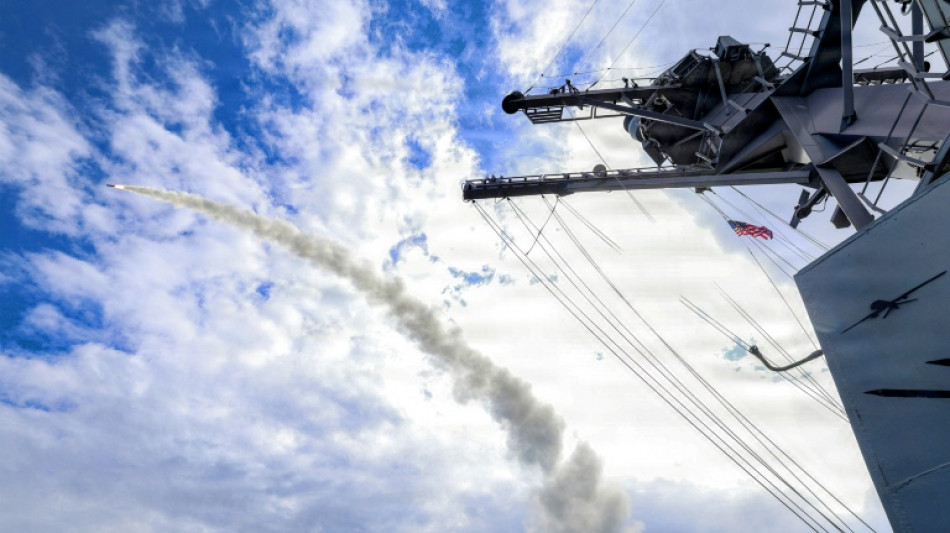
Will Iran's missiles drain US interceptor stocks? / Photo: - - US NAVY/AFP

 Saudi airport closure disrupts life in kingdom's capital

 Ramaphosa tells South Africa to prepare for loss of US-Africa trade deal
 France presses resale platforms to remove 'stolen' goods after unrest

 Yamal v PSG: Ballon d'Or backdrop to Champions League showdown

 Araujo says too soon to talk about permanent Liverpool move

 US wants to be 'strong partner' for central Asia: Rubio

 'Special' to face friend Perez in Champions League, says Liverpool's Iraola

 Monitor says Indonesia fires have burned nearly two million hectares

 French PM says could declare state of emergency over unrest 'if needed'

 Albanian PM warns of 'red line' after days of unrest

 Putin, Xi and Trump could meet at APEC summit: Kremlin

 Microsoft exits data centre deal in blow to UK AI ambitions

 European stocks retreat as France violence spreads

 North Korea warns 'grave situation' prevailing along border

 Raya proud of Arsenal's 'incredible' reaction after third straight win

 Indonesia fires have burned nearly two million hectares: monitor

 Australian lawmaker 'critically' hurt in attack, officials say

 Indonesia fires burned over 1.9 mn hectares through September: monitor

 Asian tech stocks mixed after Wall St losses, eyes on earnings
 China's third-quarter growth narrowly beats forecasts

 Asian stocks start week on back foot, tracking tech-led Wall St losses

 China growth narrowly beats forecasts

 Faith and fury: Texas Senate rivals offer contrasting visions

 Women await justice for police killings in Brazil

 The painstaking task of cataloguing the world's species

US forces have shot down hundreds of Iranian ballistic missiles in recent days, raising questions about how long American air defense interceptor stocks will last in a war that could continue for weeks or more.
Iran responded to the massive US-Israeli air campaign launched over the weekend with barrages of hundreds of missiles and drones against countries in the Middle East that host American forces and bases.
Since the start of the war, the United States has "intercepted hundreds of ballistic missiles targeting US forces, our partners and regional stability," General Dan Caine, the top US military officer, said Monday.
Those intercepts are a success -- they prevented the missiles from striking their targets -- but they also come at the cost of pricey, high-tech interceptors that are in short supply.
"There is a risk the United States and its partners could run out of interceptors before Iran runs out of missiles, though it is far from certain," said Kelly Grieco, a senior fellow at the Stimson Center think-tank.
At the beginning of the conflict, Israel estimated Iran had some 2,500 ballistic missiles -- "almost certainly more than the combined ballistic missile interceptor totals of Israel and the United States," Grieco said.
However, the United States and Israel are hunting for launchers and storage sites, so "the race is, in short, between Iranian launchers and American and Israeli strikes on the sources of those launches," she said.
- Demand outpacing production -
Caine said Iranian drones also pose a threat but did not provide a figure for the number that had been shot down, only saying that "our systems have proven effective in countering these platforms, engaging targets rapidly."
Grieco said that while interceptors are being expended on drones, it is not to the same degree as for missiles, and "the most acute shortage is with the ballistic interceptors."
The length of the conflict is a factor affecting how many interceptors will be needed, and it is currently unclear how long it will last.
US officials including Donald Trump have referred to a multi-week war, though the president said Monday that "we're already substantially ahead of our time projections."
"From the beginning we projected four to five weeks, but we have capability to go far longer than that," Trump said.
Pentagon chief Pete Hegseth had earlier given various possible timelines for the conflict: "Four weeks, two weeks, six weeks, it could move up. It could move back."
Joe Costa, director of the Atlantic Council's defense program, said that "sustained conflict with Iran could severely strain US stocks of critical air defense interceptors for China and other global priorities."
"It depends on how effective the US and Israel will be in neutralizing Iran's launch capability of missiles and drones," he said.
Grieco said that when it comes to interceptors, "production simply cannot keep pace with demand."
"Every theater, from Europe and the Indo-Pacific to the Middle East, has an acute need (of) more missile defense launchers and interceptors, and the United States is simply consuming them faster than it can replace them."
M.King--AT