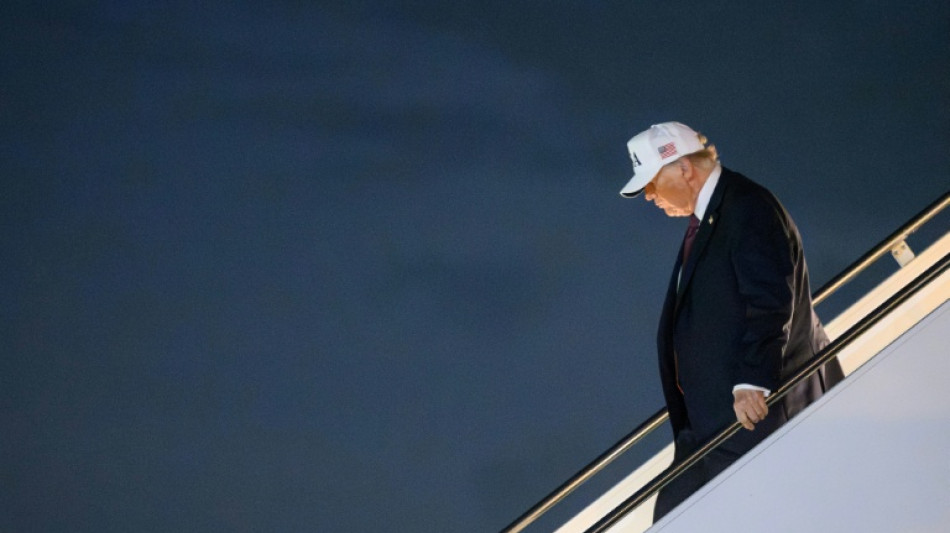
Questions cloud Trump's case for war against Iran / Photo: Mandel NGAN - AFP

 Ronaldo handed 30-day suspension: Portuguese federation
 France announces curfews as government grapples with unrest

 Boland sets pace as South Africa struggle
 Ukraine on back foot as Kremlin moots US, China meeting
 'Stay home!': Tourists find themselves in a France convulsed by protests

 Kenyan cult leader guilty on all charges over 191 starvation deaths

 Eagles star Hurts to miss rest of NFL season: reports
 Oil-rich Alberta votes on Canada breakup

 Israel announces arrests after West Bank settler attacks on Westerners
 Guehi insists players have 'trust and belief' in Man City after charges
 UN climate panel head wants swift end to deadlock over key scientific report
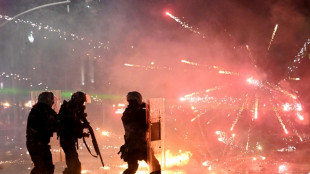
 PM calls for curfews in France as govt grapples with unrest
 Man City's Semenyo out for up to eight weeks

 Australian lawmaker critically hurt in 'violent' vehicle attack

 England women's coach Wiegman signs two-year contract extension
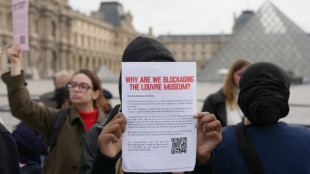
 Louvre blocked as France grapples with unrest
 Bollywood actor Tiger Shroff shot at in Mumbai, three suspects held: police
 UN biodiversity summit opens with nature goals off track

 'Physical hell': Hong Kong hosts gruelling underwater hockey tournament
 Police 'lost control' during French protests, says interior minister

 Australia's new Ghost Shark submarines grow some 'teeth'

 'I call it a bribe': Pennsylvania residents spurn $10,000 data center checks

 In a former US steel city, ordinary people struggle to get by

 'Liar,' 'clown': Lula and Bolsonaro spar in Brazil poll debate
 Record El Nino? Depends who's counting

President Donald Trump made his case for war against Iran early on Saturday as US and Israeli forces bombed the Islamic republic, saying conflict was required to eliminate "imminent threats" from Tehran.
Iran "rejected every opportunity to renounce their nuclear ambitions," Trump said in a roughly eight-minute video message posted on social media more than an hour after US strikes began.
"They attempted to rebuild their nuclear program and to continue developing long-range missiles" that "could soon reach the American homeland," the US president said, also calling on Iranians to overthrow their government.
But Iran was said to have signaled in talks that it was willing to cease stockpiling nuclear material, while Tehran may still be years away from developing significant quantities of missiles with intercontinental range -- raising significant questions about Trump's rationale for the conflict.
"President Trump did not make a strong case for an imminent threat posed by Iran that would justify the massive joint US-Israeli strikes," said Mona Yacoubian, director of the Middle East Program at the Center for Strategic and International Studies.
"His call for the Iranian people to prepare to take control underscores that the ambitions here are more akin to regime change," Yacoubian said, also noting that according to intelligence assessments, Iran's nuclear program was "still not close to weaponizing."
Trump had repeatedly claimed to have obliterated Tehran's nuclear program in June 2025 strikes, and the US military did not mention nuclear-related sites in a list of targets it had struck on Saturday.
- Progress in negotiations? -
Omani Foreign Minister Badr Albusaidi, who has been mediating talks between Tehran and Washington, said Friday that Iran had agreed to cease stockpiling nuclear material needed to make a weapon -- a major concession he said would have eliminated the nuclear threat.
"If you cannot stockpile material that is enriched then there is no way you can actually create a bomb," Albusaidi told CBS's "Face the Nation."
"If the ultimate objective is to ensure forever that Iran cannot have a nuclear bomb, I think we have cracked that problem through these negotiations," the foreign minister said.
Trump's assertion that Iranian missiles could "soon" strike the United States is meanwhile called into question by a 2025 Defense Intelligence Agency assessment that said Tehran did not have intercontinental ballistic missiles then, and that it could take until 2035 for it to develop 60 such weapons.
Tehran currently possesses short- and medium-range ballistic missiles with ranges that top out at about 1,850 miles (3,000 kilometers), according to the US Congressional Research Service.
Aside from nuclear and missile issues, Trump cited other sources of tension with Iran, including the 1979 takeover of the US embassy in Tehran, attacks by Iranian proxy groups on US forces and international shipping in the region, as well as Iran's deadly crackdown on protesters.
But proxy attacks on American forces were not currently ongoing, and Trump had hailed a ceasefire last year as having halted attacks on shipping by Yemen's Iran-backed Huthi rebels.
And while Trump had repeatedly threatened military intervention if Iran killed protesters, he pulled back from ordering strikes last month at the height of Tehran's crackdown on dissent.
T.Wright--AT