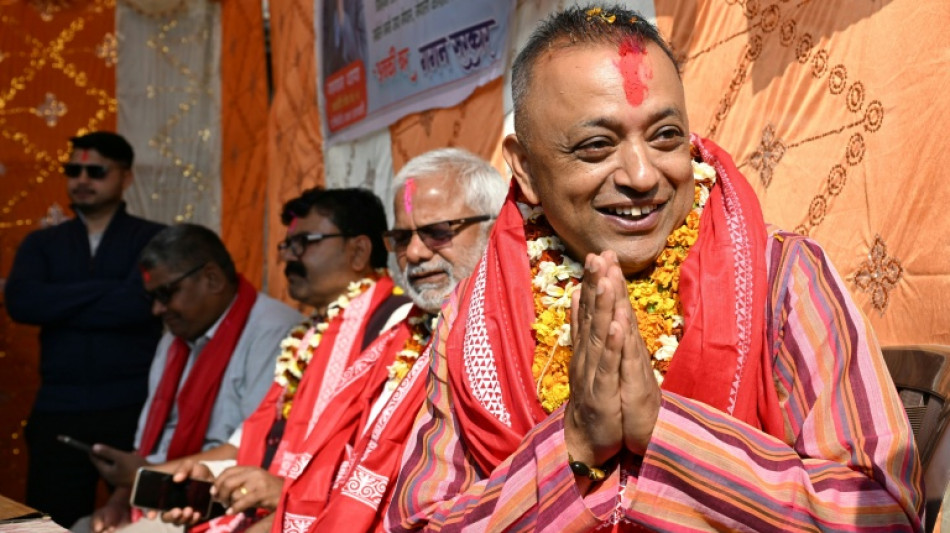
Nepal PM hopeful eyes 'change' in post-uprising elections / Photo: PRAKASH MATHEMA - AFP/File

 US to auction deep sea mining leases off American Samoa

 Australian lawmaker hurt in car attack underwent surgery overnight: PM
 Japan launches rocket for potential world first Mars moon mission
 Ethiopia PM warns Eritrea of 'severe consequences' if supports enemies

 Boland grabs opportunity for Australia as South Africa struggle in second Test

 Ronaldo handed 30-day suspension: Portuguese federation
 France announces curfews as government grapples with unrest

 Boland sets pace as South Africa struggle
 Ukraine on back foot as Kremlin moots US, China meeting
 'Stay home!': Tourists find themselves in a France convulsed by protests
 Kenyan cult leader guilty on all charges over 191 starvation deaths
 Eagles star Hurts to miss rest of NFL season: reports
 Oil-rich Alberta votes on Canada breakup

 Israel announces arrests after West Bank settler attacks on Westerners
 Guehi insists players have 'trust and belief' in Man City after charges
 UN climate panel head wants swift end to deadlock over key scientific report
 PM calls for curfews in France as govt grapples with unrest
 Man City's Semenyo out for up to eight weeks

 Australian lawmaker critically hurt in 'violent' vehicle attack
 England women's coach Wiegman signs two-year contract extension
 Louvre blocked as France grapples with unrest
 Bollywood actor Tiger Shroff shot at in Mumbai, three suspects held: police
 UN biodiversity summit opens with nature goals off track
 'Physical hell': Hong Kong hosts gruelling underwater hockey tournament
 Police 'lost control' during French protests, says interior minister
Nepali student leader-turned-politician Gagan Thapa has sought to rejuvenate his party's stale image, campaigning on generational change ahead of the Himalayan nation's first elections since a deadly youth-led uprising.
"We need energy for Nepal's change," the 49-year-old aspiring prime minister told AFP, saying his candidacy represented a break from decades of rule by a tight-knit and ageing elite.
The country of 30 million people will head to the polls on Thursday, following a wave of protests in September in which 77 people were killed, and parliament and hundreds of other buildings were torched.
The protests toppled Marxist leader KP Sharma Oli's government, in which Thapa's centrist Nepali Congress party had the biggest share of seats.
Thapa's home and party office were among the buildings set alight during the two days of violence last year.
He has since led an internal revolt and was elected party leader in January, ending the decade-long grip of former prime minister Sher Bahadur Deuba, 79, who had defied calls for reform.
Thapa, a former health minister, said he offered "the right mix of energy and experience."
"We had to change the leadership of major parties," he said, including Congress -- the country's oldest and one of the three dominant political powers that have given Nepal nearly all its prime ministers in recent history.
"For decades, two to three old-aged men were running it like a club, dominating and slowly limiting our democracy by power sharing with each other," Thapa said.
"That devastated our governance."
- 'Work together'-
Thapa was drawn into politics as a teenager in the 1980s, when leftist and communist parties led a popular movement against absolute monarchy, giving rise to multi-party democracy since 1990.
As civil war reshaped the country in 1996-2006, pitting Maoist guerrillas against the monarchy, he rose through the ranks of pro-democracy student groups linked to the Nepali Congress.
"The sense of gratification I felt when we rallied around an agenda and got results made me feel like this is what I want," Thapa said of his start as a student activist.
"People have problems -- pick them up and solve them. That gravitated me towards politics."
In 2006, when a popular uprising forced the king to abdicate, Thapa was already a prominent figure in the pro-democracy movement and had been jailed several times for his role in street protests.
Two years later he entered parliament as one of its youngest members, and has since won re-election three times from a Kathmandu constituency.
But this time, Thapa has chosen to run from Sarlahi, mainly a farming district southeast of the capital, on the plains bordering India.
"A large proportion of Nepal's population live here, and they have long felt excluded," he said.
"If I represent this region, it helps my party electorally. But in the long term, it gives me the foundation to lead all of Nepal."
His party's manifesto prioritises political and economic reform, pledging to create 1.2 million jobs in five years.
Analysts expect no single party to win an outright majority in parliament, likely leading to a coalition government.
"We will have to work together," Thapa said.
"If I get a chance to be in a leadership role, I believe in teamwork. We can fulfil the demands made during the Gen Z protest only through teamwork."
A.Anderson--AT