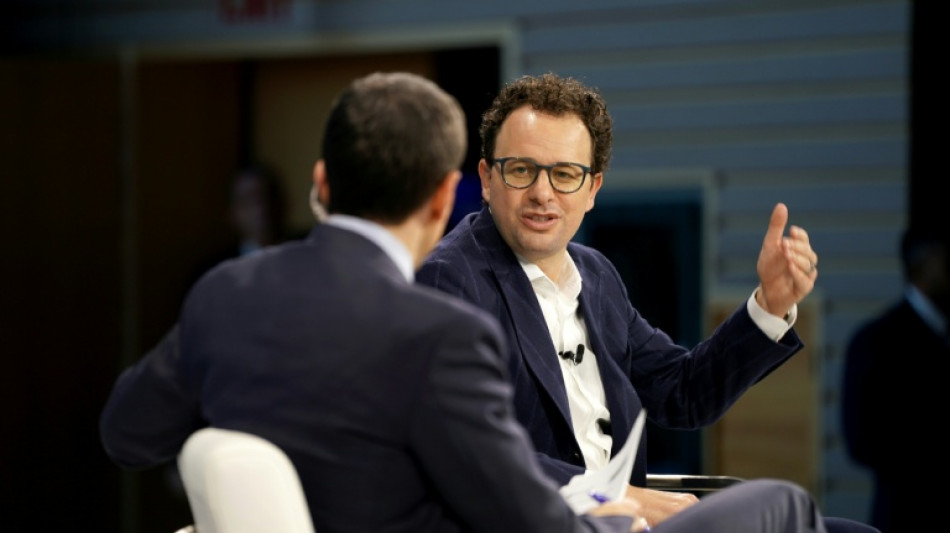
Anthropic says won't give US military unconditional AI use / Photo: David Dee Delgado - GETTY IMAGES NORTH AMERICA/AFP

 US to auction deep sea mining leases off American Samoa

 Australian lawmaker hurt in car attack underwent surgery overnight: PM
 Japan launches rocket for potential world first Mars moon mission

 Ethiopia PM warns Eritrea of 'severe consequences' if supports enemies

 Boland grabs opportunity for Australia as South Africa struggle in second Test

 Ronaldo handed 30-day suspension: Portuguese federation
 France announces curfews as government grapples with unrest

 Boland sets pace as South Africa struggle
 Ukraine on back foot as Kremlin moots US, China meeting

 'Stay home!': Tourists find themselves in a France convulsed by protests

 Kenyan cult leader guilty on all charges over 191 starvation deaths

 Eagles star Hurts to miss rest of NFL season: reports
 Oil-rich Alberta votes on Canada breakup

 Israel announces arrests after West Bank settler attacks on Westerners

 Guehi insists players have 'trust and belief' in Man City after charges

 UN climate panel head wants swift end to deadlock over key scientific report

 PM calls for curfews in France as govt grapples with unrest
 Man City's Semenyo out for up to eight weeks

 Australian lawmaker critically hurt in 'violent' vehicle attack
 England women's coach Wiegman signs two-year contract extension
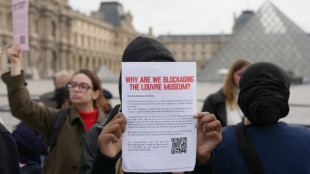
 Louvre blocked as France grapples with unrest

 Bollywood actor Tiger Shroff shot at in Mumbai, three suspects held: police

 UN biodiversity summit opens with nature goals off track

 'Physical hell': Hong Kong hosts gruelling underwater hockey tournament

 Police 'lost control' during French protests, says interior minister
AI company Anthropic said Thursday it would not give the US Defense Department unrestricted use of its technology despite being pressured to comply by the Pentagon.
"These threats do not change our position: we cannot in good conscience accede to their request," Anthropic chief executive Dario Amodei said in a statement.
Washington had given the artificial intelligence startup until Friday to agree to unconditional military use of its technology, even if it violates ethical standards at the company, or face being forced to comply under emergency federal powers.
Amodei said Anthropic models have been deployed by the Pentagon and intelligence agencies to defend the country but that it draws an ethical line regarding its use for mass surveillance of US citizens and fully-autonomous weapons.
"Using these systems for mass domestic surveillance is incompatible with democratic values," Amodei said.
And leading AI systems are not yet reliable to be trusted to power deadly weapons without a human in ultimate control, he added.
"We will not knowingly provide a product that puts America's warfighters and civilians at risk."
After meeting with Anthropic early this week, the Pentagon delivered a stark ultimatum: agree to unrestricted military use of its technology by 5:01 pm (22:01 GMT) Friday or face being forced to comply under the Defense Production Act.
The Cold War-era law, last used during the Covid pandemic, grants the federal government sweeping powers to compel private industry to prioritize national security needs.
The Pentagon also threatened to label Anthropic a supply chain risk, a designation usually reserved for firms from adversary countries that could severely damage the company's ability to work with the US government and reputation.
A senior Pentagon official at the time pushed back on the company's concerns, insisting the Defense Department had always operated within the law.
"Legality is the Pentagon's responsibility as the end user," the official said, adding that the department "has only given out lawful orders."
Officials also confirmed that an exchange regarding intercontinental ballistic missiles had taken place between Anthropic and the Pentagon, underscoring the sensitivity of the applications at the heart of the dispute.
The Pentagon confirmed that Elon Musk's Grok system had been cleared for use in a classified setting, while other contracted companies -- OpenAI and Google -- were described as close to similar clearances, piling competitive pressure on Anthropic to fall in line.
Anthropic was contracted alongside those companies last year to supply AI models for a range of military applications under a $200 million agreement.
Former OpenAI employees founded Anthropic in 2021 on the premise that AI development should prioritize safety -- a philosophy that now puts it on a collision course with the Pentagon and the White House.
"Anthropic understands that the Department of War, not private companies, makes military decisions," Amodei said.
"However, in a narrow set of cases, we believe AI can undermine, rather than defend, democratic values."
M.Robinson--AT